


Improved somatic mutagenesis in zebrafish using transcription activator-like effector nucleases (TALENs)
- PMID: 22655075
- PMCID: PMC3360007
- DOI: 10.1371/journal.pone.0037877
Improved somatic mutagenesis in zebrafish using transcription activator-like effector nucleases (TALENs)
Abstract
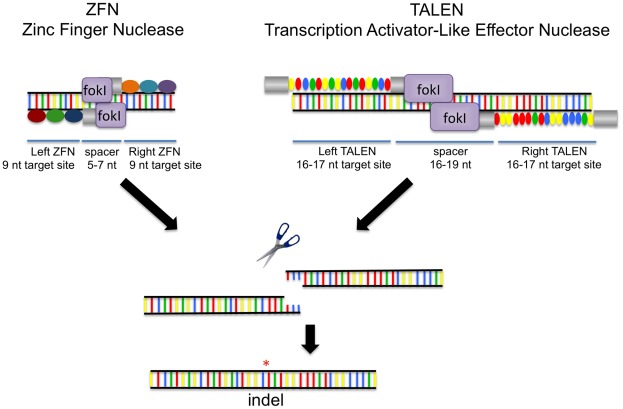
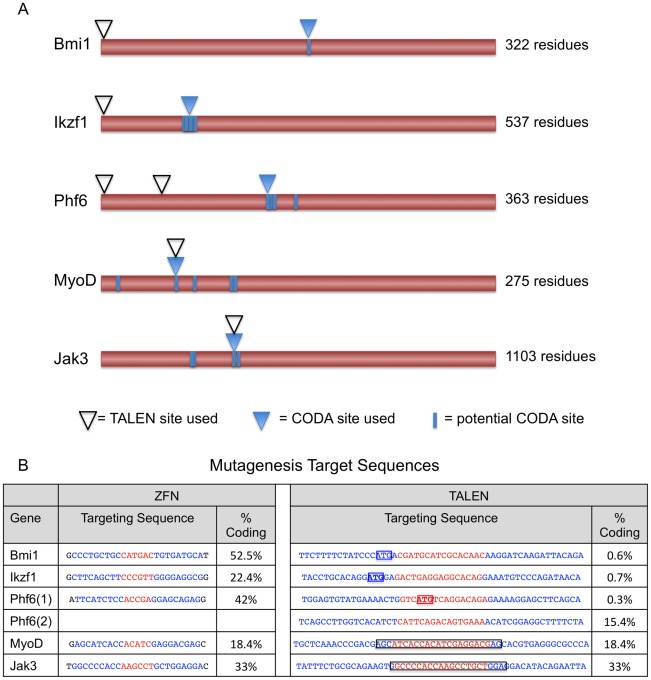
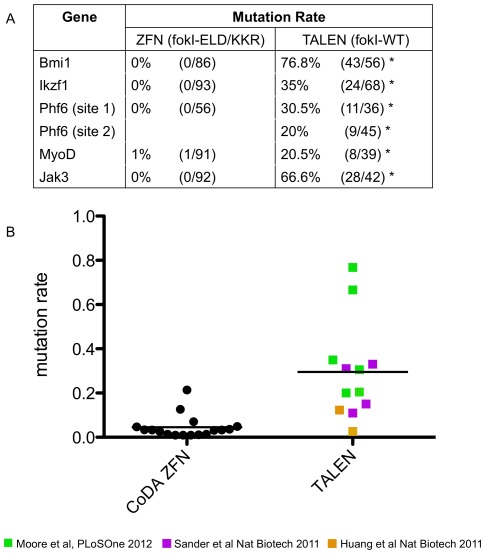
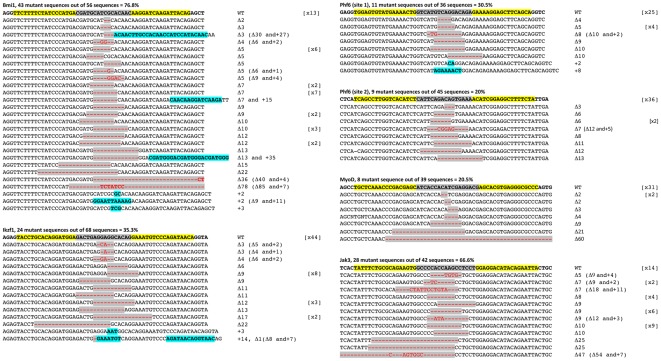
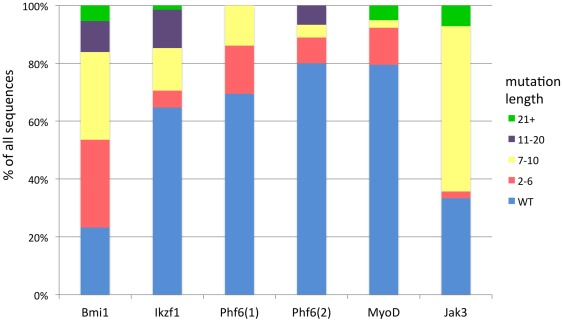
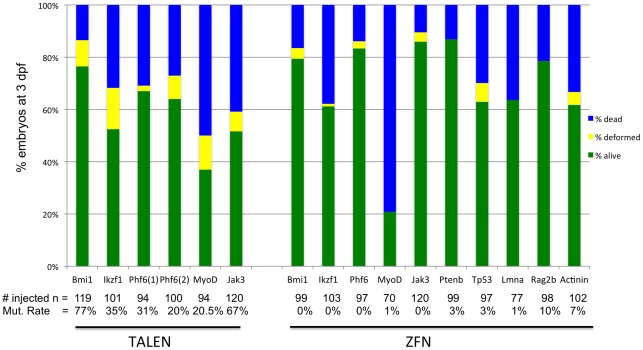
Zinc Finger Nucleases (ZFNs) made by Context-Dependent Assembly (CoDA) and Transcription Activator-Like Effector Nucleases (TALENs) provide robust and user-friendly technologies for efficiently inactivating genes in zebrafish. These designer nucleases bind to and cleave DNA at particular target sites, inducing error-prone repair that can result in insertion or deletion mutations. Here, we assess the relative efficiencies of these technologies for inducing somatic DNA mutations in mosaic zebrafish. We find that TALENs exhibited a higher success rate for obtaining active nucleases capable of inducing mutations than compared with CoDA ZFNs. For example, all six TALENs tested induced DNA mutations at genomic target sites while only a subset of CoDA ZFNs exhibited detectable rates of mutagenesis. TALENs also exhibited higher mutation rates than CoDA ZFNs that had not been pre-screened using a bacterial two-hybrid assay, with DNA mutation rates ranging from 20%-76.8% compared to 1.1%-3.3%. Furthermore, the broader targeting range of TALENs enabled us to induce mutations at the methionine translation start site, sequences that were not targetable using the CoDA ZFN platform. TALENs exhibited similar toxicity to CoDA ZFNs, with >50% of injected animals surviving to 3 days of life. Taken together, our results suggest that TALEN technology provides a robust alternative to CoDA ZFNs for inducing targeted gene-inactivation in zebrafish, making it a preferred technology for creating targeted knockout mutants in zebrafish.
Conflict of interest statement
Figures
References
-
- Sander JD, Yeh JR, Peterson RT, Joung JK. Engineering zinc finger nucleases for targeted mutagenesis of zebrafish. Methods in cell biology. 2011;104:51–58. - PubMed
Publication types
MeSH terms
Substances
Grants and funding
LinkOut - more resources
Full Text Sources
Other Literature Sources
Molecular Biology Databases
