


Developing symptom-based predictive models of endometriosis as a clinical screening tool: results from a multicenter study
- PMID: 22657249
- PMCID: PMC3679490
- DOI: 10.1016/j.fertnstert.2012.04.022
Developing symptom-based predictive models of endometriosis as a clinical screening tool: results from a multicenter study
Abstract
Objective: To generate and validate symptom-based models to predict endometriosis among symptomatic women prior to undergoing their first laparoscopy.
Design: Prospective, observational, two-phase study, in which women completed a 25-item questionnaire prior to surgery.
Setting: Nineteen hospitals in 13 countries.
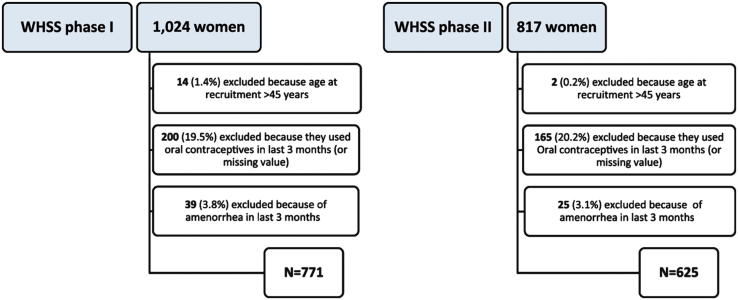
Patient(s): Symptomatic women (n = 1,396) scheduled for laparoscopy without a previous surgical diagnosis of endometriosis.
Intervention(s): None.
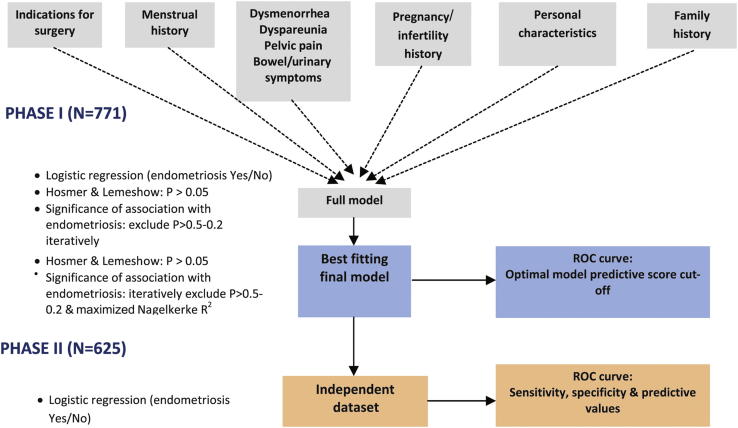
Main outcome measure(s): Sensitivity and specificity of endometriosis diagnosis predicted by symptoms and patient characteristics from optimal models developed using multiple logistic regression analyses in one data set (phase I), and independently validated in a second data set (phase II) by receiver operating characteristic (ROC) curve analysis.
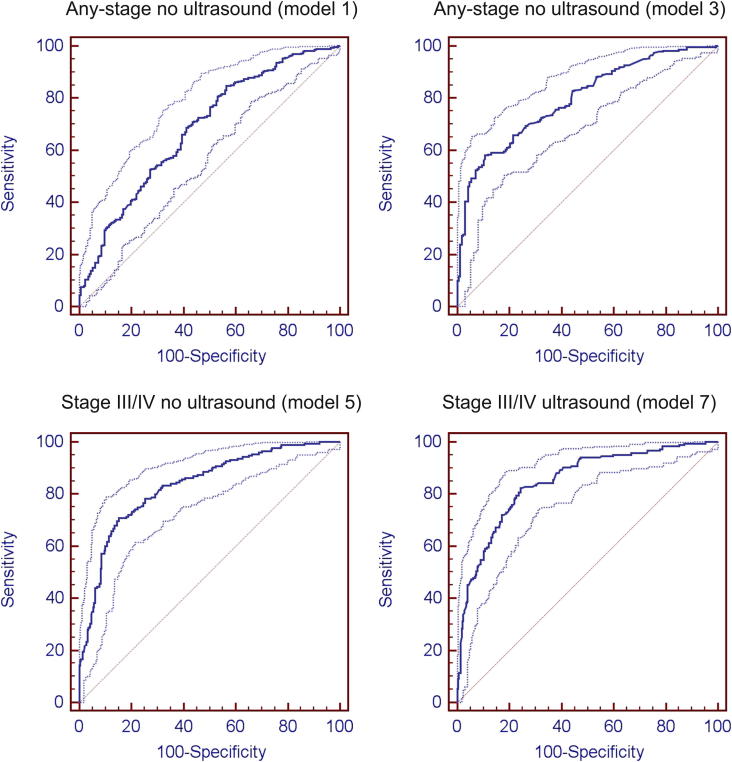
Result(s): Three hundred sixty (46.7%) women in phase I and 364 (58.2%) in phase II were diagnosed with endometriosis at laparoscopy. Menstrual dyschezia (pain on opening bowels) and a history of benign ovarian cysts most strongly predicted both any and stage III and IV endometriosis in both phases. Prediction of any-stage endometriosis, although improved by ultrasound scan evidence of cyst/nodules, was relatively poor (area under the curve [AUC] = 68.3). Stage III and IV disease was predicted with good accuracy (AUC = 84.9, sensitivity of 82.3% and specificity 75.8% at an optimal cut-off of 0.24).
Conclusion(s): Our symptom-based models predict any-stage endometriosis relatively poorly and stage III and IV disease with good accuracy. Predictive tools based on such models could help to prioritize women for surgical investigation in clinical practice and thus contribute to reducing time to diagnosis. We invite other researchers to validate the key models in additional populations.
Copyright © 2012 American Society for Reproductive Medicine. Published by Elsevier Inc. All rights reserved.
Figures
Comment in
-
Can we finally move away from the surgical diagnosis of endometriosis?Fertil Steril. 2012 Sep;98(3):609. doi: 10.1016/j.fertnstert.2012.05.028. Epub 2012 Jun 15. Fertil Steril. 2012. PMID: 22704627 No abstract available.
References
-
- Kennedy S., Bergqvist A., Chapron C., D'Hooghe T., Dunselman G., Greb R. ESHRE guideline for the diagnosis and treatment of endometriosis. Hum Reprod. 2005;20:2698–2704. - PubMed
-
- Hadfield R., Mardon H., Barlow D., Kennedy S. Delay in the diagnosis of endometriosis: a survey of women from the USA and the UK. Hum Reprod. 1996;11:878–880. - PubMed
-
- Husby G.K., Haugen R.S., Moen M.H. Diagnostic delay in women with pain and endometriosis. Acta Obstet Gynecol Scand. 2003;82:649–653. - PubMed
-
- Ballard K., Lowton K., Wright J. What's the delay? A qualitative study of women's experiences of reaching a diagnosis of endometriosis. Fertil Steril. 2006;86:1296–1301. - PubMed
Publication types
MeSH terms
Grants and funding
LinkOut - more resources
Full Text Sources
Other Literature Sources
Medical
