Review
. 2012 Aug;2(4):459-66.
doi: 10.1016/j.coviro.2012.05.004. Epub 2012 Jun 2.

Cancer associated human papillomaviruses

Affiliations
Review

Cancer associated human papillomaviruses

Margaret E McLaughlin-Drubin et al. Curr Opin Virol. 2012 Aug.

Abstract

A small group of human papillomaviruses (HPVs) cause almost all cervical carcinoma and a significant percentage of other anogenital tract and oral carcinoma. Another group of HPVs causes non-melanoma skin cancers in genetically predisposed or immune suppressed patients upon UV exposure. HPV genome replication requires the host cell's DNA synthesis machinery and HPVs encode proteins that maintain differentiated epithelial cells in a replication competent state. The resulting rewiring of cellular signal transduction circuits triggers several innate cellular tumor suppressor responses that HPVs need to inactivate in order to establish persistent and/or productive infections. This review emphasizes this interplay between virus and the infected host cells and points out biological similarities and differences between different groups of HPVs.


Figures

Figure 1
Figure 1
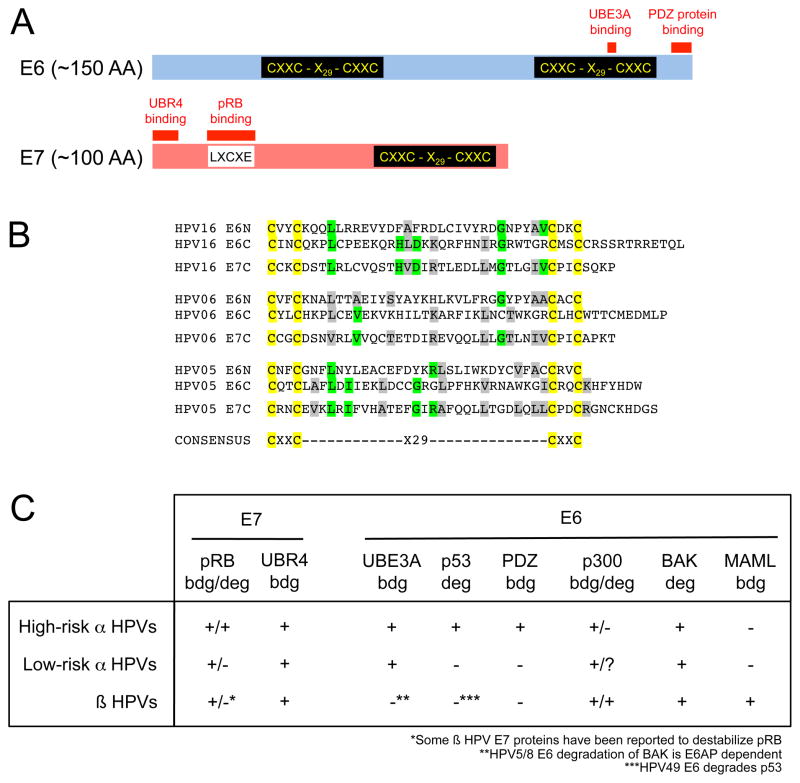
Biochemical and biological activities of HPV E6 and E7 proteins. (A) Schematic depiction of high-risk α HPV E6 and E7 proteins. The approximate locations of the zinc-binding domains and sequences necessary for association with host cell proteins are indicated. (B) Sequence alignments of E6 and E7 zinc binding domains. HPV16 (high-risk α), HPV6 (low-risk α) and HPV5 (β) are shown as representative examples. Cysteine residues are highlighted in yellow, green denote residues identical in E7 and at least one of the E6 domains and grey are chemically similar residues in E7 and at least one of the E6 domains. (C) Association of E6 and E7 proteins encoded by high-risk αlow-riskαand β HPVs with cellular proteins. “bdg” denotes “binding” and “deg” denotes “degradation”. See text for details and references.
Figure 2
Figure 2
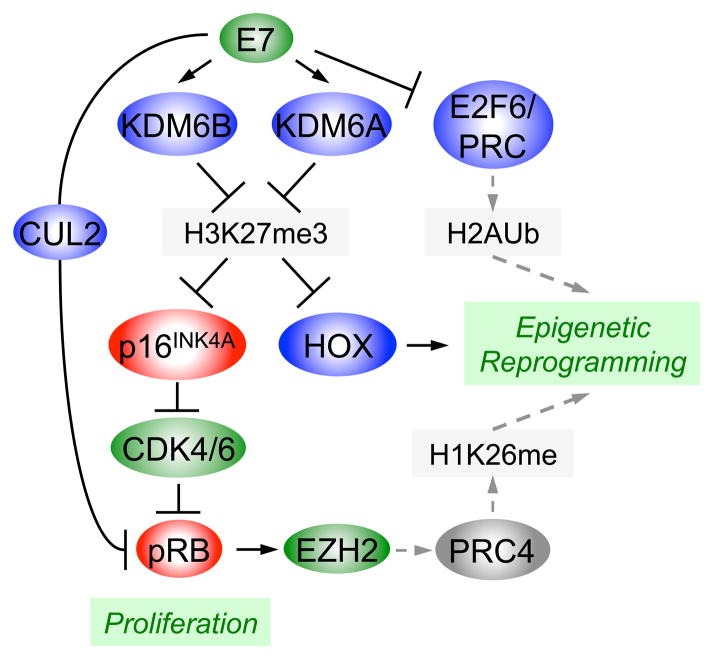
HPV16 E7 expression causes global H3K27 demethylation and potentially other changes in the histone code. Oncogenic genes are shown in green, tumor suppressors in red, components that are predicted to be altered by E7 in grey and all the other genes are highlighted in blue. Dashed grey arrows represent connections that have not been fully explored experimentally. See text for details and references.
Figure 3
Figure 3
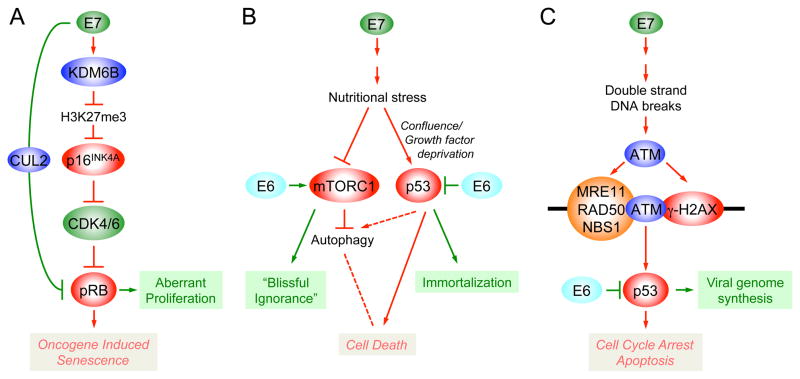
Schematic depiction of innate tumor suppressor responses triggered by high-risk α HPV E7 expression. (A) Oncogene Induced Senescence (OIS); (B) “Trophic Sentinel Response”; (C) Double strand DNA break response. Red lines represent innate tumor suppressor signaling pathways with the respective cytostatic or cytotoxic outcomes indicated in red letters. Viral subversion of these innate tumor suppressor responses is indicated by the green lines, with the respective biological outcome indicated in green letters. Autophagy can both negatively and positively affect cell death. Solid lines denote experimentally established pathways and connections, whereas dotted lines denote hypothetical connections. See text for details and references.
Figure 4
Figure 4
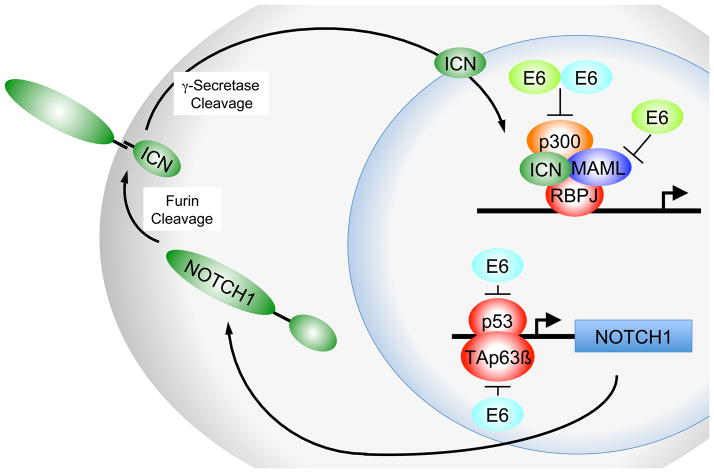
Inhibition of Notch signaling by β HPV E6 proteins (bright green) binding to members of the human mastermind like (MAML) coactivators. High-risk α HPV E6 proteins (bright blue) inhibit NOTCH1 signaling though inhibition of p53 and/or TAp63β mediated NOTCH1 transcription. ICN denotes the intracellular NOTCH fragment. See text for details and references.

References

    1. Rous P, Beard JW. The Progression to Carcinoma of Virus-Induced Rabbit Papillomas (Shope) J Exp Med. 1935;62:523–548. - PMC - PubMed
    1. Orth G, Jablonska S, Favre M, Croissant O, Jarzabek-Chorzelska M, Rzesa G. Characterization of two types of human papillomaviruses in lesions of epidermodysplasia verruciformis. Proc Natl Acad Sci U S A. 1978;75:1537–1541. - PMC - PubMed
    1. Dürst M, Gissmann L, Ikenberg H, zur Hausen H. A papillomavirus DNA from cervical carcinoma and its prevalence in cancer biopsy samples from different geographic regions. Proceedings of the National Academy of Sciences USA. 1983;80:3812–3815. - PMC - PubMed
    1. Schiffman M, Castle PE, Jeronimo J, Rodriguez AC, Wacholder S. Human papillomavirus and cervical cancer. Lancet. 2007;370:890–907. - PubMed
    1. Moody CA, Laimins LA. Human papillomavirus oncoproteins: pathways to transformation. Nat Rev Cancer. 2010;10:550–560. - PubMed

Publication types

MeSH terms

Substances