


Trajectory clustering of estradiol and follicle-stimulating hormone during the menopausal transition among women in the Study of Women's Health across the Nation (SWAN)
- PMID: 22659249
- PMCID: PMC3410268
- DOI: 10.1210/jc.2012-1422
Trajectory clustering of estradiol and follicle-stimulating hormone during the menopausal transition among women in the Study of Women's Health across the Nation (SWAN)
Abstract
Context: Variability in the pattern of change in estradiol (E2) and FSH levels over the menopause transition has not been well defined.
Objective: The current study aimed to determine whether different trajectories of E2 and FSH could be identified and whether race/ethnicity and body mass index were related to the different trajectories.
Design: The Study of Women's Health Across the Nation is a longitudinal observational study of the menopausal transition.
Setting: Women aged 42-52 yr from seven participating sites were recruited and underwent up to 11 annual visits.
Participants: Postmenopausal women with 12 or more months of amenorrhea that was not due to hysterectomy/oophorectomy and who were not using hormone therapy before the final menstrual period participated in the study.
Main outcome measures: Annual serum E2 and FSH levels anchored to final menstrual period were measured.
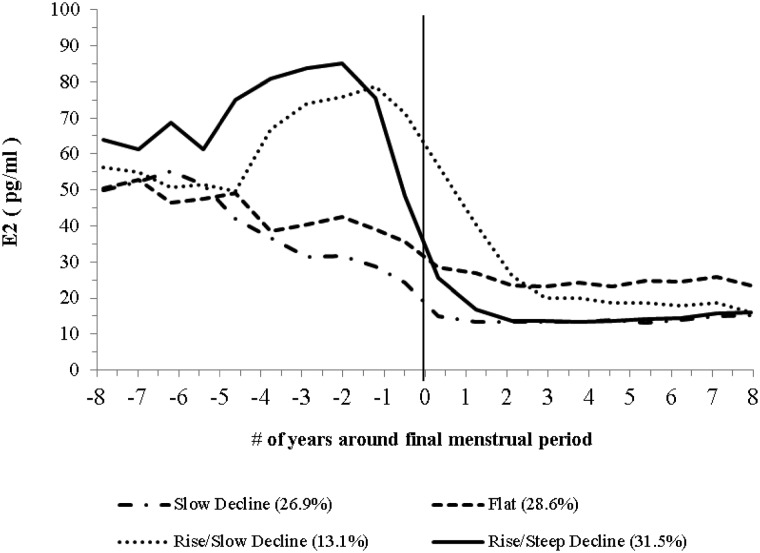
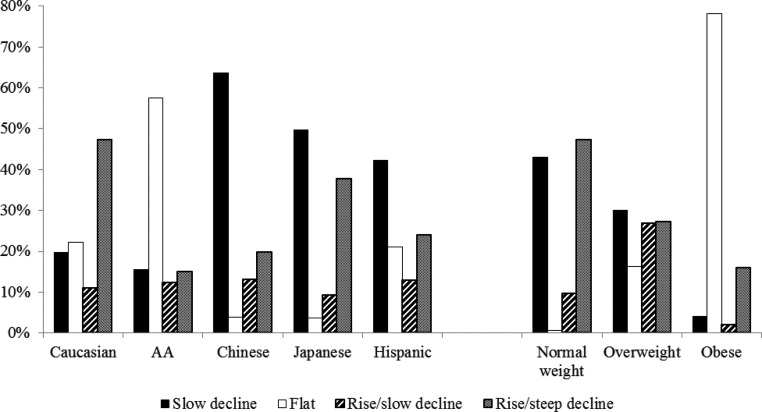
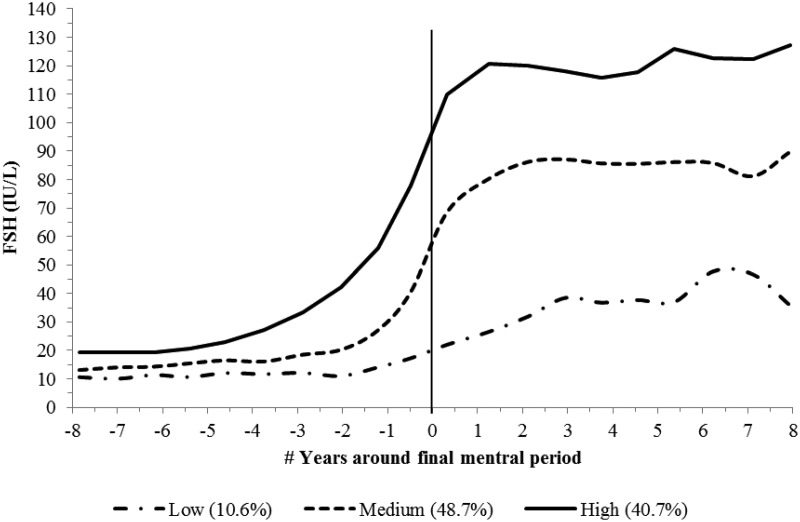
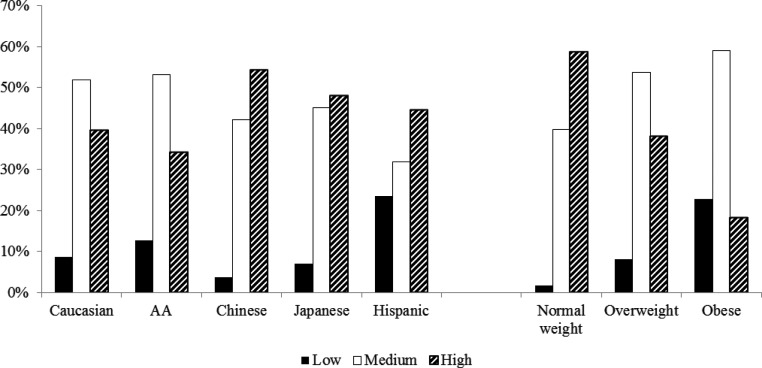
Results: Four distinct E2 trajectories and three distinct FSH trajectories were identified. The E2 trajectories were: slow decline (26.9%), flat (28.6%), rise/slow decline (13.1%), and rise/steep decline (31.5%). The FSH trajectories were: low (10.6%), medium (48.7%), and high (41.7%) rising patterns. Obesity increased the likelihood of a flat E2 and low FSH trajectory for all race/ethnic groups. Normal-weight Caucasian and African-American women tended to follow the rise/steep decline E2 and high FSH trajectories. Normal-weight Chinese/Japanese women tended to follow the slow decline E2 and the high/medium FSH trajectories.
Conclusions: E2 and FSH trajectories over the menopausal transition are not uniform across the population of women. Race/ethnicity and body mass index affect the trajectory of both E2 and FSH change over the menopausal transition.
Figures
References
-
- O'Connor KA, Holman DJ, Wood JW. 2001. Menstrual cycle variability and the perimenopause. Am J Hum Biol 13:465–478 - PubMed
-
- Taffe JR, Dennerstein L. 2002. Menstrual patterns leading to the final menstrual period. Menopause 9:32–40 - PubMed
-
- Burger HG, Hale GE, Robertson DM, Dennerstein L. 2007. A review of hormonal changes during menopausal transition: focus on findings from the Melbourne Women's Midlife Health Project. Hum Reprod Update 13:559–565 - PubMed
-
- Weiss G, Skurnick JH, Goldsmith LT, Santoro NF, Park SJ. 2004. Menopause and hypothalamic-pituitary sensitivity to estrogen. JAMA 292:2991–2996 - PubMed
Publication types
MeSH terms
Substances
Grants and funding
- AG012553/AG/NIA NIH HHS/United States
- AG012554/AG/NIA NIH HHS/United States
- AG012539/AG/NIA NIH HHS/United States
- AG012531/AG/NIA NIH HHS/United States
- U01 AG012495/AG/NIA NIH HHS/United States
- U01 AG012505/AG/NIA NIH HHS/United States
- AG012535/AG/NIA NIH HHS/United States
- AG012546/AG/NIA NIH HHS/United States
- NR004061/NR/NINR NIH HHS/United States
- U01 AG012554/AG/NIA NIH HHS/United States
- U01 AG012535/AG/NIA NIH HHS/United States
- U01 AG012553/AG/NIA NIH HHS/United States
- U01 NR004061/NR/NINR NIH HHS/United States
- U01 AG012539/AG/NIA NIH HHS/United States
- AG012495/AG/NIA NIH HHS/United States
- U01 AG012546/AG/NIA NIH HHS/United States
- U01 AG012531/AG/NIA NIH HHS/United States
- AG012505/AG/NIA NIH HHS/United States
LinkOut - more resources
Full Text Sources
Medical
