Review
. 2012 Oct 1;4(10):a008037.
doi: 10.1101/cshperspect.a008037.

Wnt signaling in mammary glands: plastic cell fates and combinatorial signaling

Affiliations
Review

Wnt signaling in mammary glands: plastic cell fates and combinatorial signaling

Caroline M Alexander et al. Cold Spring Harb Perspect Biol. .

Abstract

The mouse mammary gland is an outstanding developmental model that exemplifies the activities of many of the effector pathways known to organize mammalian morphogenesis; furthermore, there are well-characterized methods for the specific genetic manipulation of various mammary epithelial cell components. Among these signaling pathways, Wnt signaling has been shown to generate plasticity of fate determination, expanding the genetic programs available to cells in the mammary lineage. It is responsible first for the appearance of the mammary fate in embryonic ectoderm and then for maintaining bi-potential basal stem cells in adult mammary ductal trees. Recent technical developments have led to the separate analysis of various mammary epithelial cell subpopulations, spurring the investigation of Wnt-dependent interactions. Although Wnt signaling was shown to be oncogenic for mouse mammary epithelium even before being identified as the principle oncogenic driver for gut epithelium, conclusive data implicating this pathway as a tumor driver for breast cancer lag behind, and we examine potential reasons.


Figures
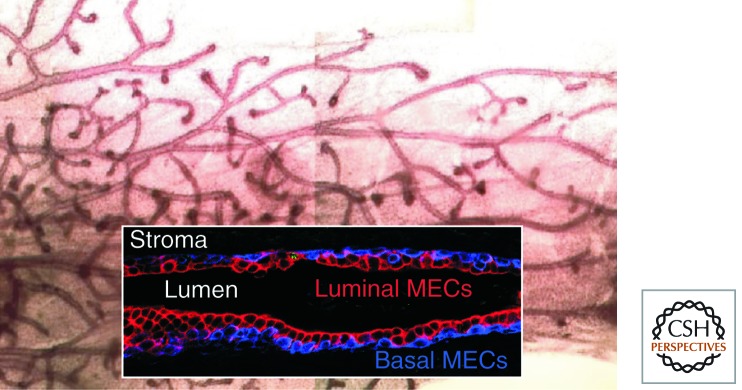
Figure 1.
Figure 1.
The mouse mammary gland, organization, and cell types. The (10) mouse mammary gland(s) comprise fat pads attached to the ventral mouse skin, colonized by a branched tree of hollow, epithelial mammary ducts (stained with carmine red) that are connected to the nipple. During pregnancy, there is massive proliferation of lobuloalveolar side branches to colonize the interstitial spaces between ducts, becoming filled with milk, expressed by oxytocin-induced contraction of myoepithelial cells. (Inset) An immunofluorescent stain of a longitudinal cross section of a non-pregnant duct, stained with a basal cell anti-cytokeratin (CK5) together with a luminal cell anti-cytokeratin (CK8), to show the bilayered structure of the epithelium.
Figure 2.
Figure 2.
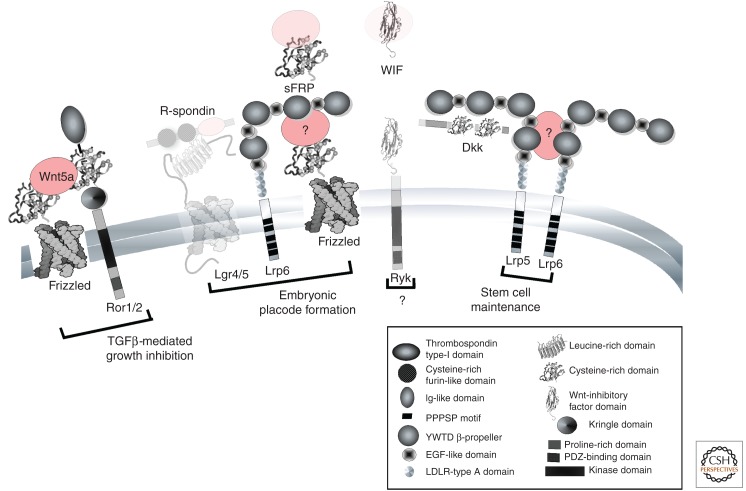
Cell surface Wnt signaling components shown to function during various phases of mammary gland growth and development. Structural and function information is drawn from data from He et al. (2004), Liepinsh et al. (2006), Kikuchi et al. (2007), Green et al. (2008), Bourhis et al. (2010), and Weis (2011). The information presented here can be cross-referenced to Table 1 for expression data. Physiological activities are detailed in the text. The Lgr4/5/RSpo component of embryonic placode formation is likely but has not yet been shown (hence it is grayed out). Although both Lrp5 and Lrp6 are required to maintain mammary stem cells, the Lrp5-6 heterodimer shown here is implied from our data (Goel et al. 2012a). It is not known whether the inhibitors shown (dkks, WIF, and sFRPs) are functional, but several are expressed. When components are illustrated with ribbon diagrams, their structure is known in some detail. (Wnt ligands are shown in pink.)

References

    1. Ai L, Tao Q, Zhong S, Fields CR, Kim WJ, Lee MW, Cui Y, Brown KD, Robertson KD 2006. Inactivation of Wnt inhibitory factor-1 (WIF1) expression by epigenetic silencing is a common event in breast cancer. Carcinogenesis 27: 1341–1348 - PubMed
    1. Archbold HC, Yang YX, Chen L, Cadigan KM 2012. How do they do Wnt they do?: Regulation of transcription by the Wnt/β-catenin pathway. Acta Physiol (Oxf) 204: 74–109 - PubMed
    1. Asselin-Labat ML, Vaillant F, Sheridan JM, Pal B, Wu D, Simpson ER, Yasuda H, Smyth GK, Martin TJ, Lindeman GJ, et al. 2010. Control of mammary stem cell function by steroid hormone signalling. Nature 465: 798–802 - PubMed
    1. Badders NM, Goel S, Clark RJ, Klos KS, Kim S, Bafico A, Lindvall C, Williams BO, Alexander CM 2009. The Wnt receptor, Lrp5, is expressed by mouse mammary stem cells and is required to maintain the basal lineage. PLoS ONE 4: e6594. - PMC - PubMed
    1. Baker R, Kent CV, Silbermann RA, Hassell JA, Young LJ, Howe LR 2010. Pea3 transcription factors and Wnt1-induced mouse mammary neoplasia. PloS ONE 5: e8854. - PMC - PubMed

Publication types

LinkOut - more resources