Evaluation of pulmonary embolism in the emergency department and consistency with a national quality measure: quantifying the opportunity for improvement
- PMID: 22664742
- PMCID: PMC3775003
- DOI: 10.1001/archinternmed.2012.1804
Evaluation of pulmonary embolism in the emergency department and consistency with a national quality measure: quantifying the opportunity for improvement
Abstract
Background: The National Quality Forum (NQF) has endorsed a performance measure designed to increase imaging efficiency for the evaluation of pulmonary embolism (PE) in the emergency department (ED). To our knowledge, no published data have examined the effect of patient-level predictors on performance.
Methods: To quantify the prevalence of avoidable imaging in ED patients with suspected PE, we performed a prospective, multicenter observational study of ED patients evaluated for PE from 2004 through 2007 at 11 US EDs. Adult patients tested for PE were enrolled, with data collected in a standardized instrument. The primary outcome was the proportion of imaging that was potentially avoidable according to the NQF measure. Avoidable imaging was defined as imaging in a patient with low pretest probability for PE, who either did not have a D-dimer test ordered or who had a negative D-dimer test result. We performed subanalyses testing alternative pretest probability cutoffs and imaging definitions on measure performance as well as a secondary analysis to identify factors associated with inappropriate imaging. χ(2) Test was used for bivariate analysis of categorical variables and multivariable logistic regression for the secondary analysis.
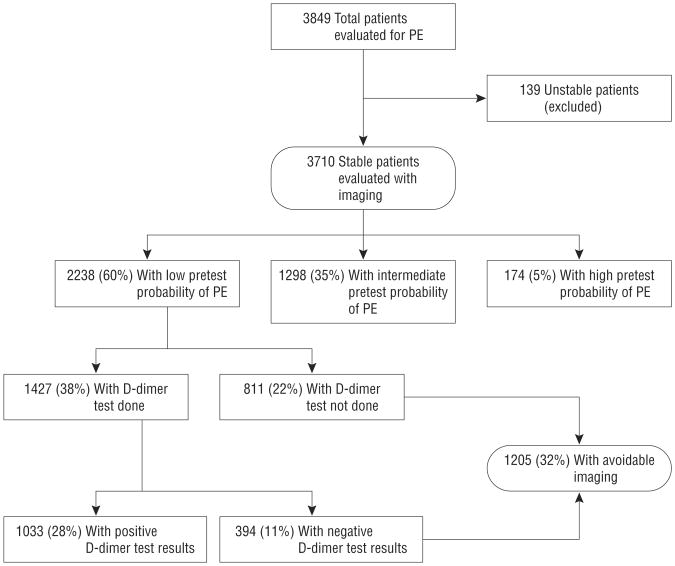
Results: We enrolled 5940 patients, of whom 4113 (69%) had low pretest probability of PE. Imaging was performed in 2238 low-risk patients (38%), of whom 811 had no D-dimer testing, and 394 had negative D-dimer test results. Imaging was avoidable, according to the NQF measure, in 1205 patients (32%; 95% CI, 31%-34%). Avoidable imaging owing to not ordering a D-dimer test was associated with age (odds ratio [OR], 1.15 per decade; 95% CI, 1.10-1.21). Avoidable imaging owing to imaging after a negative D-dimer test result was associated with inactive malignant disease (OR, 1.66; 95% CI, 1.11-2.49).
Conclusions: One-third of imaging performed for suspected PE may be categorized as avoidable. Improving adherence to established diagnostic protocols is likely to result in significantly fewer patients receiving unnecessary irradiation and substantial savings.
Figures
Comment in
-
Computed tomography in the emergency department setting.JAMA Intern Med. 2013 Jan 28;173(2):167-8. doi: 10.1001/2013.jamainternmed.1031. JAMA Intern Med. 2013. PMID: 23358840 No abstract available.
-
Computed tomography in the emergency department setting--reply.JAMA Intern Med. 2013 Jan 28;173(2):168. doi: 10.1001/jamainternmed.2013.1548. JAMA Intern Med. 2013. PMID: 23358841 No abstract available.
References
-
- Niska RW, Bhuiya F, Xu J. National hospital ambulatory medical care survey: 2007 emergency department summary. [Accessed April 2, 2012];National Health Statistics Reports. 2010 26(1-32) http://www.cdc.gov/nchs/data/nhsr/nhsr026.pdf. - PubMed
-
- Kline JA, Courtney DM, Kabrhel C, et al. Prospective multicenter evaluation of the pulmonary embolism rule-out criteria. J Thromb Haemost. 2008;6(5):772–780. - PubMed
-
- Runyon MS, Richman PB, Kline JA Pulmonary Embolism Research Consortium Study Group. Emergency medicine practitioner knowledge and use of decision rules for the evaluation of patients with suspected pulmonary embolism: variations by practice setting and training level. Acad Emerg Med. 2007;14(1):53–57. - PubMed
-
- Corwin MT, Donohoo JH, Partridge R, Egglin TK, Mayo-Smith WW. Do emergency physicians use serum D-dimer effectively to determine the need for CT when evaluating patients for pulmonary embolism? review of 5,344 consecutive patients. AJR Am J Roentgenol. 2009;192(5):1319–1323. - PubMed
-
- Costantino MM, Randall G, Gosselin M, Brandt M, Spinning K, Vegas CD. CT angiography in the evaluation of acute pulmonary embolus. AJR Am J Roentgenol. 2008;191(2):471–474. - PubMed
Publication types
MeSH terms
Substances
Grants and funding
LinkOut - more resources
Full Text Sources
Medical