Contributions of polyclonal malaria, gametocytemia, and pneumonia to infant severe anemia incidence in malaria hyperendemic Pemba, Tanzania
- PMID: 22665595
- PMCID: PMC3366534
- DOI: 10.4269/ajtmh.2012.11-0164
Contributions of polyclonal malaria, gametocytemia, and pneumonia to infant severe anemia incidence in malaria hyperendemic Pemba, Tanzania
Abstract
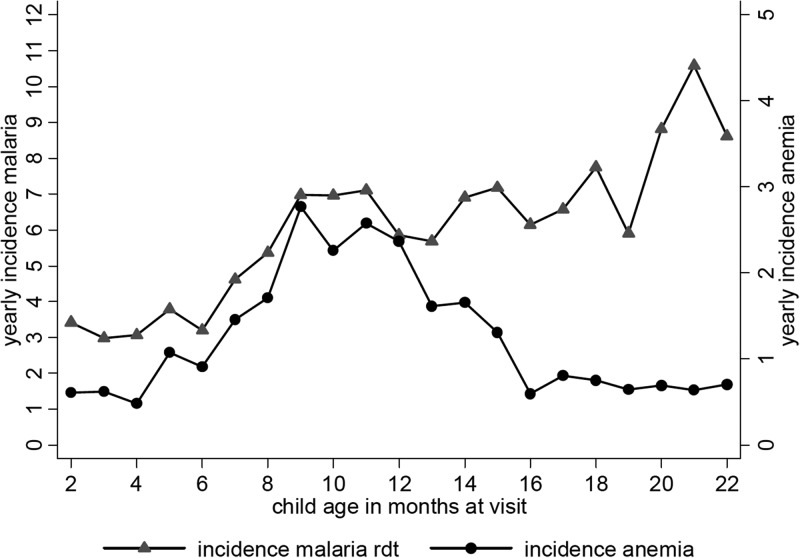
The causative factors for severe anemia incidence in sub-Saharan Africa are multifactorial. In an observational, longitudinal study of two cohorts of about 300 infants followed-up for six months in a malaria hyperendemic area, the risk factors for severe anemia incidence were clinical malaria and pneumonia, which outweighed nutritional and sociodemographic factors. Severe anemia incidence was 1-2/year at age 2 months, peaked around 6-7/year at age 7-12 months, and decreased back to 1-2/year at age 16-22 months. The age-dependent increase of severe anemia incidence was shown to be parallel to the age-dependent increase of clinical malaria. Previous clinical malaria episodes increased the severe anemia risk by 80%, and gametocyte carriage and pneumonia at prior visit was associated with a six-fold increase and a > 10-fold increase, respectively. The role of pneumonia and malaria as risk factors, and areas for interventions for severe anemia, should not be underestimated.
Figures
References
-
- Milman N. Anemia–still a major health problem in many parts of the world! Ann Hematol. 2011;90:369–377. - PubMed
-
- Ellman R, Maxwell C, Finch R, Shayo D. Malaria and anaemia at different altitudes in the Muheza district of Tanzania: childhood morbidity in relation to level of exposure to infection. Ann Trop Med Parasitol. 1998;92:741–753. - PubMed
-
- Kitua AY, Smith TA, Alonso PL, Urassa H, Masanja H, Kimario J, Tanner M. The role of low level Plasmodium falciparum parasitaemia in anaemia among infants living in an area of intense and perennial transmission. Trop Med Int Health. 1997;2:325–333. - PubMed
-
- Premji Z, Hamisi Y, Shiff C, Minjas J, Lubega P, Makwaya C. Anaemia and Plasmodium falciparum infections among young children in an holoendemic area, Bagamoyo, Tanzania. Acta Trop. 1995;59:55–64. - PubMed
-
- Shiff C, Checkley W, Winch P, Premji Z, Minjas J, Lubega P. Changes in weight gain and anaemia attributable to malaria in Tanzanian children living under holoendemic conditions. Trans R Soc Trop Med Hyg. 1996;90:262–265. - PubMed
Publication types
MeSH terms
Associated data
LinkOut - more resources
Full Text Sources
Medical