. 2012:2012:849456.
doi: 10.1155/2012/849456. Epub 2012 May 10.

The molecular biology of soft-tissue sarcomas and current trends in therapy

Affiliations

The molecular biology of soft-tissue sarcomas and current trends in therapy

Jorge Quesada et al. Sarcoma. 2012.

Abstract

Basic research in sarcoma models has been fundamental in the discovery of scientific milestones leading to a better understanding of the molecular biology of cancer. Yet, clinical research in sarcoma has lagged behind other cancers because of the multiple clinical and pathological entities that characterize sarcomas and their rarity. Sarcomas encompass a very heterogeneous group of tumors with diverse pathological and clinical overlapping characteristics. Molecular testing has been fundamental in the identification and better definition of more specific entities among this vast array of malignancies. A group of sarcomas are distinguished by specific molecular aberrations such as somatic mutations, intergene deletions, gene amplifications, reciprocal translocations, and complex karyotypes. These and other discoveries have led to a better understanding of the growth signals and the molecular pathways involved in the development of these tumors. These findings are leading to treatment strategies currently under intense investigation. Disruption of the growth signals is being targeted with antagonistic antibodies, tyrosine kinase inhibitors, and inhibitors of several downstream molecules in diverse molecular pathways. Preliminary clinical trials, supported by solid basic research and strong preclinical evidence, promises a new era in the clinical management of these broad spectrum of malignant tumors.


Figures
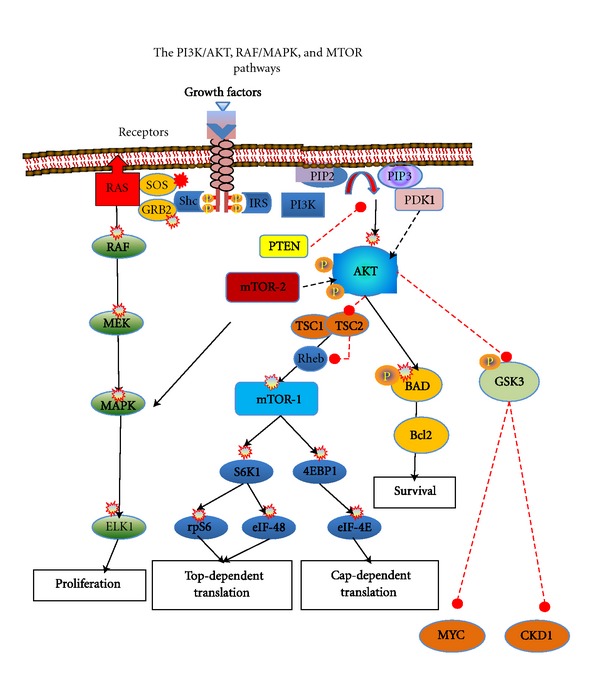
Figure 1
Figure 1
Several growth factor signals activate cell membrane receptor tyrosine kinases leading to activation of downstream interacting signal transduction pathways (PI3K/AKT, RAF/MAPK, and MTOR). Within the RAF/MAPK pathway, activated receptors lead to SHC-mediated activation of RAS and propagation of signalling through RAF, MEK (a.k.a. MAP2K), and MAPK (a.k.a. ERK). Activated MAPK forward signals to the nucleus that regulate proliferation, differentiation, angiogenesis, and cell survival. A second essential signalling pathway is the PI3K/AKT pathway. PI3K catalyzes triple phosphorylation of phosphatidylinositol (PI) AKT in conjunction with its PDK1. AKT is a key molecular “node” acting as a master switch, which triggers multiple downstream signaling pathways including mTOR pathway activation. A key regulatory enzyme is PTEN that modulates PI3K and SHC phosphorylation. Activated AKT signals a number of mitogenic processes promoting proliferation and increased cell survival, antiapoptotic signals, and upregulation of cell-cycle proteins (cyclin D1 and CDK4).
Figure 2
Figure 2
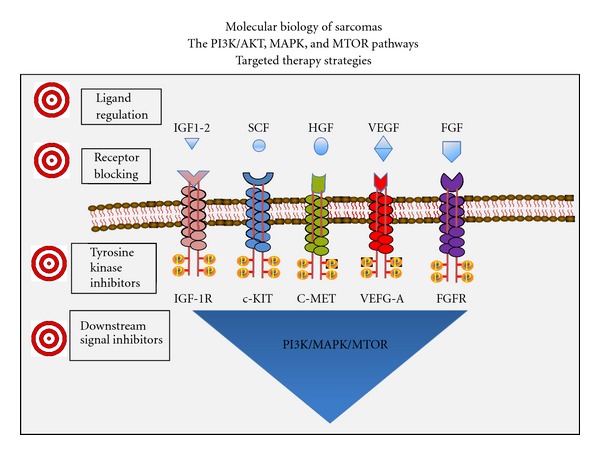
Several ligands (IGF1/2, SCF, HGF, VEGF, and FGF) activate cell membrane receptor tyrosine kinases (IGF1R, C-KIT, C-MET, VEGFR-A, and FGFR) triggering shared interacting signal transduction pathways (PI3K/AKT, RAF/MAPK, and MTOR). The availability of ligands via paracrine secretion (IGF1), autocrine loops (VEGF), or ligand binding (IGFBPs) can modulate activation of these pathways. Molecular anomalies of the receptors or the downstream signals lead to constitutive activation or dysregulation of these signals. Multiple cell processes including proliferation, differentiation, angiogenesis, and survival are promoted as a result of the activation of these main pathways in sarcomas and other neoplasms. Actionable targets are listed that may interfere with the abnormal signalling and could result in beneficial biologic and clinical effects.

References

    1. Hanahan D, Weinberg RA. Hallmarks of cancer: the next generation. Cell. 2011;144(5):646–674. - PubMed
    1. Rous P. A sarcoma of the fowl transmissible by an agent separable from the tumor cells. The Journal of Experimental Medicine. 1911;13:397–411. - PMC - PubMed
    1. Rubin H. The early history of tumor virology: Rous, RIF, and RAV. Proceedings of the National Academy of Sciences of the United States of America. 2011;108(35):14389–14396. - PMC - PubMed
    1. Butel JS. Viral carcinogenesis: revelation of molecular mechanisms and etiology of human disease. Carcinogenesis. 2000;21(3):405–426. - PubMed
    1. Huebner RJ, Todaro GJ. Oncogenes of rna tumor viruses as determinants of cancer. Proceedings of the National Academy of Sciences of the United States of America. 1969;64(3):1087–1094. - PMC - PubMed

LinkOut - more resources