Common features at the start of the neurodegeneration cascade
- PMID: 22666178
- PMCID: PMC3362641
- DOI: 10.1371/journal.pbio.1001335
Common features at the start of the neurodegeneration cascade
Abstract
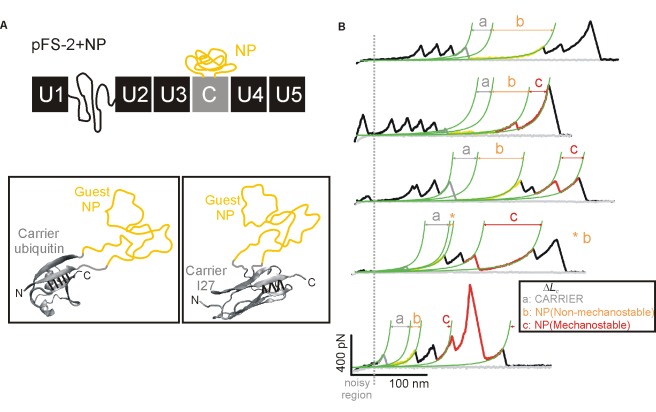
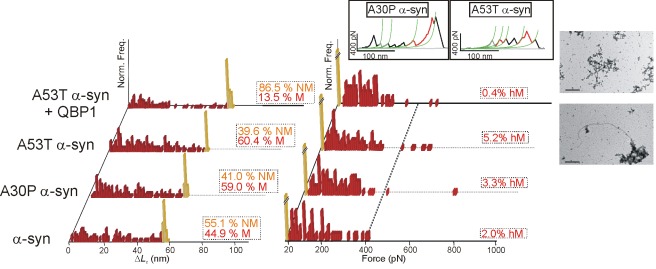
Amyloidogenic neurodegenerative diseases are incurable conditions with high social impact that are typically caused by specific, largely disordered proteins. However, the underlying molecular mechanism remains elusive to established techniques. A favored hypothesis postulates that a critical conformational change in the monomer (an ideal therapeutic target) in these "neurotoxic proteins" triggers the pathogenic cascade. We use force spectroscopy and a novel methodology for unequivocal single-molecule identification to demonstrate a rich conformational polymorphism in the monomer of four representative neurotoxic proteins. This polymorphism strongly correlates with amyloidogenesis and neurotoxicity: it is absent in a fibrillization-incompetent mutant, favored by familial-disease mutations and diminished by a surprisingly promiscuous inhibitor of the critical monomeric β-conformational change, neurotoxicity, and neurodegeneration. Hence, we postulate that specific mechanostable conformers are the cause of these diseases, representing important new early-diagnostic and therapeutic targets. The demonstrated ability to inhibit the conformational heterogeneity of these proteins by a single pharmacological agent reveals common features in the monomer and suggests a common pathway to diagnose, prevent, halt, or reverse multiple neurodegenerative diseases.
Conflict of interest statement
The authors declare a competing financial interest: M.C.-V., J.O., and R.H. are co-inventors on an international patent application (No. P 201031846,PCT/ES2011/070867) covering the results contained in this article. Any potential income generated by exploitation of the patent rights and received by their employer, the CSIC, shall be shared with these authors according to Spanish law and the regulations of the CSIC.
Figures



Comment in
-
Single-molecule technique links structural fluctuations of proteins to brain diseases.PLoS Biol. 2012;10(5):e1001338. doi: 10.1371/journal.pbio.1001338. Epub 2012 May 29. PLoS Biol. 2012. PMID: 22666179 Free PMC article. No abstract available.
References
-
- Chiti F, Dobson C. M. Protein misfolding, functional amyloid and human disease. Ann Rev Biochem. 2006;75:333–366. - PubMed
-
- Uversky V. Intrinsic disorder in proteins associated with neurodegenerative diseases. In: Ovádi J, Orosz F, editors. Protein folding and misfolding: neurodegenerative diseases. New York: Springer-Verlag; 2009. pp. 21–75.
-
- Kayed R, Head E, Thompson J. L, McIntire T. M, Milton S. C, et al. Common structure of soluble amyloid oligomers implies common mechanism of pathogenesis. Science. 2003;300:486–489. - PubMed
-
- Nagai Y, Popiel H. A. Conformational changes and aggregation of expanded polyglutamine proteins as therapeutic targets of the polyglutamine diseases: exposed β-sheet hypothesis. Curr Pharm Des. 2008;14:3267–3279. - PubMed
-
- Nagai Y, Inui T, Popiel H. A, Fujikake N, Hasegawa K, et al. A toxic monomeric conformer of the polyglutamine protein. Nat Struct Biol. 2007;14:332–340. - PubMed
Publication types
MeSH terms
Substances
LinkOut - more resources
Full Text Sources
Other Literature Sources
Medical
Miscellaneous