


Analysis of dehydration and strength in elite badminton players
- PMID: 22666396
- PMCID: PMC3362600
- DOI: 10.1371/journal.pone.0037821
Analysis of dehydration and strength in elite badminton players
Abstract
Background: The negative effects of dehydration on aerobic activities are well established. However, it is unknown how dehydration affects intermittent sports performance. The purpose of this study was to identify the level of dehydration in elite badminton players and its relation to muscle strength and power production.
Methodology: Seventy matches from the National Spanish badminton championship were analyzed (46 men's singles and 24 women's singles). Before and after each match, jump height and power production were determined during a countermovement jump on a force platform. Participants' body weight and a urine sample were also obtained before and after each match. The amount of liquid that the players drank during the match was also calculated by weighing their individual drinking bottles.
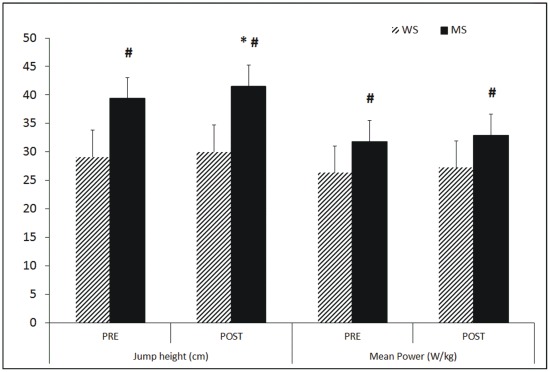
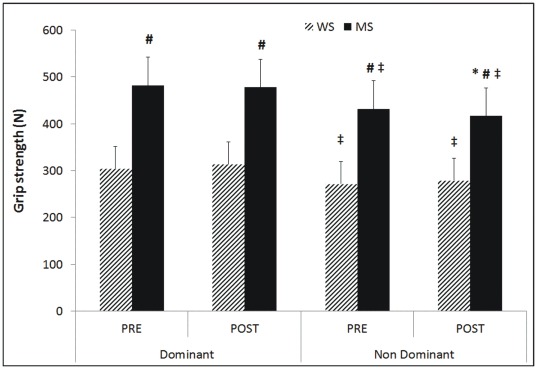
Results and discussion: Sweat rate during the game was 1.14 ± 0.46 l/h in men and 1.02 ± 0.64 l/h in women. The players rehydrated at a rate of 1.10 ± 0.55 l/h and 1.01 ± 0.44 l/h in the male and female groups respectively. Thus, the dehydration attained during the game was only 0.37 ± 0.50% in men and 0.32 ± 0.83% in women. No differences were found in any of the parameters analyzed during the vertical jump (men: from 31.82 ± 5.29 to 32.90 ± 4.49 W/kg; p>0.05, women: from 26.36 ± 4.73 to 27.25 ± 4.44 W/kg; p>0.05). Post-exercise urine samples revealed proteinuria (60.9% of cases in men and 66.7% in women), leukocyturia (men = 43.5% and women = 50.0%) and erythrocyturia (men = 50.0% and women = 21.7%).
Conclusions: Despite a moderate sweat rate, badminton players adequately hydrated during a game and thus the dehydration attained was low. The badminton match did not cause muscle fatigue but it significantly increased the prevalence of proteinuria, leukocyturia and erythrocyturia.
Conflict of interest statement
Figures
References
-
- Sawka MN, Young AJ. Physiological systems and their responses to conditions of heat and cold. In: Tipton CMS, M. N.; Tate, C A, Terjung R L, editors. ACSM's advanced exercise physiology. Baltimore, MD: Lippincott Williams & Wilkins; 2006. pp. 535–563.
-
- Baker LB, Dougherty KA, Chow M, Kenney WL. Progressive dehydration causes a progressive decline in basketball skill performance. Med Sci Sports Exerc. 2007;39:1114–1123. - PubMed
-
- Dougherty KA, Baker LB, Chow M, Kenney WL. Two percent dehydration impairs and six percent carbohydrate drink improves boys basketball skills. Med Sci Sports Exerc. 2006;38:1650–1658. - PubMed
-
- Watson G, Judelson DA, Armstrong LE, Yeargin SW, Casa DJ, et al. Influence of diuretic-induced dehydration on competitive sprint and power performance. Med Sci Sports Exerc. 2005;37:1168–1174. - PubMed
-
- Gutierrez A, Mesa JL, Ruiz JR, Chirosa LJ, Castillo MJ. Sauna-induced rapid weight loss decreases explosive power in women but not in men. Int J Sports Med. 2003;24:518–522. - PubMed
MeSH terms
LinkOut - more resources
Full Text Sources
Medical
