


Modelling the genetic risk in age-related macular degeneration
- PMID: 22666427
- PMCID: PMC3364197
- DOI: 10.1371/journal.pone.0037979
Modelling the genetic risk in age-related macular degeneration
Abstract
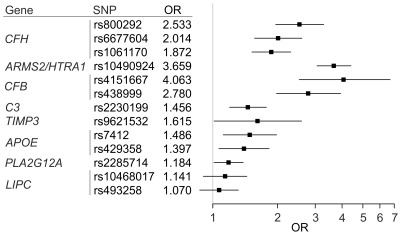
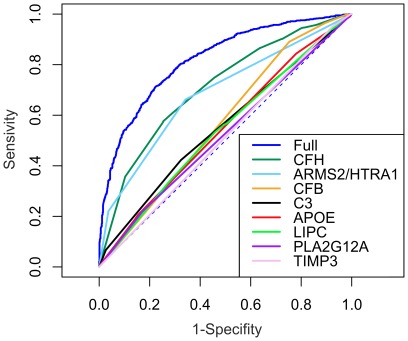
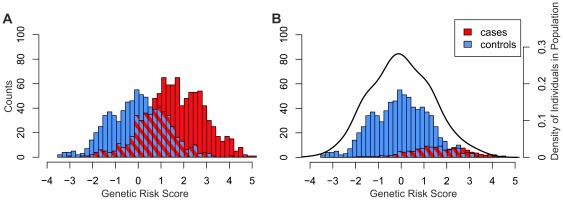
Late-stage age-related macular degeneration (AMD) is a common sight-threatening disease of the central retina affecting approximately 1 in 30 Caucasians. Besides age and smoking, genetic variants from several gene loci have reproducibly been associated with this condition and likely explain a large proportion of disease. Here, we developed a genetic risk score (GRS) for AMD based on 13 risk variants from eight gene loci. The model exhibited good discriminative accuracy, area-under-curve (AUC) of the receiver-operating characteristic of 0.820, which was confirmed in a cross-validation approach. Noteworthy, younger AMD patients aged below 75 had a significantly higher mean GRS (1.87, 95% CI: 1.69-2.05) than patients aged 75 and above (1.45, 95% CI: 1.36-1.54). Based on five equally sized GRS intervals, we present a risk classification with a relative AMD risk of 64.0 (95% CI: 14.11-1131.96) for individuals in the highest category (GRS 3.44-5.18, 0.5% of the general population) compared to subjects with the most common genetic background (GRS -0.05-1.70, 40.2% of general population). The highest GRS category identifies AMD patients with a sensitivity of 7.9% and a specificity of 99.9% when compared to the four lower categories. Modeling a general population around 85 years of age, 87.4% of individuals in the highest GRS category would be expected to develop AMD by that age. In contrast, only 2.2% of individuals in the two lowest GRS categories which represent almost 50% of the general population are expected to manifest AMD. Our findings underscore the large proportion of AMD cases explained by genetics particularly for younger AMD patients. The five-category risk classification could be useful for therapeutic stratification or for diagnostic testing purposes once preventive treatment is available.
Conflict of interest statement
Figures
References
-
- Congdon N, O'Colmain B, Klaver CCW, Klein R, Muñoz B, et al. Causes and prevalence of visual impairment among adults in the United States. Archives of ophthalmology. 2004;122:477–485. Available: http://www.ncbi.nlm.nih.gov/pubmed/15078664. - PubMed
-
- de Jong PTVM. Age-related macular degeneration. The New England journal of medicine. 2006;355:1474–1485. Available: http://www.ncbi.nlm.nih.gov/pubmed/17021323. - PubMed
-
- Jager RD, Mieler WF, Miller JW. Age-related macular degeneration. The New England journal of medicine. 2008;358:2606–2617. Available: http://www.ncbi.nlm.nih.gov/pubmed/18550876. - PubMed
-
- Rosenfeld PJ, Brown DM, Heier JS, Boyer DS, Kaiser PK, et al. Ranibizumab for neovascular age-related macular degeneration. The New England journal of medicine. 2006;355:1419–1431. Available: http://www.ncbi.nlm.nih.gov/pubmed/17021318. - PubMed
-
- Brown DM, Kaiser PK, Michels M, Soubrane G, Heier JS, et al. Ranibizumab versus verteporfin for neovascular age-related macular degeneration. The New England journal of medicine. 2006;355:1432–1444. Available: http://www.ncbi.nlm.nih.gov/pubmed/17021319. Accessed 2011 Sept 28. - PubMed
Publication types
MeSH terms
LinkOut - more resources
Full Text Sources
Other Literature Sources
Medical
