


Articles with short titles describing the results are cited more often
- PMID: 22666797
- PMCID: PMC3351256
- DOI: 10.6061/clinics/2012(05)17
Articles with short titles describing the results are cited more often
Abstract
Objective: The aim of this study was to evaluate some features of article titles from open access journals and to assess the possible impact of these titles on predicting the number of article views and citations.
Methods: Research articles (n = 423, published in October 2008) from all Public Library of Science (PLoS) journals and from 12 Biomed Central (BMC) journals were evaluated. Publication metrics (views and citations) were analyzed in December 2011. The titles were classified according to their contents, namely methods-describing titles and results-describing titles. The number of title characters, title typology, the use of a question mark, reference to a specific geographical region, and the use of a colon or a hyphen separating different ideas within a sentence were analyzed to identify predictors of views and citations. A logistic regression model was used to identify independent title characteristics that could predict citation rates.
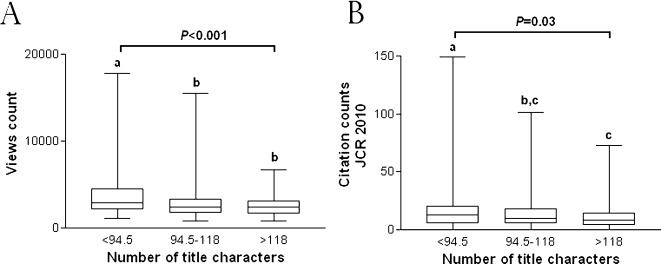
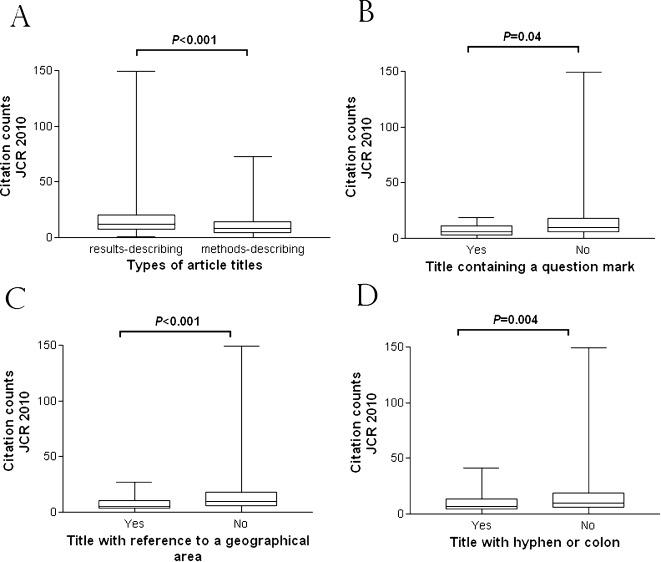
Results: Short-titled articles had higher viewing and citation rates than those with longer titles. Titles containing a question mark, containing a reference to a specific geographical region, and that used a colon or a hyphen were associated with a lower number of citations. Articles with results-describing titles were cited more often than those with methods-describing titles. After multivariate analysis, only a low number of characters and title typology remained as predictors of the number of citations.
Conclusions: Some features of article titles can help predict the number of article views and citation counts. Short titles presenting results or conclusions were independently associated with higher citation counts. The findings presented here could be used by authors, reviewers, and editors to maximize the impact of articles in the scientific community.
Conflict of interest statement
No potential conflict of interest was reported.
Figures
References
-
- Thomson Reuters. ISI Web of Knowledge Web site. 2011; Available at http://wokinfo.com/. Accessed December 13, 2011.
-
- Elsevier. Scopus Web site. 2011; Available at http://www.scopus.com. Accessed December 13, 2011.
-
- Google. Google Scholar beta Web site. 2011; Available at http://scholar.google.com. Accessed December 13, 2011.
MeSH terms
LinkOut - more resources
Full Text Sources
