. 2012 Jul;9(3):658-72.
doi: 10.1007/s13311-012-0125-x.

Inactivation of the constitutively active ghrelin receptor attenuates limbic seizure activity in rodents

Affiliations

Inactivation of the constitutively active ghrelin receptor attenuates limbic seizure activity in rodents

Jeanelle Portelli et al. Neurotherapeutics. 2012 Jul.

Abstract

Ghrelin is a pleiotropic neuropeptide that has been recently implicated in epilepsy. Animal studies performed to date indicate that ghrelin has anticonvulsant properties; however, its mechanism of anticonvulsant action is unknown. Here we show that the anticonvulsant effects of ghrelin are mediated via the growth hormone secretagogue receptor (GHSR). To our surprise, however, we found that the GHSR knockout mice had a higher seizure threshold than their wild-type littermates when treated with pilocarpine. Using both in vivo and in vitro models, we further discovered that inverse agonism and desensitization/internalization of the GHSR attenuate limbic seizures in rats and epileptiform activity in hippocampal slices. This constitutes a novel mechanism of anticonvulsant action, whereby an endogenous agonist reduces the activity of a constitutively active receptor.


Figures

Fig. 1
Fig. 1
Ghrelin attenuates limbic seizures without affecting extracellular hippocampal γ-amino butyric acid (GABA) levels. a, bIn vivo microdialysis in conscious rats. The mean total seizure severity score (TSSS) with SEM for the rat groups that underwent intrahippocampal administration of (a) ghrelin and (b) capromorelin prior to pilocarpine administration (one-way analysis of variance; *p < 0.05, **p < 0.01, ***p < 0.001). c Effect of the intrahippocampally administered anticonvulsant doses of ghrelin on the baseline hippocampal GABA dialysate levels in rats. The first data point (0-120) represents the mean ± SEM GABA level of the first 6 basal microdialysis collections (grey box). The following data points represent the mean ± SEM GABA level of a subsequent 20-minute collection period during the 120 minutes perfusion with 1 μM or 10 μM ghrelin via the microdialysis probe
Fig. 2
Fig. 2
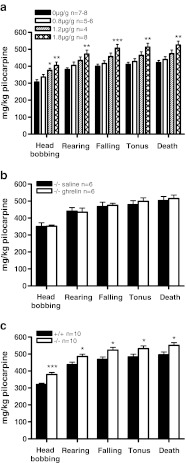
GHSR-/- mice are unresponsive to ghrelin but have a higher seizure threshold than wild-type littermates. a Threshold doses of pilocarpine for the induction of seizures in growth hormone secretagogue receptor (GHSR)+/+ mice receiving ghrelin intraperitoneally 0-0.8-1.2-1.8 μg/g (n = 4-8 per group) 30 minutes prior to pilocarpine infusion in the tail vein (one-way analysis of variance; *p < 0.05, **p < 0.01, ***p < 0.001). b Threshold doses of pilocarpine for the induction of seizure-associated behaviors in GHSR-/- mice after saline and 1.8 μg/g ghrelin administration (n = 6 per group). c Threshold doses of pilocarpine for the induction of seizure-associated behaviors (n = 10 for each genotype) in GHSR+/+ and GHSR-/- mice in the pilocarpine tail vein infusion model (unpaired Student’s t test; *p < 0.05, *** P < 0.001)
Fig. 3
Fig. 3
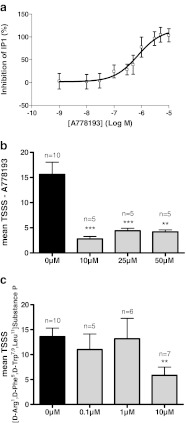
Growth hormone secretagogue receptor (GHSR) inverse agonists reduce pilocarpine-induced seizures in vivo.a Dose-dependent inhibition of constitutive inositol 1-phosphate (IP1)-production by the GHSR inverse agonist A778193 in HEK293 cells expressing the cloned hGHSR. b, c The mean total seizure severity score (TSSS) with SEM for the rat groups that underwent intrahippocampal administration of (b) A778193 (one-way analysis of variance; **p < 0.01, ***p < 0.001) and (c) the GHSR inverse agonist [D-Arg1,D-Phe5,D-Trp7,9,Leu11]substance P (unpaired Student’s t test, **p < 0.01) prior to pilocarpine administration
Fig. 4
Fig. 4
The sample time courses of in vivo electroencephalography (EEG) recordings from growth hormone secretagogue receptor (GHSR) inverse agonists test groups. Representative EEG recordings of (a) control, (b) 10 μM of the GHSR inverse agonist A778193, and (c) 10 μM of the GHSR inverse agonist [D-Arg1,D-Phe5,D-Trp7,9,Leu11]substance P intrahippocampally administered microdialysis experiments. Each EEG recording represents 30 minutes of baseline, 2 h of drug perfusion or sham (i.e., Ringer’s solution alone in the case of control), 40 minutes co-administration of inverse agonist/sham and pilocarpine, and 2 h, 40 minutes of inverse agonist/sham perfusion until the end of the experiment. The insets of magnified windows represent EEG samples for 30 seconds in each highlighted time window. Green boxes indicate a 30-second interval, 15 minutes prior to drug administration; blue boxes indicate a 30-second interval, 50 minutes after the start of inverse agonist/sham administration; and red boxes indicate a 30-second interval, 50 minutes after initiation of intrahippocampal pilocarpine and inverse agonist/sham co-administration
Fig. 5
Fig. 5
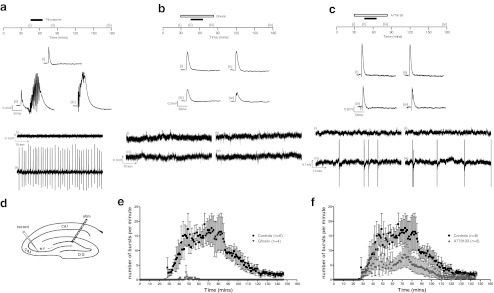
Ghrelin and A778193 protect against pilocarpine-induced epileptiform activity in vitro. a-c The timeline configuration of the experiments (top), electrically evoked field recordings (middle) and continuous acquisition traces (bottom). The insets are representative traces taken according to the time indicated in the timeline: (a) baseline conditions (i), 20 minutes after pilocarpine cessation (ii), and after washout for at least 2 h (iii); (b) baseline conditions (i), after 20 minutes of 1 μM ghrelin alone (ii), 20 minutes after pilocarpine cessation (iii), and after 95 minutes washout period (iv). c baseline conditions (i), after 20 minutes of 1 μM of the growth hormone secretagogue receptor (GHSR) inverse agonist A778193 alone (ii), 20 minutes after pilocarpine cessation (iii), and after 95 minutes washout period (iv). d Positioning of electrodes for recording spontaneous and electrically evoked responses in the rat hippocampal slice. e, f Number of spontaneous interictal bursts per minute for the control group, and (e) ghrelin, or (f) A778193 pretreated group
Fig. 6
Fig. 6
Desensitization, internalization, and re-sensitization of growth hormone secretagogue receptors (GHSRs). a (left) Intracellular Ca2+ rises in response to different concentrations of ghrelin (X-axis). Pretreated responses are expressed as percentage of responses without pretreatment (blank). (Right) The maxima of the concentration response curves in the left graph are expressed as a function of the pretreatment concentration (X-axis). b The effect of different pretreatment times with ghrelin at different concentrations (X-axis) on the maximum (Y-axis) of a subsequent stimulation with ghrelin. Three minutes, 10 minutes, 20 minutes, and 60 minutes of pre-incubation with ghrelin all resulted in a similar GHSR desensitization. c GHSR internalization was observed as redistribution of fluorescence to the cytosol at 37 ° C in HEK293 cells expressing an enhanced green fluorescent protein (EGFP) tagged GHSR. d Re-sensitization of GHSR. After pretreatment with ghrelin at 10-6 M, 10-7 M, or 10-8 M for the duration of 3 minutes, the cells were washed and re-stimulated with ghrelin (dose response 10-6 M – 10-10 M) after 3 minutes, 20 minutes, 1 h, 2 h , 5 h, or 24 h, respectively. eIn vitro desensitization concentration response curve (3 minutes) for ghrelin, the GHSR agonist capromorelin, ghrelin(1-14), and ghrelin(1-5) amide. Ghrelin(1-5) amide has a much lower capacity to desensitize the GHSR compared to ghrelin and capromorelin. f The mean total seizure severity score (TSSS) with SEM for the rat groups that underwent intrahippocampal administration of ghrelin(1-5) amide prior to pilocarpine administration (unpaired Student’s t test; *p < 0.05)

References

    1. Kojima M, Hosoda H, Date Y, et al. Ghrelin is a growth-hormone-releasing acylated peptide from stomach. Nature. 1999;402:656–660. doi: 10.1038/45230. - DOI - PubMed
    1. Diano S, Farr SA, Benoit SC, et al. Ghrelin controls hippocampal spine synapse density and memory performance. Nat Neurosci. 2006;9:381–388. doi: 10.1038/nn1656. - DOI - PubMed
    1. Andrews ZB, Liu ZW, Wallingford N, et al. UCP2 mediates ghrelin's action on NPY/AgRP neurons by lowering free radicals. Nature. 2008;454:846–851. doi: 10.1038/nature07181. - DOI - PMC - PubMed
    1. Angelidis G, Valotassiou V, Georgoulias P. Current and potential roles of ghrelin in clinical practice. J Endocrinol Invest. 2010;33:823–838. - PubMed
    1. Camina JP. Cell biology of the ghrelin receptor. J Neuroendocrinol. 2006;18:65–76. doi: 10.1111/j.1365-2826.2005.01379.x. - DOI - PubMed

Publication types

MeSH terms