


Thromboelastometry Based Early Goal-Directed Coagulation Management Reduces Blood Transfusion Requirements, Adverse Events, and Costs in Acute Type A Aortic Dissection: A Pilot Study
- PMID: 22670130
- PMCID: PMC3364080
- DOI: 10.1159/000337723
Thromboelastometry Based Early Goal-Directed Coagulation Management Reduces Blood Transfusion Requirements, Adverse Events, and Costs in Acute Type A Aortic Dissection: A Pilot Study
Abstract
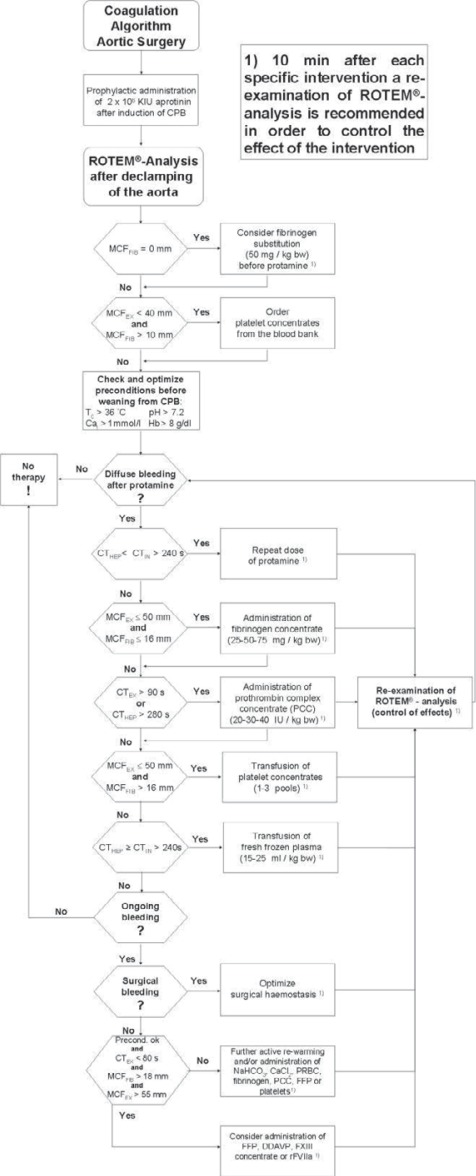
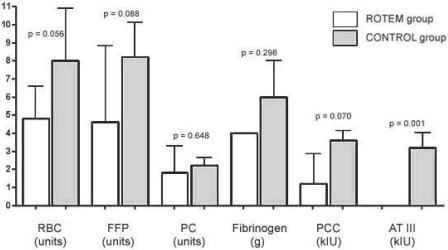
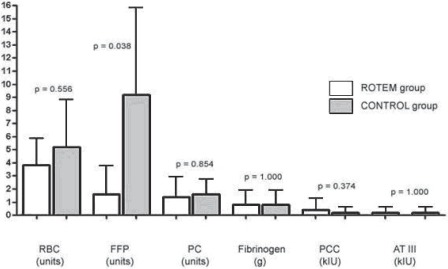
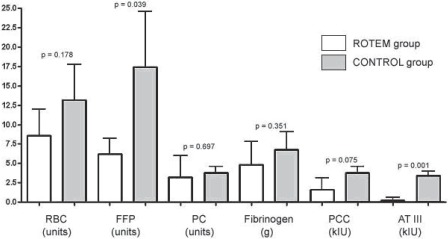
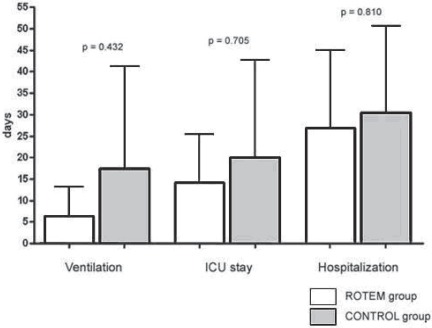
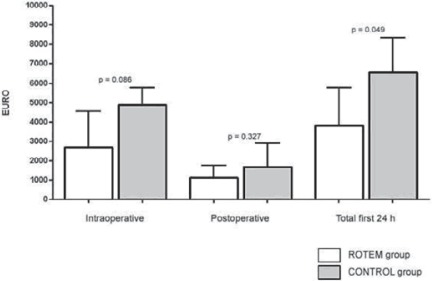
BACKGROUND: In aortic surgery bleeding complications can be fatal. Therefore, rotational thromboelastometry(ROTEM™)-based coagulation management was introduced. METHODS: After 5 cases of acute type A aortic dissection and aortic arch replacement had been treated based on ROTEM findings (ROTEM group; RG), 5 cases without ROTEM were matched as control group (CG). CG treatment was based on conventional tests and clinical findings. Blood component and coagulation factor requirements, ventilation time, duration of stay at intensive care unit (ICU), hospitalization, and thrombotic or bleeding incidents as well as transfusion-associated costs were compared. RESULTS: Administration of blood products and coagulation factor concentrates, ventilation time, ICU length of stay, and hospitalization tended to be lower in RG. Postoperative plasma transfusion (p = 0.038), recognized incidents (p = 0.048), and resulting costs on coagulation treatment (p = 0.049) were significantly reduced. CONCLUSION: Our data suggest that ROTEM-based coagulation management can reduce transfusion requirements and corresponding costs in patients with aortic arch replacement. These data has to be confirmed by prospective randomized trials.
Hintergrund: Blutungskomplikationen in der Aortenchirurgie gehen mit erheblichen Risiken für die Patienten einher und können fatale Folgen haben. Aus diesem Grund wurde ein Rotationsthromboelastometrie(ROTEM™)-basierter Algorithmus zum Gerinnungsmanagement eingeführt.
Methoden: Nach 5 Fällen von Patienten mit akuter Typ-A-Aorten-Dissektion und entsprechendem Aortenbogenersatz, welche gemäß dem genannten Algorithmus therapiert wurden (ROTEM-Gruppe; RG), wurden 5 Fälle ohne ROTEM-Monitoring als Kontrollgruppe (CG) genutzt. Die Therapie der CG basierte auf konventionellen Labortests und klinischen Eindrücken. Der Verbrauch von Blutkomponenten und Gerinnungsfaktorkonzentraten, Ventilations-und Liegezeiten auf der Intensivstation wie auch die Dauer des Intensivaufenthalts und der Hospitalisierung wurden erfasst. Ferner wurden thrombembolische und Blutungskomplikationen sowie die transfusionsassoziierten Kosten analysiert.
Ergebnisse: Der Verbrauch von Blutprodukten und Gerinnungsfaktorkonzentraten, die Beatmungsdauer, die Intensivliegedauer sowie die Hospitalisierung waren tendenziell niedriger in der RG. Der postoperative Verbrauch an gefrorenem Frischplasma (p = 0,038), die Komplikationshäufigkeit (p = 0,048) und die transfusionsassoziierten Kosten (p = 0,049) waren in der RG signifikant reduziert.
Schlussfolgerung: Unsere Daten deuten darauf hin, dass durch ein ROTEM-basiertes Gerinnungsmanagement der Bedarf an Transfusionen und die entsprechend assoziierten Kosten bei Patienten mit akuter Typ-A-Dissektionen reduziert werden können. Dies muss künftig durch prospektive randomisierte Studien belegt werden.
Figures
References
-
- Apaydin AZ, Islamoglu F, Posacioglu H, Calkavur T, Yagdi T, Atay Y, Buket S. Surgical treatment of acute arch dissection. Jpn J Thorac Cardiovasc Surg. 2003;51:48–52. - PubMed
-
- Ghavidel AA, Tabatabaei MB, Yousefnia MA, Omrani GR, Givtaj N, Raesi K. Mortality and morbidity after aortic root replacement: 10-year experience. Asian Cardiovasc Thorac Ann. 2006;14:462–466. - PubMed
-
- Irarrazaval Ll MJ, Moran VS, Zalaquett SR, Becker RP, Baeza PC, Urzúa UJ, Lema FG, Canessa BR, Chamorro SG, Braun JS, Córdova AS, Garayar PB. Partial or total replacement of the aortic arch. Experience in 23 patients. Rev Med Chil. 2006;134:575–580. - PubMed
-
- Khalil A, Tarik T, Porembka DT. Aortic pathology: Aortic trauma, debris, dissection, and aneurysm. Crit Care Med. 2007;35(8 suppl):S392–400. - PubMed
-
- Schachner T, Vertacnik K, Nagiller J, Laufer G, Bonatti J. Factors associated with mortality and long time survival in patients undergoing modified Bentall operations. J Cardiovasc Surg (Torino) 2005;46:449–455. - PubMed
LinkOut - more resources
Full Text Sources
