


Recommendations and considerations for the use of biologics in orthopedic surgery
- PMID: 22671767
- PMCID: PMC4045485
- DOI: 10.2165/11631680-000000000-00000
Recommendations and considerations for the use of biologics in orthopedic surgery
Abstract
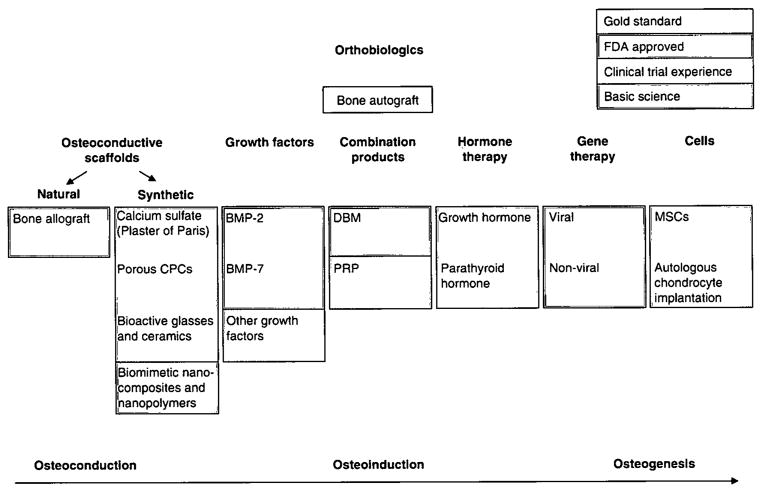
Reconstruction of extensive bone defects remains technically challenging and has considerable medical and financial impact on our society. Surgical procedures often require a bone/substitute graft to enhance and accelerate bone repair. Bone autografts are associated with morbidity related to bone harvesting and are limited in quantity. Alternatively, bone allografts expose the patient to the risk of transmission of infectious disease. Synthetic bone graft substitutes, such as calcium sulfates, hydroxyapatite, tricalcium phosphate, and combinations, circumvent some of the disadvantages of auto- and allografts, but have limited indications. Biomedical research has made possible the stimulation of the body's own healing mechanisms, either by delivering exogenous growth factors locally, or by stimulating their local production by gene transfer. Among all known factors having osteoinductive properties, only two bone morphogenetic proteins (for specific indications) and demineralized bone matrix have been approved for clinical use. In addition, ongoing research is exploring the efficacy of cell therapy and tissue engineering. The present report examines the composition, biological properties, indications, clinical experience and regulations of several of the biotherapeutics employed for bone reconstruction.
Conflict of interest statement
No competing financial interests exist for the authors.
Figures
References
-
- Khan SN, Cammisa FP, Jr, Sandhu HS, et al. The biology of bone grafting. J Am Acad Orthop Surg. 2005 Feb;13( 1):77–86. - PubMed
-
- Kappe T, Cakir B, Mattes T, et al. Infections after bone allograft surgery: a prospective study by a hospital bone bank using frozen femoral heads from living donors. Cell Tissue Bank. 2010 Aug;11( 3):253–9. - PubMed
-
- Goldberg VM, Akhavan S. Biology of bone grafts. In: Lieberman JR, Friedlaender GE, editors. Bone regeneration and repair: biology and clinical applications. Totowa (NJ): Humana Press; 2005. pp. 57–65.
-
- Ullmark G, Obrant KJ. Histology of impacted bone-graft incorporation. J Arthroplasty. 2002 Feb;17( 2):150–7. - PubMed
-
- van der Donk S, Buma P, Slooff TJ, et al. Incorporation of morselized bone grafts: a study of 24 acetabular biopsy specimens. Clin Orthop Relat Res. 2002 Mar;(396):131–41. - PubMed
Publication types
MeSH terms
Substances
Grants and funding
LinkOut - more resources
Full Text Sources
