


A genome-wide association study of venous thromboembolism identifies risk variants in chromosomes 1q24.2 and 9q
- PMID: 22672568
- PMCID: PMC3419811
- DOI: 10.1111/j.1538-7836.2012.04810.x
A genome-wide association study of venous thromboembolism identifies risk variants in chromosomes 1q24.2 and 9q
Abstract
Objectives: To identify venous thromboembolism (VTE) disease-susceptibility genes.
Patients and methods: We performed in silico genome wide association scan (GWAS) analyses using genotype data imputed to approximately 2.5 million single-nucleotide polymorphisms (SNPs) from adults with objectively-diagnosed VTE (n=1503), and controls frequency matched on age and gender (n=1459; discovery population). Single-nucleotide polymorphisms exceeding genome-wide significance were replicated in a separate population (VTE cases, n=1407; controls, n=1418). Genes associated with VTE were re-sequenced.
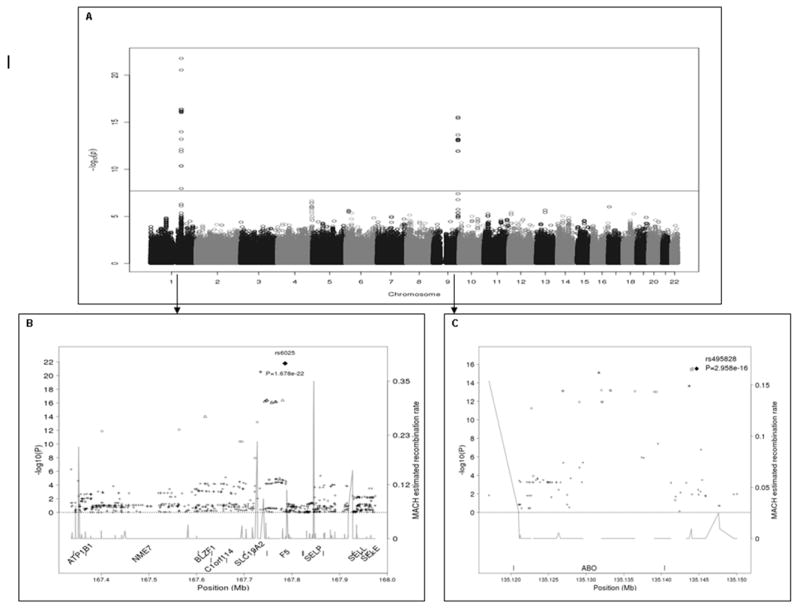
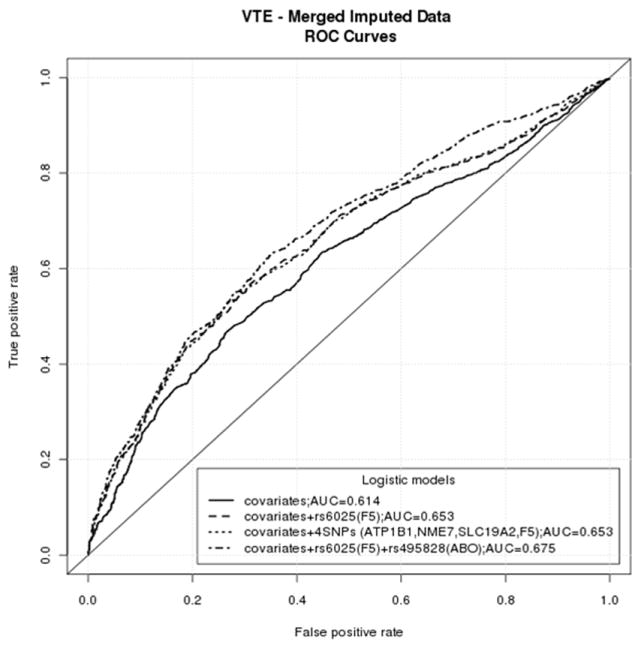
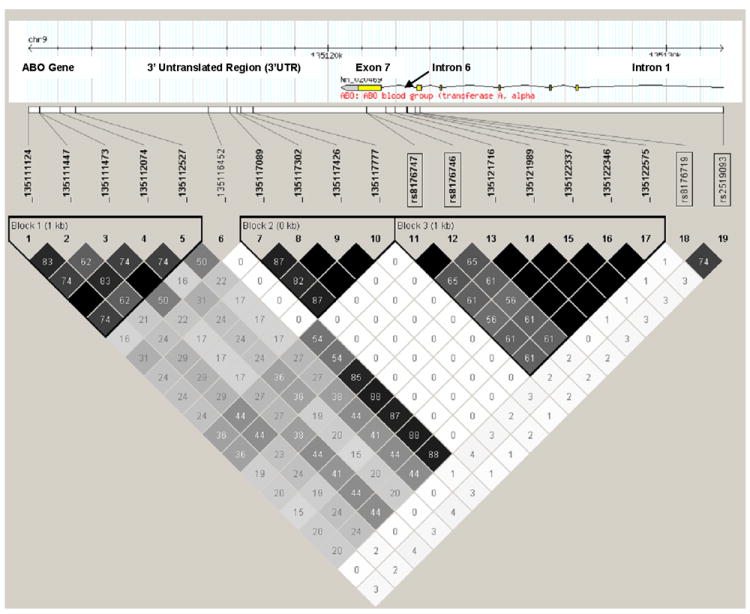
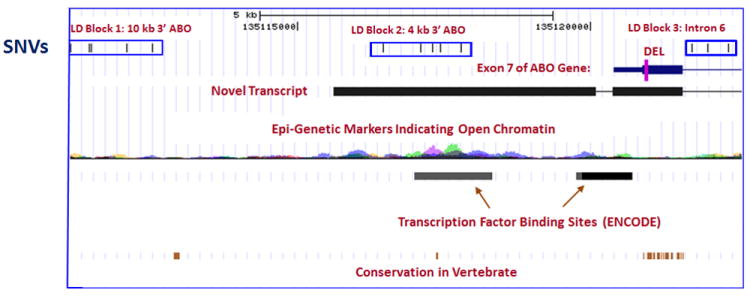
Results: Seven SNPs exceeded genome-wide significance (P<5×10(-8)): four on chromosome 1q24.2 (F5 rs6025 [factor V Leiden], BLZF1 rs7538157, NME7 rs16861990 and SLC19A2 rs2038024) and three on chromosome 9q34.2 (ABO rs2519093 [ABO intron 1], rs495828, rs8176719 [ABO blood type O allele]). The replication study confirmed a significant association of F5, NME7 and ABO with VTE. However, F5 was the main signal on 1q24.2 as only ABO SNPs remained significantly associated with VTE after adjusting for F5 rs6025. This 1q24.2 region was shown to be inherited as a haplotype block. ABO re-sequencing identified 15 novel single nucleotide variations (SNV) in ABO intron 6 and the ABO 3' UTR that were strongly associated with VTE (P<10(-4)) and belonged to three distinct linkage disequilibrium (LD) blocks; none were in LD with ABO rs8176719 or rs2519093. Our sample size provided 80% power to detect odds ratios (ORs)=2.0 and 1.51 for minor allele frequencies=0.05 and 0.5, respectively (α=1×10(-8); 1% VTE prevalence).
Conclusions: Apart from F5 rs6025, ABO rs8176719, rs2519093 and F2 rs1799963, additional common and high VTE-risk SNPs among whites are unlikely.
© 2012 International Society on Thrombosis and Haemostasis.
Conflict of interest statement
The authors have no conflict of interest to declare.
Figures
References
-
- Heit JA, Silverstein MD, Mohr DN, Petterson TM, O’Fallon WM, Melton LJI. Predictors of survival after deep vein thrombosis and pulmonary embolism: a population-based, cohort study. Arch Intern Med. 1999;159:445–53. - PubMed
-
- Souto JC, Almasy L, Borrell M, Blanco-Vaca F, Mateo J, Soria JM, Coll I, Felices R, Stone W, Fontcuberta J, Blangero J. Genetic susceptibility to thrombosis and its relationship to physiological risk factors: the GAIT study. Genetic Analysis of Idiopathic Thrombophilia. Am J Hum Genet. 2000;67:1452–9. - PMC - PubMed
-
- Heit JA, Phelps MA, Ward SA, Slusser JP, Petterson TM, De Andrade M. Familial segregation of venous thromboembolism. J Thromb Haemost. 2004;2:731–6. - PubMed
-
- Larsen TB, Sorensen HT, Skytthe A, Johnsen SP, Vaupel JW, Christensen K. Major genetic susceptibility for venous thromboembolism in men: a study of Danish twins. Epidemiology. 2003;14:328–32. - PubMed
Publication types
MeSH terms
Substances
Grants and funding
LinkOut - more resources
Full Text Sources
Other Literature Sources
Molecular Biology Databases
Research Materials
Miscellaneous
