


Review
doi: 10.3233/JAD-2012-129016.
Recent advances in imaging Alzheimer's disease
Affiliations
- PMID: 22672880
- PMCID: PMC4110110
- DOI: 10.3233/JAD-2012-129016
Item in Clipboard
Review
Recent advances in imaging Alzheimer's disease
J Alzheimers Dis.
2013.
Abstract
Advances in brain imaging technology in the past five years have contributed greatly to the understanding of Alzheimer's disease (AD). Here, we review recent research related to amyloid imaging, new methods for magnetic resonance imaging analyses, and statistical methods. We also review research that evaluates AD risk factors and brain imaging, in the context of AD prediction and progression. We selected a variety of illustrative studies, describing how they advanced the field and are leading AD research in promising new directions.
Figures
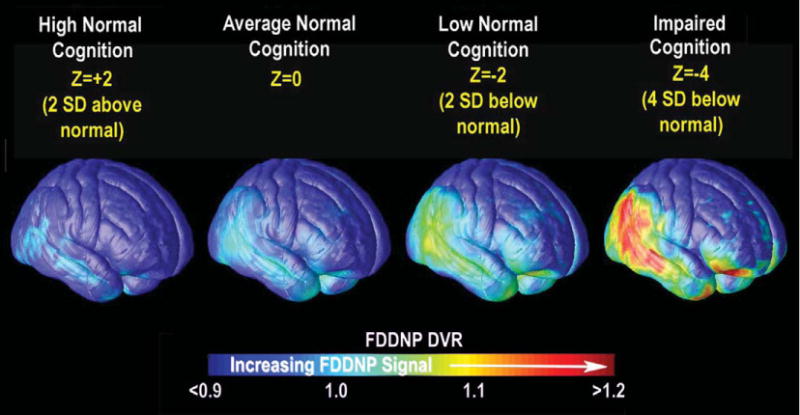
Spread of AD pathology mapped with PET. By regressing cortical measures of [18F]FDDNP signal (DVR) against cognitive scores in cross sectional data, we computed the pattern of pathology for subjects who were certain numbers of standard deviations above and below the norm for cognitive performance. Red indicates where greater predicted [18F]FDDNP signal was associated with poorer cognition based on a nonlinear spatially-varying model. Adapted from Braskie et al. [31] with permission from the authors and publishers.
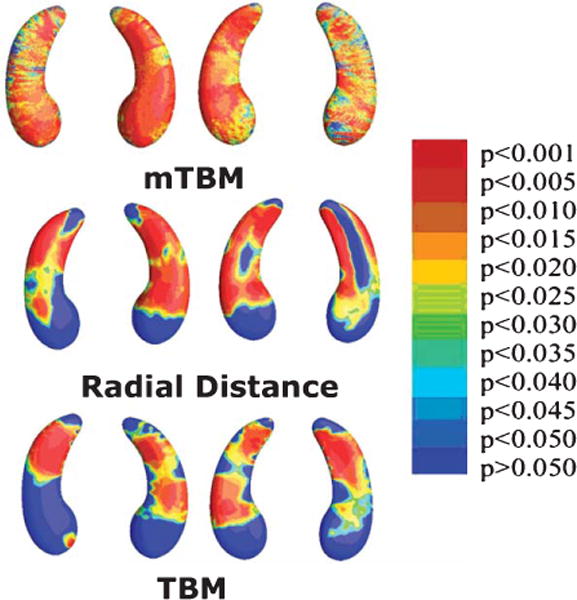
Mapping hippocampal correlates of tau proteins in the CSF. Here 3D maps show where alterations of hippocampal shape relate to levels of tau protein, measured in the CSF using lumbar puncture. To create these maps, we use a method called ‘multivariate tensor-based morphometry’ (mTBM; top row), as well as other methods to assess surface morphometry: radial distance maps (middle row) and standard TBM (bottom row). Non-blue colors show vertices with statistical differences, at the 0.05 level, uncorrected. Relationships were detected most sensitively with mTBM. Clearly, advanced mathematical methods can boost power to pick up associations between brain and CSF biomarkers, offering more detail than traditional measures of hippocampal volume. Adapted from Wang et al. [70] with permission of the authors and publishers.
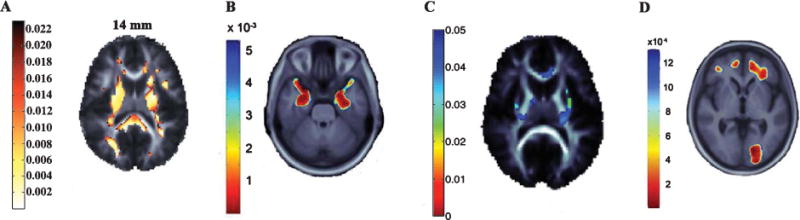
Commonly carried genes associated with brain atrophy on MRI and brain integrity on diffusion tensor imaging. Highlighted voxels in each panel represent p-values indicating the relationship between a genetic variant and a brain feature. A) The AD risk allele C at rs11136000 in the CLU gene was associated with lower diffusion tensor imaging fractional anisotropy (FA), a measure of white matter integrity, in healthy young adults [11]. B) rs10845840 in the GRIN2B glutamate receptor gene—important in learning and memory—is associated with medial temporal lobe structure in MCI patients [94]. C) The H63D polymorphism in the HFE gene was associated with white matter FA in healthy young adults [13]. D) Regional brain tissue volumes in healthy older adults was lower in those who carried the obesity-associated allele of rs3751812 in the FTO gene [99], in line with prior work showing higher brain atrophy in more obese people. Figures are adapted from the referenced publications with the permission of the authors and publishers.
References
-
- Hebert LE, Scherr PA, Bienias JL, Bennett DA, Evans DA. Alzheimer disease in the US population: Prevalence estimates using the 2000 census. Arch Neurol. 2003;60:1119–1122. - PubMed
-
- Bergem AL, Engedal K, Kringlen E. The role of heredity in late-onset Alzheimer disease and vascular dementia. A twin study. Arch Gen Psychiatry. 1997;54:264–270. - PubMed
-
- Gatz M, Pedersen NL, Berg S, Johansson B, Johansson K, Mortimer JA, Posner SF, Viitanen M, Winblad B, Ahlbom A. Heritability for Alzheimer’s disease: The study of dementia in Swedish twins. J Gerontol A Biol Sci Med Sci. 1997;52:M117–M125. - PubMed
-
- Gatz M, Reynolds CA, Fratiglioni L, Johansson B, Mortimer JA, Berg S, Fiske A, Pedersen NL. Role of genes and environments for explaining Alzheimer disease. Arch Gen Psychiatry. 2006;63:168–174. - PubMed
-
- Corder EH, Saunders AM, Strittmatter WJ, Schmechel DE, Gaskell PC, Small GW, Roses AD, Haines JL, Pericak-Vance MA. Gene dose of apolipoprotein E type 4 allele and the risk of Alzheimer’s disease in late onset families. Science. 1993;261:921–923. - PubMed
Publication types
MeSH terms
Substances
Grants and funding
LinkOut - more resources
Full Text Sources
Medical
Miscellaneous
