Parallel evolution of angiosperm colour signals: common evolutionary pressures linked to hymenopteran vision
- PMID: 22673351
- PMCID: PMC3396912
- DOI: 10.1098/rspb.2012.0827
Parallel evolution of angiosperm colour signals: common evolutionary pressures linked to hymenopteran vision
Abstract
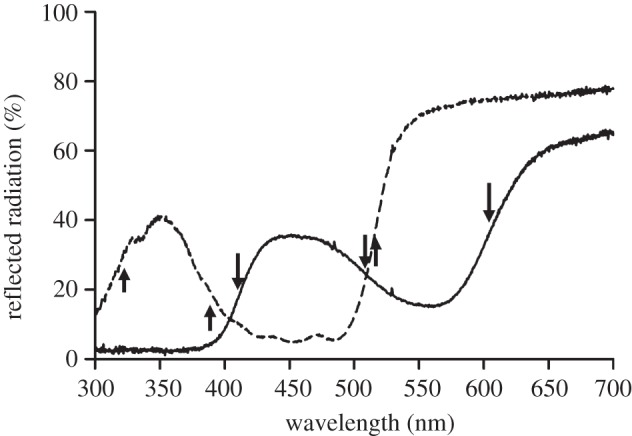
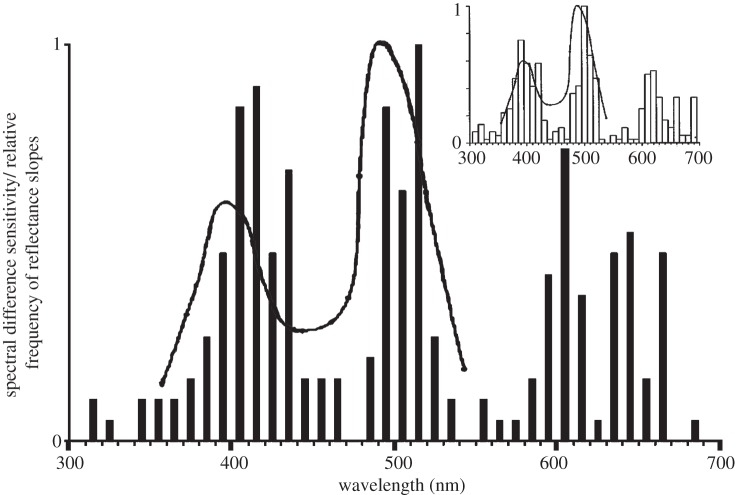
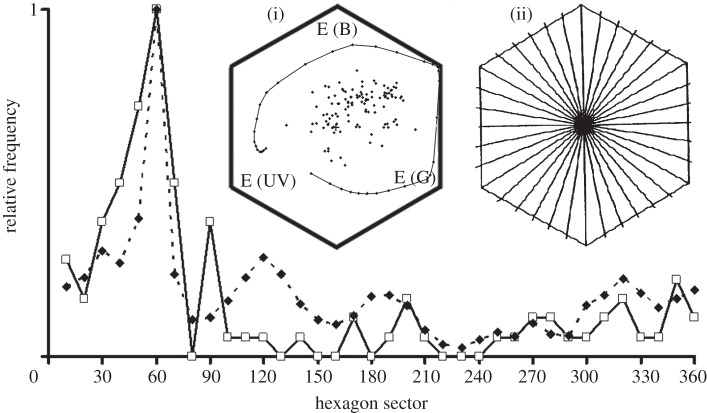
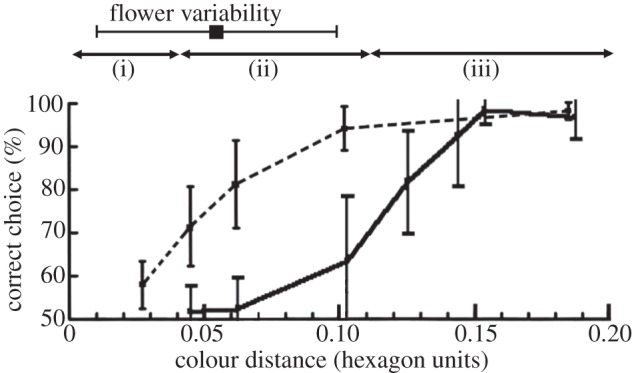
Flowering plants in Australia have been geographically isolated for more than 34 million years. In the Northern Hemisphere, previous work has revealed a close fit between the optimal discrimination capabilities of hymenopteran pollinators and the flower colours that have most frequently evolved. We collected spectral data from 111 Australian native flowers and tested signal appearance considering the colour discrimination capabilities of potentially important pollinators. The highest frequency of flower reflectance curves is consistent with data reported for the Northern Hemisphere. The subsequent mapping of Australian flower reflectances into a bee colour space reveals a very similar distribution of flower colour evolution to the Northern Hemisphere. Thus, flowering plants in Australia are likely to have independently evolved spectral signals that maximize colour discrimination by hymenoptera. Moreover, we found that the degree of variability in flower coloration for particular angiosperm species matched the range of reflectance colours that can only be discriminated by bees that have experienced differential conditioning. This observation suggests a requirement for plasticity in the nervous systems of pollinators to allow generalization of flowers of the same species while overcoming the possible presence of non-rewarding flower mimics.
Figures
Similar articles
-
Association between community assemblage of flower colours and pollinator fauna: a comparison between Japanese and New Zealand alpine plant communities.Ann Bot. 2019 Feb 15;123(3):533-541. doi: 10.1093/aob/mcy188. Ann Bot. 2019. PMID: 30380008 Free PMC article.
-
Australian native flower colours: Does nectar reward drive bee pollinator flower preferences?PLoS One. 2020 Jun 11;15(6):e0226469. doi: 10.1371/journal.pone.0226469. eCollection 2020. PLoS One. 2020. PMID: 32525873 Free PMC article.
-
Colour evolution within orchids depends on whether the pollinator is a bee or a fly.Plant Biol (Stuttg). 2019 Jul;21(4):745-752. doi: 10.1111/plb.12968. Epub 2019 Feb 14. Plant Biol (Stuttg). 2019. PMID: 30681768
-
Colourful cones: how did flower colour first evolve?J Exp Bot. 2020 Jan 23;71(3):759-767. doi: 10.1093/jxb/erz479. J Exp Bot. 2020. PMID: 31714579 Review.
-
The modelling of flower colour: spectral purity or colour contrast as biologically relevant descriptors of flower colour signals for bees depending upon the perceptual task.Plant Biol (Stuttg). 2024 Oct;26(6):896-910. doi: 10.1111/plb.13682. Epub 2024 Jul 3. Plant Biol (Stuttg). 2024. PMID: 38958933 Review.
Cited by
-
Evidence of bird dropping masquerading by a spider to avoid predators.Sci Rep. 2014 May 29;4:5058. doi: 10.1038/srep05058. Sci Rep. 2014. PMID: 24875182 Free PMC article.
-
Comparative psychophysics of Western honey bee (Apis mellifera) and stingless bee (Tetragonula carbonaria) colour purity and intensity perception.J Comp Physiol A Neuroethol Sens Neural Behav Physiol. 2022 Nov;208(5-6):641-652. doi: 10.1007/s00359-022-01581-y. Epub 2022 Oct 21. J Comp Physiol A Neuroethol Sens Neural Behav Physiol. 2022. PMID: 36269403 Free PMC article.
-
How biotic and abiotic effects colour flowers in a land Down Under.New Phytol. 2020 Dec;228(6):1701-1703. doi: 10.1111/nph.16856. Epub 2020 Aug 29. New Phytol. 2020. PMID: 32860725 Free PMC article.
-
Ancient insect vision tuned for flight among rocks and plants underpins natural flower colour diversity.Proc Biol Sci. 2023 Dec 20;290(2013):20232018. doi: 10.1098/rspb.2023.2018. Epub 2023 Dec 20. Proc Biol Sci. 2023. PMID: 38113941 Free PMC article.
-
Honeybees prefer novel insect-pollinated flower shapes over bird-pollinated flower shapes.Curr Zool. 2019 Aug;65(4):457-465. doi: 10.1093/cz/zoy095. Epub 2018 Dec 13. Curr Zool. 2019. PMID: 31413718 Free PMC article.
References
-
- Barth F. G. 1985. Insects and flowers: the biology of a partnership. Princeton, NJ: Princeton University Press
-
- Proctor M. Y., Yeo P. 1972. The pollination of flowers. New York, NY: Taplinger
-
- Waddington K. D. 1983. Foraging behavior of pollinators. In Pollination biology (ed. Real L.), pp. 213–239 New York, NY: Academic Press
-
- Reinhard J., Srinivasan M. V., Zhang S. W. 2004. Olfaction: scent-triggered navigation in honeybees. Nature 427, 411.10.1038/427411a (doi:10.1038/427411a) - DOI - DOI - PubMed
-
- Dyer A. G., Whitney H. M., Arnold S. E. J., Glover B. J., Chittka L. 2007. Mutations perturbing petal cell shape and anthocyanin synthesis influence bumblebee perception of Antirrhinum majus flower colour. Arthropod Plant Interact. 1, 45–5510.1007/s11829-007-9002-7 (doi:10.1007/s11829-007-9002-7) - DOI - DOI
Publication types
MeSH terms
Substances
LinkOut - more resources
Full Text Sources