


The emerging role of IL-17 in the pathogenesis of psoriasis: preclinical and clinical findings
- PMID: 22673731
- PMCID: PMC3568997
- DOI: 10.1038/jid.2012.194
The emerging role of IL-17 in the pathogenesis of psoriasis: preclinical and clinical findings
Abstract
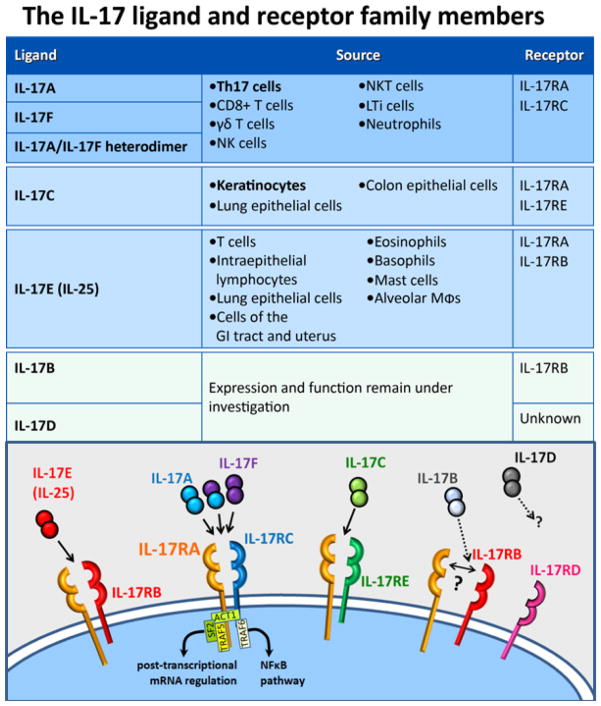
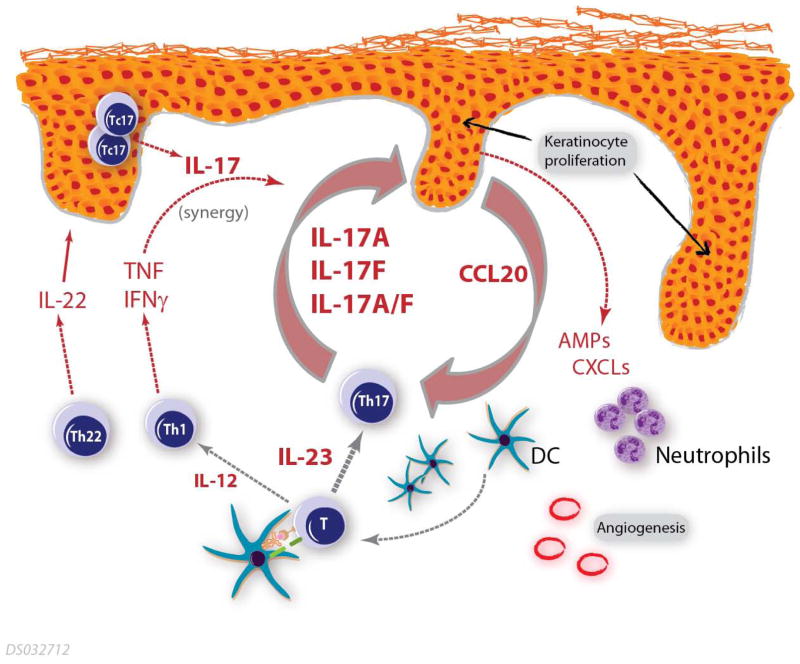
Although the histological changes seen in psoriasis have long been well characterized, the underlying cellular and molecular mechanisms have only begun to be elucidated over the past 20 years. Proinflammatory factors such as tumor necrosis factor (TNF)-α have a central role in psoriasis pathogenesis, and many T-helper 1 (Th1) cytokines and messenger RNAs are elevated in psoriatic lesions. IL-17A, IL-17F, and other Th17 cell-derived cytokines have been shown in murine models to induce features that mimic human psoriasis. This review focuses on the emerging biology of the IL-17 cytokine family in psoriasis, and on the molecular and genetic information gained from animal models and human clinical studies that confirm IL-17 as a crucial proinflammatory cytokine in psoriasis. Expression of IL-17A, IL-17C, and IL-17F is strikingly increased in psoriatic lesions, and successful therapy is associated with restoration of the expression of a wide range of genes (including effector molecules downstream of IL-17 such as cytokines, chemokines, and antimicrobial peptides) to near-normal levels. Therapeutic agents in development that target IL-17 are discussed, and an emerging model of the key role of IL-17 in the pathogenesis of psoriasis is presented.
Conflict of interest statement
D. Martin, C. Russell, J. Towne, G. Kricorian, and P. Klekotka are employees and stock holders of Amgen. J. Gudjonsson has been a consultant for Novartis. J. Krueger has been a consultant for Astellas, Amgen, Biogen, Boehringer, Centocor (Janssen), Celgene, GSK, Lilly, Merck, Novartis, and Pfizer; has been an investigator for Boehringer, Centocor (Janssen), Lilly, Merck, Novartis, and Pfizer; has received honoraria from Astellas, Biogen, Boehringer, Centocor (Janssen), Celgene, Lilly, Merck, and Pfizer; and has received research grants from Amgen, Boehringer, Centocor (Janssen), Lilly, Merck, and Pfizer.
Figures
References
-
- Acosta-Rodriguez EV, Napolitani G, Lanzavecchia A, Sallusto F. Interleukins 1beta and 6 but not transforming growth factor-beta are essential for the differentiation of interleukin 17-producing human T helper cells. Nat Immunol. 2007;8:942–949. - PubMed
-
- Austin LM, Ozawa M, Kikuchi T, Walters IB, Krueger JG. The majority of epidermal T cells in Psoriasis vulgaris lesions can produce type 1 cytokines, interferon-gamma, interleukin-2, and tumor necrosis factor-alpha, defining TC1 (cytotoxic T lymphocyte) and TH1 effector populations: a type 1 differentiation bias is also measured in circulating blood T cells in psoriatic patients. J Invest Dermatol. 1999;113:752–759. - PubMed
-
- Australia and New Zealand Multiple Sclerosis Genetics Consortium. Genome-wide association study identifies new multiple sclerosis susceptibility loci on chromosomes 12 and 20. Nat Genet. 2009;41:824–828. - PubMed
Publication types
MeSH terms
Substances
Grants and funding
LinkOut - more resources
Full Text Sources
Other Literature Sources
Medical
Miscellaneous
