


Review
doi: 10.1007/978-94-007-4186-7_5.
Adherens junction assembly
Affiliations
- PMID: 22674069
- PMCID: PMC6002756
- DOI: 10.1007/978-94-007-4186-7_5
Item in Clipboard
Review
Adherens junction assembly
Subcell Biochem.
2012.
Abstract
Classical cadherins are a family of transmembrane proteins that mediate cell-cell adhesion at adherens junctions. A complex chain of cis- and trans- interactions between cadherin ectodomains establishes a cadherin adhesive cluster. A principal adhesive interaction in such clusters is an exchange of β strands between the first extracellular cadherin domains (EC1). The structure of cadherin adhesive clusters can be modified by other adherens junction proteins including additional transmembrane proteins, nectins and various intracellular proteins that directly or indirectly interact with the intracellular cadherin region. These interactions determine the dynamics and stability of cadherin adhesive structures.
Figures
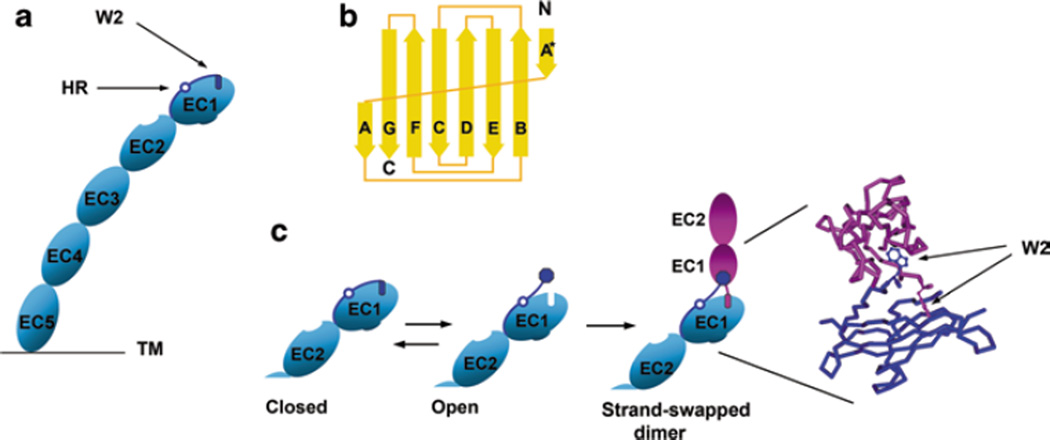
Cadherin dimerization using the strand-swap interface. a Schematic representation of the cadherin ectodomain. It consists of five homological cadherin-like domains (EC1–EC5). The A* and A strands of EC1 are dark blue. They are separated by the hinge region (open circle, HR). The most important residue of the A* strand is Trp2 (dark blue rectangle, W2). The cadherin molecule shown is in the closed conformation—its Trp2 residue is inserted into its own core. b Topology diagram of the classical cadherin EC1 domain. Note that the domain consists of seven β strands. The first strand is broken into two parts, strands A* and A. Strand A* forms a contact with strand B. This interaction can be intra- or inter-molecular. c Schematic representation of the strand-swapping process. Only EC1 and EC2 domains are shown. In the presence of calcium ions, the closed cadherin conformation is unstable and is in equilibrium with the open conformation in which Trp2 is exposed to solvent. Two cadherin molecules in open conformation produce a strand-swap cadherin dimer. The structural model of the strand-swapped dimer (only EC1 domains of both molecules are shown) is on the right. Note that the W2 residues of both molecules in the dimer are in nearly perpendicular planes
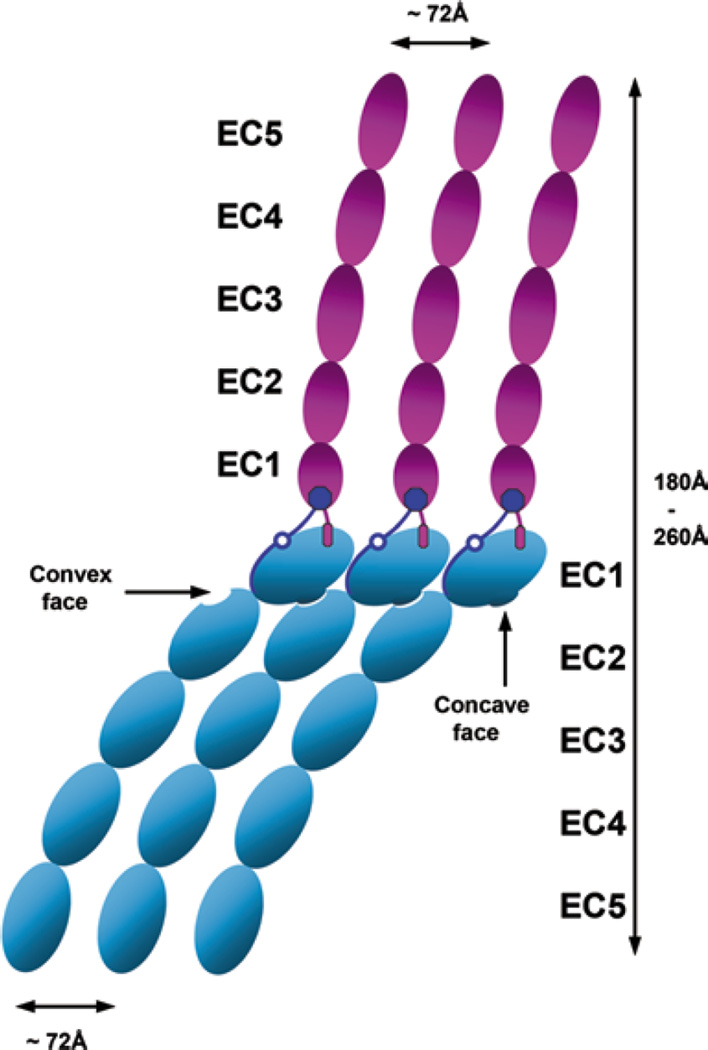
Schematic representation of the cadherin adhesive cluster formed by cis and trans intercadherin interactions. Blue molecules are organized in a linear array through cis interactions. The periodicity of the array is 72 Å. Each molecule in the array is engaged in strand-swapped trans interactions with magenta molecules, which belong to the opposite cell. Each of these molecules is part of its own array. Note that the opposing arrays are at right angles
References
-
- Adams CL, Nelson WJ. Cytomechanics of cadherin-mediated cell-cell adhesion. Curr Opin Cell Biol. 1998;10:572–577. - PubMed
-
- Al-Amoudi A, Díez DC, Betts MJ, Frangakis AS. The molecular architecture of cadherins in native epidermal desmosomes. Nature. 2007;450:832–837. - PubMed
-
- Asakura T, Nakanishi H, Sakisaka T, Takahashi K, Mandai K, Nishimura M, Sasaki T, Takai Y. Similar and differential behaviour between the nectin-afadin-ponsin and cadherin-catenin systems during the formation and disruption of the polarized junctional alignment in epithelial cells. Genes Cells. 1999;4:573–581. - PubMed
-
- Bakolitsa C, de Pereda JM, Bagshaw CR, Critchley DR, Liddington RC. Crystal structure of the vinculin tail suggests a pathway for activation. Cell. 1999;99:603–613. - PubMed
-
- Boggon TJ, Murray J, Chappuis-Flament S, Wong E, Gumbiner BM, Shapiro L. C-cadherin ectodomain structure and implications for cell adhesion mechanisms. Science. 2002;296:1308–1313. - PubMed
Publication types
MeSH terms
Substances
Grants and funding
LinkOut - more resources
Full Text Sources
