


Sleep spindles predict neural and behavioral changes in motor sequence consolidation
- PMID: 22674673
- PMCID: PMC6870513
- DOI: 10.1002/hbm.22116
Sleep spindles predict neural and behavioral changes in motor sequence consolidation
Abstract
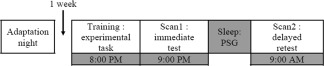
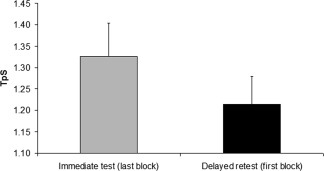
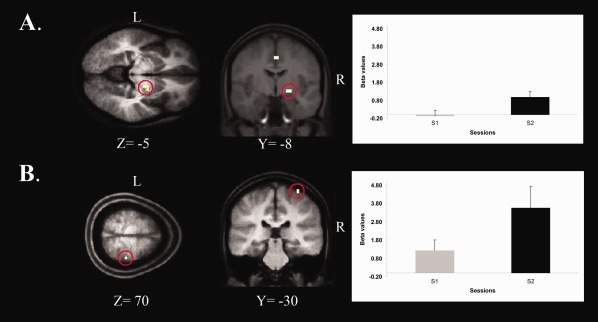
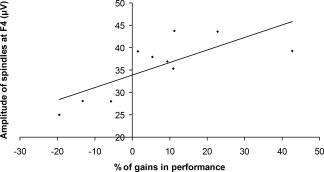
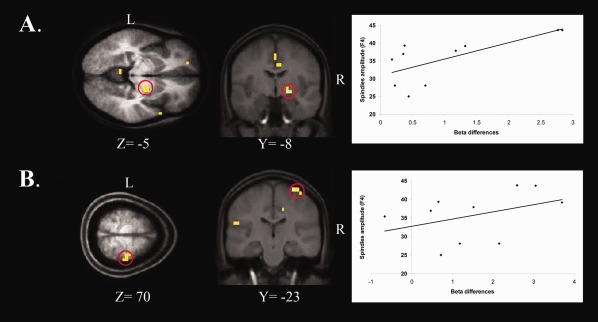
The purpose of this study was to investigate the predictive function of sleep spindles in motor sequence consolidation. BOLD responses were acquired in 10 young healthy subjects who were trained on an explicitly known 5-item sequence using their left nondominant hand, scanned at 9:00 pm while performing that same task and then were retested and scanned 12 h later after a night of sleep during which polysomnographic measures were recorded. An automatic algorithm was used to detect sleep spindles and to quantify their characteristics (i.e., density, amplitude, and duration). Analyses revealed significant positive correlations between gains in performance and the amplitude of spindles. Moreover, significant increases in BOLD signal were observed in several motor-related areas, most of which were localized in the right hemisphere, particularly in the right cortico-striatal system. Such increases in BOLD signal also correlated positively with the amplitude of spindles at several derivations. Taken together, our results show that sleep spindles predict neural and behavioral changes in overnight motor sequence consolidation.
Keywords: EEG; cortico-striatal system; fMRI; motor sequence consolidation; sleep spindles.
Copyright © 2012 Wiley Periodicals, Inc.
Figures
References
-
- Albouy G, Maquet P (2008): Hippocampus, striatum and sequences. Med Sci (Paris) 24:921–922. - PubMed
-
- Albouy G, Sterpenich V, Balteau E, Vandewalle G, Desseilles M, Dang‐Vu T, Darsaud A, Ruby P, Luppi PH, Degueldre C, et al. (2008): Both the hippocampus and striatum are involved in consolidation of motor sequence memory. Neuron 58:261–272. - PubMed
-
- Barakat M, Doyon J, Debas K, Vandewalle G, Morin A, Poirier G, Martin N, Lafortune M, Karni A, Ungerleider LG, et al. (2010): Fast and slow spindle involvement in the consolidation of a new motor sequence. Behav Brain Res 217:117–121. - PubMed
-
- Beck A, Steer R (1987): The Beck Depression Inventory. Psychological Corporation.
