. 2012 May;109(19):352-8.
doi: 10.3238/arztebl.2012.0352. Epub 2012 May 11.

Current standards in the treatment of chronic hepatitis C

Affiliations

Current standards in the treatment of chronic hepatitis C

Wolf Peter Hofmann et al. Dtsch Arztebl Int. 2012 May.

Abstract

Background: In Germany, 400 000 to 500 000 people are chronically infected with the hepatitis C virus (HCV), 70% to 80% of them with HCV genotype 1. Combined treatment with peginterferon-alfa and ribavirin leads to a sustained virologic response (SVR) in 40% to 50% of patients with genotype 1 and 70% to 80% of patients with genotypes 2 and 3. The HCV protease inhibitors boceprevir and telaprevir were approved for clinical use in Germany in 2011.

Methods: Selective literature review.

Results: Treatment with peginterferon and ribavirin is recommended for a variable length of time depending on the HCV genotype (24 to 72 weeks for genotype 1, 16 to 48 weeks for genotypes 2 and 3), the baseline HCV-RNA concentration (greater or less than 600 000 to 800 000 IU/mL), and the decline in HCV-RNA concentration after 4 and 12 weeks of treatment. Either boceprevir or telaprevir is given in addition to peginterferon and ribavirin. In the approval studies, these triple combinations were shown to yield higher SVR rates than dual treatment for genotype 1 (66% to 75% versus 37% to 44%). If there is a favorable early decline in HCV-RNA, the treatment can be shortened to 24 to 28 weeks in 44% to 65% of patients with genotype 1. The SVR rates in genotype 1 patients who failed previous dual therapy were 69% to 88% for prior relapsers, 52% to 59% for partial responders, and 33% for null responders. Triple combination therapy is associated with new adverse events.

Conclusion: Individualized treatment durations are recommended for the treatment of chronic hepatitis C with peginterferon and ribavirin. Triple therapy in combination with either boceprevir or telaprevir leads to a higher rate of SVR both in previously untreated genotype 1 patients and in those who have failed prior antiviral treatment.\


Figures
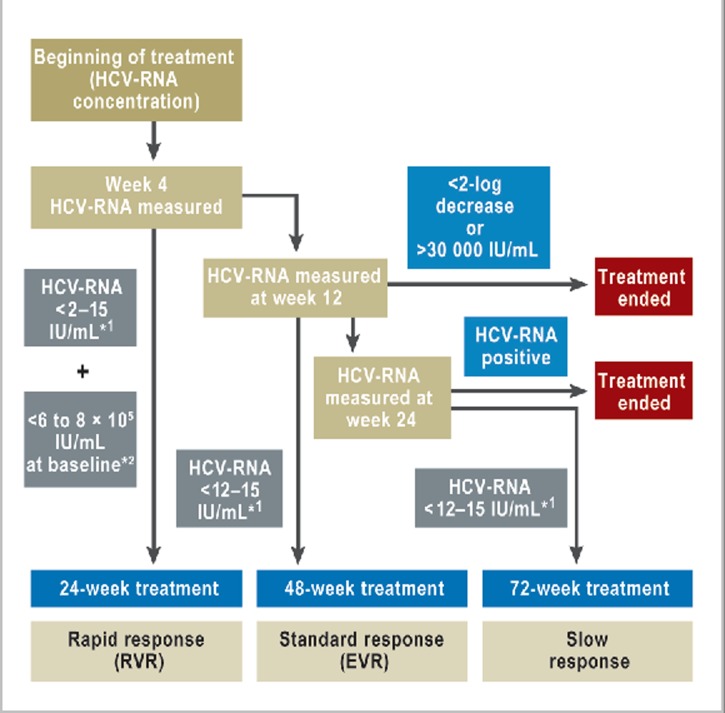
Figure 1
Figure 1
Treatment procedure for dual combination therapy in treatment-naive patients infected with HCV genotype 1 (or 4–6) (1) *1Highly sensitive assay reveals no evidence of HCV-RNA. *2Maximum baseline viral load in studies examined: 600 000 IU/mL for peginterferon alfa-2b, 800 000 IU/mL for peginterferon alfa-2a. Treatment duration not reduced for any patients with no favorable predictive patient-related factors. RVR: rapid virologic response; EVR: early virologic response
Figure 2
Figure 2
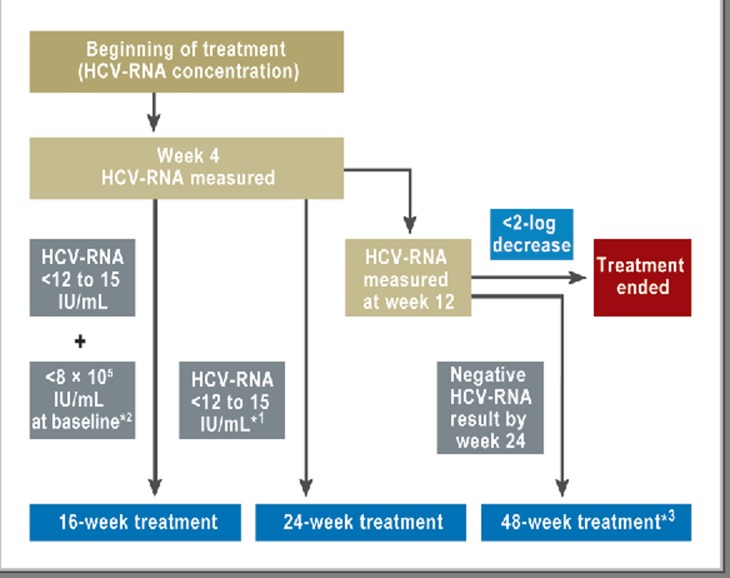
Treatment procedure for dual combination therapy in treatment-naive patients infected with HCV genotype 2 or 3 (1) *1Highly sensitive assay reveals no evidence of HCV-RNA *2Treatment duration not reduced for patients with no favorable predictive patient-related factors (see text) *348-week treatment duration not yet sufficiently well-known, currently being examined in prospective studies
Figure 3
Figure 3
Currently recommended treatment procedure for triple combination therapy with a) boceprevir or b) telaprevir in treatment-naive and previously treated patients infected with HCV genotype 1 (15) PegIFN: pegylated interferon; RBV: ribavirin; BOC: boceprevir; TVR: telaprevir; LI: lead-in lasting 4 weeks and involving peginterferon alfa-2b and ribavirin; -: HCV-RNA <10 IU/mL; +: HCV-RNA >10 IU/mL; RVR: rapid virologic response (no evidence of HCV-RNA in weeks 4 to 12 [telaprevir] or weeks 8 to 24 [boceprevir]); stars indicate that boceprevir or telaprevir treatment must be ended (see text for details)
eFigure 1
eFigure 1
Sustained virologic response rates in the SPRINT-2 study for treatment-naive patients with HCV genotype 1 (17) Lead-in (LI) involved peginterferon alfa-2b and ribavirin for 4 weeks before all treatment arms. Patients in group 1 received response-guided therapy (RGT) consisting of boceprevir and peginterferon/ribavirin for 24 weeks, followed by 20 weeks of peginterferon/ribavirin if there was evidence of HCV-RNA during weeks 8 to 24 of treatment ([LI] BOC + pegIFN/RBV for 24 weeks, pegIFN/RBV for 20 weeks). Group 2 received boceprevir and peginterferon/ribavirin for 44 weeks ([LI] BOC + pegIFN/RBV for 44 weeks). Patients in the control arm received peginterferon/ribavirin for 48 weeks (pegIFN/RBV for 48 weeks)
eFigure 2
eFigure 2
Sustained virologic response rates in the ADVANCE study for treatment-naive patients with HCV genotype 1 (19) Patients received telaprevir combined with peginterferon alfa-2b/ribavirin for 8 or 12 weeks, followed by dual peginterferon/ribavirin treatment for a total of 24 to 48 weeks (TVR for 12 weeks + pegIFN/RBV for 24 or 48 weeks, or TVR for 8 weeks + pegIFN/RBV for 24 or 48 weeks). Treatment was shortened to 24 weeks if rapid virologic response (no evidence of HCV-RNA at weeks 4 and 12) was achieved. Patients in the control group received peginterferon/ribavirin for 48 weeks (pegIFN/RBV for 48 weeks)
eFigure 3
eFigure 3
Sustained virologic response rates in the RESPOND-2 study for previously treated patients with HCV genotype 1 (21) Lead-in (LI) involved peginterferon alfa-2b/ribavirin for 4 weeks before all treatment arms. Patients in the control arm received peginterferon alfa-2b/ribavirin for 48 weeks (pegIFN/RBV for 48 weeks). Patients in group 1 received response-guided therapy (RGT) consisting of boceprevir and peginterferon/ribavirin for 32 weeks, followed by 12 weeks of peginterferon/ribavirin dual treatment if there was evidence of HCV-RNA at week 8 or subsequent visits ([LI] BOC + pegIFN/RBV for 32 weeks ± pegIFN/RBV for 12 weeks [RGT]). Patients in group 2 received boceprevir and peginterferon/ribavirin for 44 weeks ([LI] BOC + pegIFN/RBV for 44 weeks). Relapsers were patients who had shown a repeat occurrence of HCV-RNA after the end of previous treatment. Partial responders were patients who had shown a decrease in HCV-RNA of at least 2 log IU/mL during previous treatment but had never tested negative for HCV-RNA
eFigure 4
eFigure 4
Sustained virologic response rates in the REALIZE study for previously treated patients with HCV genotype 1 (22) Lead-in (LI) involved peginterferon alfa-2a/ribavirin for 4 weeks. Patients received telaprevir triple therapy for 12 weeks, followed by peginterferon/ribavirin dual treatment for 36 weeks (TVR for 12 weeks + pegIFN/RBV for 48 weeks), or LI for 4 weeks followed by 12 weeks of triple therapy and then 32 weeks of peginterferon/ribavirin ([LI] TVR for 12 weeks + pegIFN/RBV for 44 weeks), or peginterferon/ribavirin in the control arm for 48 weeks (pegIFN/RBV for 48 weeks). Relapsers were patients who had shown a repeat occurrence of HCV-RNA after the end of previous treatment. Partial responders were patients who had shown a decrease in HCV-RNA of at least 2 log IU/mL during previous treatment but had never tested negative for HCV-RNA. Null responders were those who had achieved a decrease in HCV-RNA of less than 2 log IU/mL at week 12 of previous treatment

Comment in

  • Early assessment of benefits.
    Kaiser T, Lange S, Wieseler B, Windeler J. Kaiser T, et al. Dtsch Arztebl Int. 2012 Nov;109(44):755; author reply 755-6. doi: 10.3238/arztebl.2012.0755a. Epub 2012 Nov 2. Dtsch Arztebl Int. 2012. PMID: 23189113 Free PMC article. No abstract available.

References

    1. Sarrazin C, Berg T, Ross RS, et al. [Prophylaxis, diagnosis and therapy of hepatitis C virus (HCV) infection: the German guidelines on the management of HCV infection] Z Gastroenterol. 2010;48:289–351. - PubMed
    1. Seeff LB. Natural history of chronic hepatitis C. Hepatology. 2002;36:35–46. - PubMed
    1. Fattovich G, Stroffolini T, Zagni I, Donato F. Hepatocellular carcinoma in cirrhosis: incidence and risk factors. Gastroenterology. 2004;127:35–50. - PubMed
    1. Manns MP, McHutchison JG, Gordon SC, et al. Peginterferon alfa-2b plus ribavirin compared with interferon alfa-2b plus ribavirin for initial treatment of chronic hepatitis C: a randomised trial. Lancet. 2001;358:958–965. - PubMed
    1. Zeuzem S, Hultcrantz R, Bourliere M, et al. Peginterferon alfa-2b plus ribavirin for treatment of chronic hepatitis C in previously untreated patients infected with HCV genotypes 2 or 3. J Hepatol. 2004;40:993–999. - PubMed

MeSH terms

Substances