


Therapeutic validity and effectiveness of preoperative exercise on functional recovery after joint replacement: a systematic review and meta-analysis
- PMID: 22675429
- PMCID: PMC3364996
- DOI: 10.1371/journal.pone.0038031
Therapeutic validity and effectiveness of preoperative exercise on functional recovery after joint replacement: a systematic review and meta-analysis
Abstract
Background: Our aim was to develop a rating scale to assess the therapeutic validity of therapeutic exercise programmes. By use of this rating scale we investigated the therapeutic validity of therapeutic exercise in patients awaiting primary total joint replacement (TJR). Finally, we studied the association between therapeutic validity of preoperative therapeutic exercise and its effectiveness in terms of postoperative functional recovery.
Methods: (Quasi) randomised clinical trials on preoperative therapeutic exercise in adults awaiting TJR on postoperative recovery of functioning within three months after surgery were identified through database and reference screening. Two reviewers extracted data and assessed the risk of bias and therapeutic validity. Therapeutic validity of the interventions was assessed with a nine-itemed, expert-based rating scale (scores range from 0 to 9; score ≥6 reflecting therapeutic validity), developed in a four-round Delphi study. Effects were pooled using a random-effects model and meta-regression was used to study the influence of therapeutic validity.
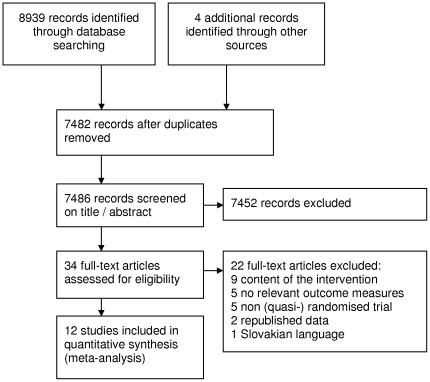
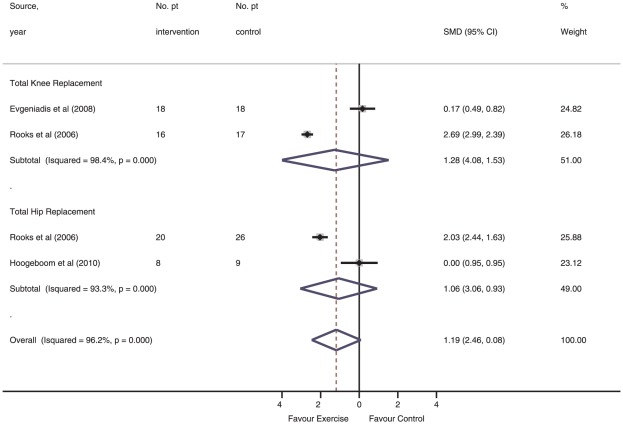
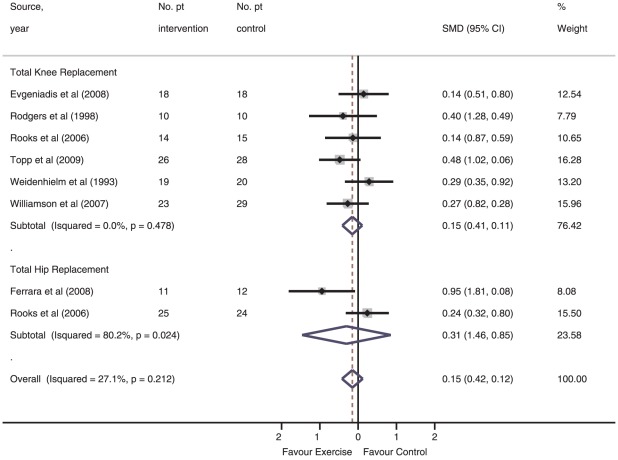
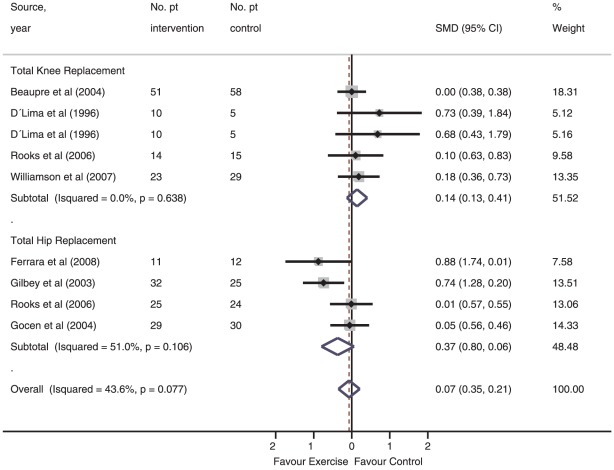
Results: Of the 7,492 articles retrieved, 12 studies (737 patients) were included. None of the included studies demonstrated therapeutic validity and two demonstrated low risk of bias. Therapeutic exercise was not associated with 1) observed functional recovery during the hospital stay (Standardised Mean Difference [SMD]: -1.19; 95%-confidence interval [CI], -2.46 to 0.08); 2) observed recovery within three months of surgery (SMD: -0.15; 95%-CI, -0.42 to 0.12); and 3) self-reported recovery within three months of surgery (SMD -0.07; 95%-CI, -0.35 to 0.21) compared with control participants. Meta-regression showed no statistically significant relationship between therapeutic validity and pooled-effects.
Conclusion: Preoperative therapeutic exercise for TJR did not demonstrate beneficial effects on postoperative functional recovery. However, poor therapeutic validity of the therapeutic exercise programmes may have hampered potentially beneficial effects, since none of the studies met the predetermined quality criteria. Future review studies on therapeutic exercise should address therapeutic validity.
Conflict of interest statement
Figures
References
-
- Ewald FC, Wright RJ, Poss R, Thomas WH, Mason MD, et al. Kinematic total knee arthroplasty: a 10- to 14-year prospective follow-up review. J Arthroplasty. 1999;14:473–480. - PubMed
-
- Anderson JG, Wixson RL, Tsai D, Stulberg SD, Chang RW. Functional outcome and patient satisfaction in total knee patients over the age of 75. J Arthroplasty. 1996;11:831–840. - PubMed
-
- Hawker GA. Who, when, and why total joint replacement surgery? The patient's perspective. Curr Opin Rheumatol. 2006;18:526–530. - PubMed
-
- Wylde V, Dieppe P, Hewlett S, Learmonth ID. Total knee replacement: is it really an effective procedure for all? Knee. 2007;14:417–423. - PubMed
-
- Ditmyer MM, Topp R, Pifer M. Prehabilitation in preparation for orthopaedic surgery. Orthop Nurs. 2002;21:43–51. - PubMed
Publication types
MeSH terms
LinkOut - more resources
Full Text Sources
Medical
Miscellaneous
