. 2012;7(5):e38359.
doi: 10.1371/journal.pone.0038359. Epub 2012 May 31.

Performance of repetitive tasks induces decreased grip strength and increased fibrogenic proteins in skeletal muscle: role of force and inflammation

Affiliations

Performance of repetitive tasks induces decreased grip strength and increased fibrogenic proteins in skeletal muscle: role of force and inflammation

Samir M Abdelmagid et al. PLoS One. 2012.

Abstract

Background: This study elucidates exposure-response relationships between performance of repetitive tasks, grip strength declines, and fibrogenic-related protein changes in muscles, and their link to inflammation. Specifically, we examined forearm flexor digitorum muscles for changes in connective tissue growth factor (CTGF; a matrix protein associated with fibrosis), collagen type I (Col1; a matrix component), and transforming growth factor beta 1 (TGFB1; an upstream modulator of CTGF and collagen), in rats performing one of two repetitive tasks, with or without anti-inflammatory drugs.

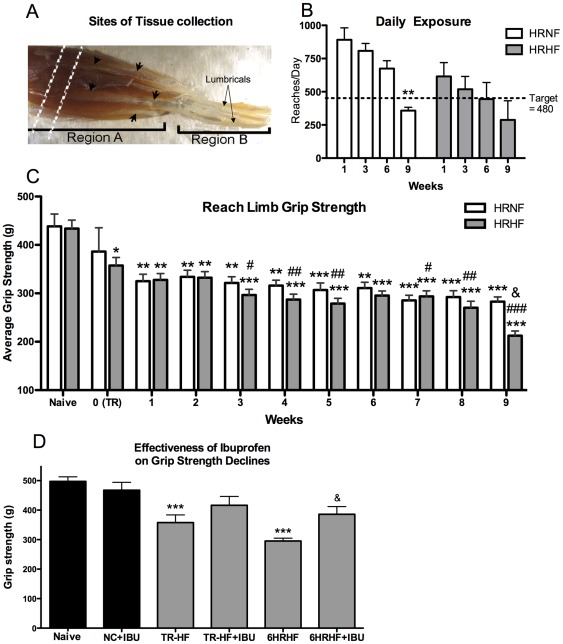
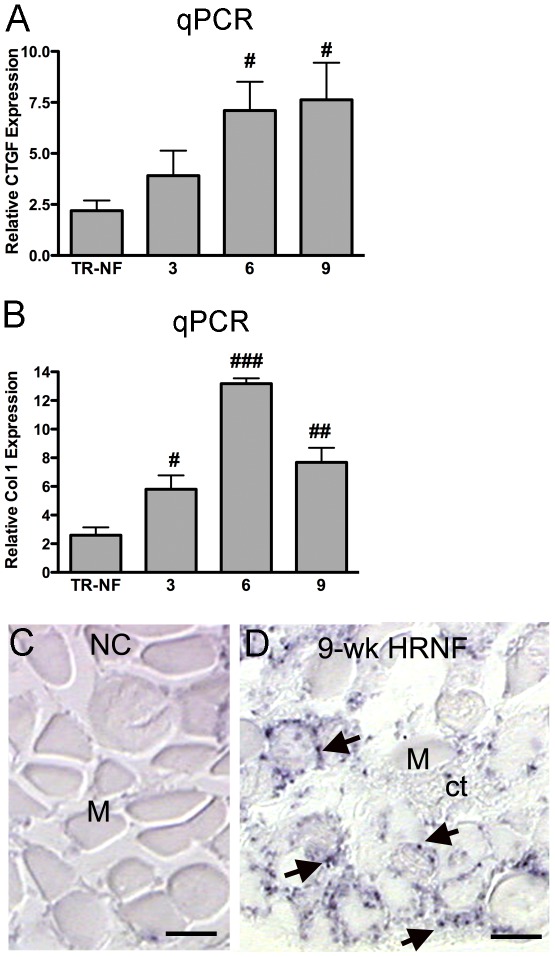
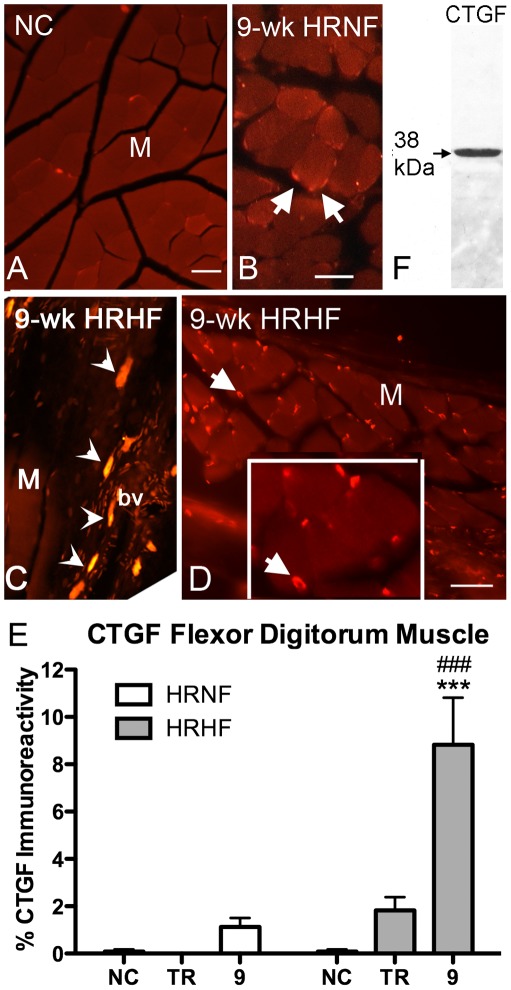
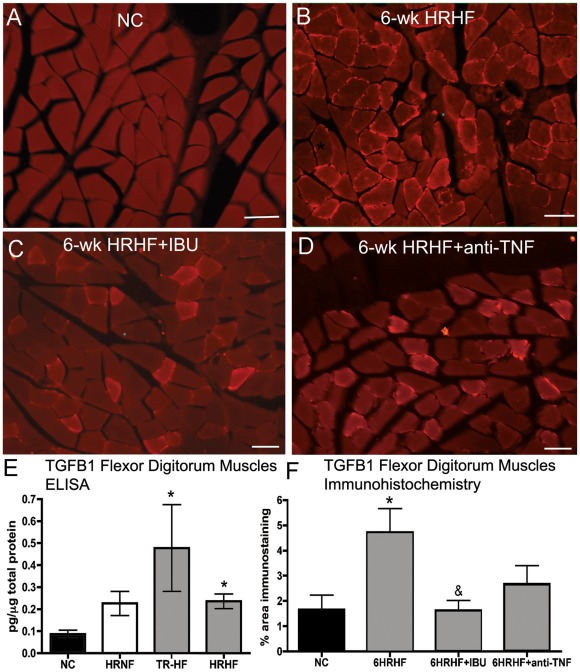
Methodology/results: To examine the roles of force versus repetition, rats performed either a high repetition negligible force food retrieval task (HRNF), or a high repetition high force handle-pulling task (HRHF), for up to 9 weeks, with results compared to trained only (TR-NF or TR-HF) and normal control rats. Grip strength declined with both tasks, with the greatest declines in 9-week HRHF rats. Quantitative PCR (qPCR) analyses of HRNF muscles showed increased expression of Col1 in weeks 3-9, and CTGF in weeks 6 and 9. Immunohistochemistry confirmed PCR results, and also showed greater increases of CTGF and collagen matrix in 9-week HRHF rats than 9-week HRNF rats. ELISA, and immunohistochemistry revealed greater increases of TGFB1 in TR-HF and 6-week HRHF, compared to 6-week HRNF rats. To examine the role of inflammation, results from 6-week HRHF rats were compared to rats receiving ibuprofen or anti-TNF-α treatment in HRHF weeks 4-6. Both treatments attenuated HRHF-induced increases in CTGF and fibrosis by 6 weeks of task performance. Ibuprofen attenuated TGFB1 increases and grip strength declines, matching our prior results with anti-TNFα.

Conclusions/significance: Performance of highly repetitive tasks was associated with force-dependent declines in grip strength and increased fibrogenic-related proteins in flexor digitorum muscles. These changes were attenuated, at least short-term, by anti-inflammatory treatments.


Conflict of interest statement

Competing Interests: The authors have declared that no competing interests exist.

Figures

Figure 1
Figure 1. Forelimb tissues examined, daily exposure, and grip strength declines.
(A) Flexor digitorum muscles were collected from region A of the flexor digitorum muscles, a region containing primarily muscle but also proximal tendon slips (short arrows). The vertical dashed lines indicate the region of muscle cut into cross-section for histological analysis. The remaining part of region A and region B were sectioned together longitudinally. Lumbricals are located in region B (long arrows in the palm). Region A was used for PCR, ELISA and western blot analyses in separate animals than those for histology. (B) Daily exposure (mean reaches/day) decreased similarly in both groups with continued task performance, and dropped below the target of 480 reaches/day (indicated by dotted line) in each by week 9, although significantly lower only in week 9 HRNF rats compared to their week 1 level. **p<0.01 compared to same group week 1. (C) Average grip strength decreased in both groups with continued task performance, with the greatest declines in HRHF week 9. *p<0.05, **p<0.01, ***p<0.001, compared to naïve; #p<0.05, ##p<0.01, ###p<0.001 compared to HRHF week 0 (end of training period (TR) for TR-HF rats); &p<0.05 compared to 9-week HRNF rats. (D) Grip strength declines in the preferred reach limb of trained (TR-HF) and 6-week HRHF rats were attenuated after two weeks of ibuprofen treatment in trained rats (TR-HF+IBU) and HRHF rats (6HRHF+IBU). ***p<0.001 compared to NC; &p<0.05 compared to untreated 6-week HRHF rats.
Figure 2
Figure 2. Examination of expression levels of connective tissue growth factor (CTGF) and collagen 1 (Col1) with HRNF task using quantitative PCR (qPCR).
RNA was extracted from region A of the flexor digitorum muscles of normal controls (NC), trained-only rats (TR-NF), and HRNF rats that had performed the task for 3, 6 or 9 weeks. (A,B) Quantitative real-time PCR (qPCR) showing CTGF and Col1 mRNA expression levels, relative to GAPDH. qPCR data represents average of n = 3/gp. #p<0.05, ##p<0.01, ###p<0.001, compared to TR-NF. (C) NC muscle (M) cut in cross section showed no expression of CTGF mRNA using in situ hybridization. (D) 9-week HRNF muscle showed increased CTGF mRNA using in situ hybridization in small cells around myofibers (M) and in surrounding connective tissue (ct). Similar in situ hybridization results were replicated in n = 3/gp. Scale bars = 50 µm.
Figure 3
Figure 3. Connective tissue growth factor immunostaining increased more in HRHF muscles than in HRNF.
Cross-sections (panels A,B,D), and longitudinal sections (panel C) from region A of flexor digitorum muscles (M) are shown. (A) NC muscle showing only low levels of CTGF immunostaining. (B) 9-week HRNF muscle showing a small increase in CTGF-immunostained cells at peripheral edges of myofibers (arrows). (C) 9-week HRHF muscle showing increased CTGF in larger mast-like cells (arrowheads) near a blood vessel (bv). (D) 9-week HRHF muscle also contained smaller CTGF-immunostained cells (arrows) at the periphery of myofibers. Inset shows higher power of the CTGF-immunostained cells at edges of myofibers. (E) Quantification of CTGF immunostaining in flexor digitorum muscles. (F) A lane from a representative Western blot showing that the CTGF antibody used for the immunohistochemistry detects a band at 38 kDa in the flexor digitorum muscles, the expected molecular weight of CTGF. The whitish band below the 38 kDa band indicates the site of GAPDH. The gel was first stained with anti-GAPDH and then stripped prior to staining with anti-CTGF. ***p<0.001 and ###p<0.001, compared to NC and TR-HF, respectively (n = 3–10/gp). Scale bars = 50 µm.
Figure 4
Figure 4. Collagen immunostaining increases in flexor digitorum muscles with HRNF and HRHF tasks.
Cross-sections (panels A,B,D), and longitudinal sections (panel C) from region A of flexor digitorum muscle (M) are shown. (A) NC muscle (M) showing no immunostaining for collagen type 1 in or around individual myofibers. (B) 9-week HRNF muscle showing increased collagen type I staining around a few myofibers. Arrows indicate collagen immunoreactive staining extending around individual myofibers. Inset shown higher power photo of area in panel B indicated with an asterisk. (C,D) 9-week HRHF muscle showing increased collagen type I staining in the endomyseum (panel C), and in small cells at the edges of some myofibers (arrows; panel D), as well as within some myofibers (panel D).The T in panel C indicates a small tendon slip within the muscle mass region. Similar results were observed in n = 3/gp. (E) Lanes from a representative Western blot of flexor digitorum muscles from HRHF rats probed with the collagen type 1 antibody used for the immunohistochemistry. Lane 1 shows the standards; Lane 2 shows bands at the expected molecular weights of procollagen type I (approximately 140 kDa; [45], [46]) and mature collagen (75 Kda here; known to be between 70 and 90 kDa; [45]); Lane 3 from a different muscle sample showing mainly detection of a band at the molecular weight of mature collagen. Scale bars = 50 µm.
Figure 5
Figure 5. TGFB1 increases in TR-HF and 6-week HRHF rats and is attenuated by ibuprofen.
( A ) NC muscle cut in cross-section showing no TGFB1 immunoreactive cells. (B) 6-week HRHF muscle showing TGFB1-immunostained cells at edges of myofibers (arrows). (C) Muscle from a 6-week HRHF rat treated with ibuprofen (6-wk HRHF+IBU) showing fewer TGFB1-immunostained cells than in panel B. (D) Muscle from a 6-week HRHF rat treated with anti-TNF-α (6-wk HRHF+anti-TNF) showing reduced TGFB1 immunostaining. (E) ELISA results for TGFB1 in muscles from NC, 6-week HRNF, TR-HF, and 6-week HRHF rats; n = 3–8/gp. (F) Quantification of percent area of muscle with TGFB1 immunostaining. *p<0.05 compared to NC; &p<0.05 compared to untreated 6-week HRHF; n = 4–10/gp. Scale bars = 50 µm.
Figure 6
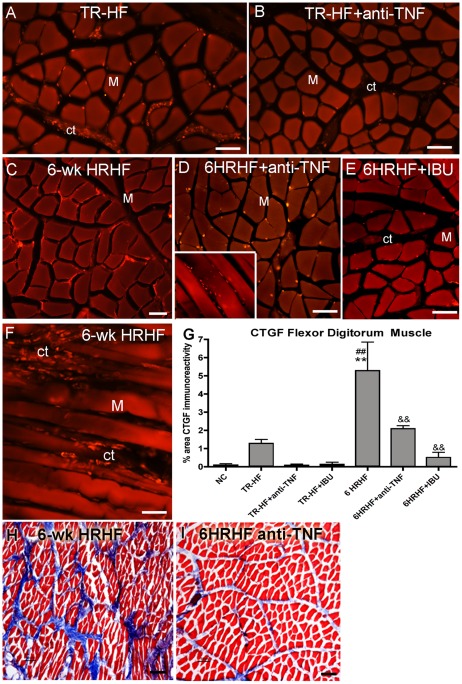
Figure 6. Increased CTGF and collagen staining decreases after anti-inflammatory drug treatments.
CTGF immunohistochemistry (panels A–F) and Masson's trichrome staining (panels G,H) increased in flexor digitorum muscles (M) and lumbricals in TR-HF and 6-week HRHF task rats, and decrease with anti-inflammatory drugs. Panels A–F show CTGF immunostaining (red) of flexor digitorum muscles from: (A) TR-HF, (B) TR-HF treated with anti-TNF-α, (C) untreated 6-week HRHF (showing CTGF-immunostained cells at edges of myofibers), (D) 6-week HRHF treated with anti-TNF-α (inset shows small CTGF-immunostained cells in endomyseum), (E) 6-week HRHF treated with ibuprofen, and (F) untreated 6-week HRHF (showing increased CTGF-immunostained cells in endomyseum (ct)). (G) Quantification of percent area with CTGF immunostaining. **p<0.01 compared to NC; ## p<0.01 compared to TR-HF; &&p<0.01 compared to untreated 6-week HRHF; n = 4–12/gp. (F) Lumbricals from Region B stained with Masson's Trichrome showing: (H) increased blue stained collagen matrix in an untreated 6-week HRHF rat, and (I) decreased blue staining in a 6-week HRHF treated with anti-TNF-α. Scale bars = 50 µm.

References

    1. Bureau of Labor Statistics. Nonfatal occupational injuries and illnesses requiring days away from work, 2009. Publication number: USDL-10-1546. 2010;10 Available: http://www.bls.gov/opub/ted/2011/ted_20110713.htm. Accessed 2012 May.
    1. Larsson B, Libelius R, Ohlsson K. Trapezius muscle changes unrelated to static work load. Chemical and morphologic controlled studies of 22 women with and without neck pain. Acta Orthop Scand. 1992;63:203–206. - PubMed
    1. Sjogaard G, Rosendal L, Kristiansen J, Blangsted AK, Skotte J, et al. Muscle oxygenation and glycolysis in females with trapezius myalgia during stress and repetitive work using microdialysis and NIRS. Eur J Appl Physiol. 2010;108:657–669. - PubMed
    1. NIOSH . National Institute for Occupational Safety and Health; 2011. National Manufacturing Agenda – June 2010.
    1. Barbe MF, Barr AE, Gorzelany I, Amin M, Gaughan JP, et al. Chronic repetitive reaching and grasping results in decreased motor performance and widespread tissue responses in a rat model of MSD. J Orthop Res. 2003;21:167–176. - PMC - PubMed

Publication types

Substances