


Relationships between high-sensitive C-reactive protein and markers of arterial stiffness in hypertensive patients. Differences by sex
- PMID: 22676422
- PMCID: PMC3473264
- DOI: 10.1186/1471-2261-12-37
Relationships between high-sensitive C-reactive protein and markers of arterial stiffness in hypertensive patients. Differences by sex
Abstract
Background: The present study was designed to evaluate the relationship between high-sensitivity C-reactive protein (hs-CRP) and arterial stiffness according to sex in patients with arterial hypertension.
Methods: A case-series study was carried out in 258 hypertensive patients without antecedents of cardiovascular disease or diabetes mellitus. Nephelometry was used to determine hs-CRP. Office or clinical and home blood pressures were measured with a validated OMRON model M10 sphygmomanometer. Ambulatory blood pressure monitoring was performed with the SpaceLabs 90207 system. Pulse wave velocity (PWV) and central and peripheral augmentation index (AIx) were measured with the SphygmoCor system, and a Sonosite Micromax ultrasound unit was used for automatic measurements of carotid intima-media thickness (IMT). Ambulatory arterial stiffness index and home arterial stiffness index were calculated as "1-slope" from the within-person regression analysis of diastolic-on-systolic ambulatory blood pressure.
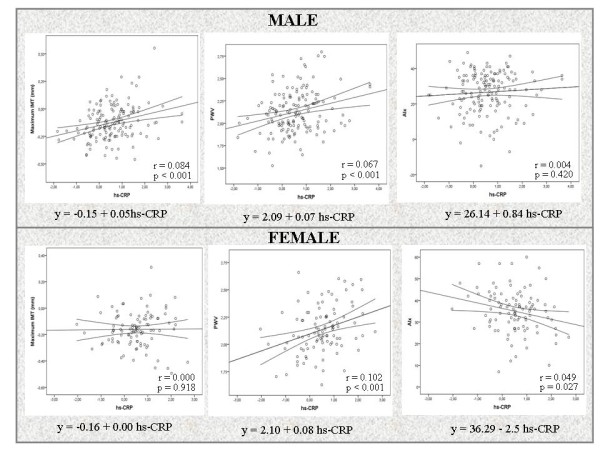
Results: Central and peripheral AIx were greater in women than in men: 35.31 ± 9.95 vs 26.59 ± 11.45 and 102.06 ± 20.47 vs 85.97 ± 19.13, respectively. IMT was greater in men (0.73 ± 0.13 vs 0.69 ± 0.10). hs-CRP was positively correlated to IMT (r=0.261), maximum (r=0.290) and to peripheral AIx (r=0.166) in men, and to PWV in both men (r=0.280) and women (r=0.250). In women, hs-CRP was negatively correlated to central AIx (r= -0.222). For each unit increase in hs-CRP, carotid IMT would increase 0.05 mm in men, and PWV would increase 0.07 m/sec in men and 0.08 m/sec in women, while central AIx would decrease 2.5 units in women. In the multiple linear regression analysis, hs-CRP explained 10.2% and 6.7% of PWV variability in women and men, respectively, 8.4% of carotid IMT variability in men, and 4.9% of central AIx variability in women.
Conclusions: After adjusting for age, other cardiovascular risk factors and the use of antihypertensive and lipid-lowering drugs, hs-CRP was seen to be positively correlated to carotid IMT in men, and negatively correlated to central AIx in women. The association of hs-CRP to arterial stiffness parameters differs between men and women.
Figures
References
-
- Koenig W, Sund M, Frohlich M, Fischer HG, Lowel H, Doring A, Hutchinson WL, Pepys MB. C-Reactive protein, a sensitive marker of inflammation, predicts future risk of coronary heart disease in initially healthy middle-aged men: results from the MONICA (Monitoring Trends and Determinants in Cardiovascular Disease) Augsburg Cohort Study, 1984 to 1992. Circulation. 1999;99(2):237–242. doi: 10.1161/01.CIR.99.2.237. - DOI - PubMed
Publication types
MeSH terms
Substances
LinkOut - more resources
Full Text Sources
Medical
Research Materials
Miscellaneous
