


States of mind: emotions, body feelings, and thoughts share distributed neural networks
- PMID: 22677148
- PMCID: PMC3453527
- DOI: 10.1016/j.neuroimage.2012.05.079
States of mind: emotions, body feelings, and thoughts share distributed neural networks
Abstract
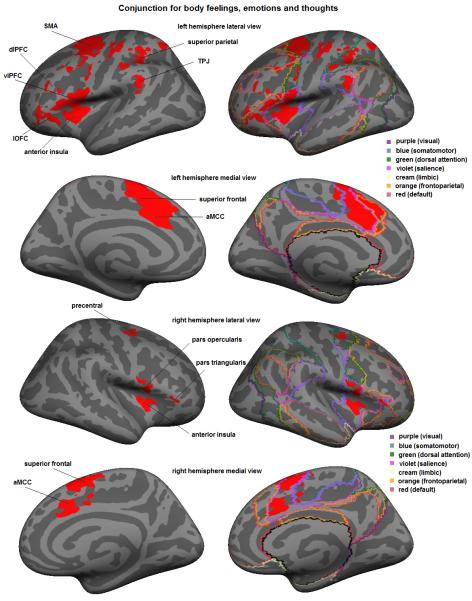
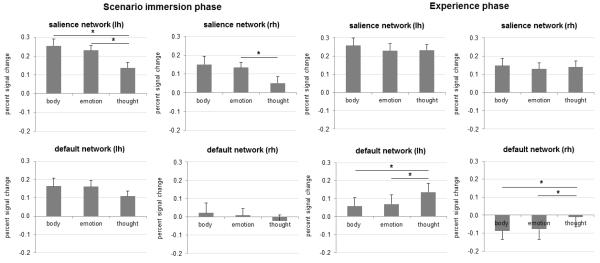
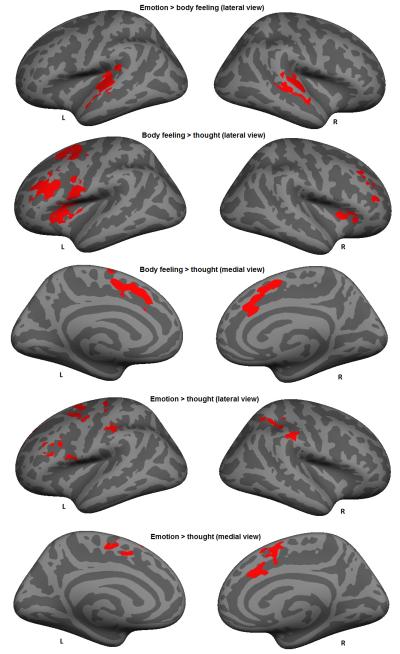
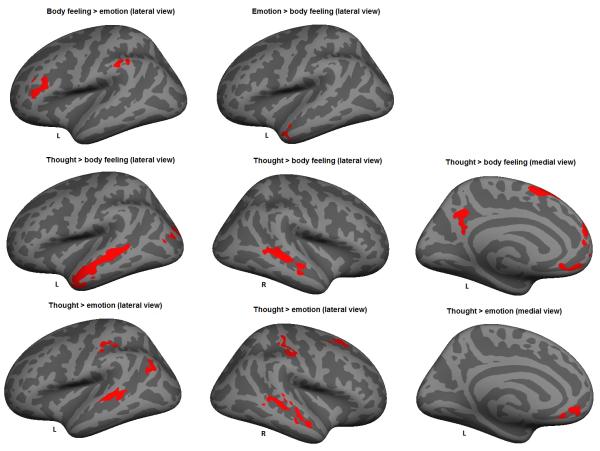
Scientists have traditionally assumed that different kinds of mental states (e.g., fear, disgust, love, memory, planning, concentration, etc.) correspond to different psychological faculties that have domain-specific correlates in the brain. Yet, growing evidence points to the constructionist hypothesis that mental states emerge from the combination of domain-general psychological processes that map to large-scale distributed brain networks. In this paper, we report a novel study testing a constructionist model of the mind in which participants generated three kinds of mental states (emotions, body feelings, or thoughts) while we measured activity within large-scale distributed brain networks using fMRI. We examined the similarity and differences in the pattern of network activity across these three classes of mental states. Consistent with a constructionist hypothesis, a combination of large-scale distributed networks contributed to emotions, thoughts, and body feelings, although these mental states differed in the relative contribution of those networks. Implications for a constructionist functional architecture of diverse mental states are discussed.
Copyright © 2012 Elsevier Inc. All rights reserved.
Figures
References
-
- Adolphs R, Gosselin F, Buchanan TW, Tranel D, Schyns P, Damasio AR. A mechanism for impaired fear recognition after amygdala damage. Nature. 2005;433(7021):68–72. - PubMed
-
- Adolphs R, Tranel D, Damasio H, Damasio A. Impaired recognition of emotion in facial expressions following bilateral damage to the human amygdala. Nature. 1994;372(6507):669–672. - PubMed
-
- Adolphs R, Tranel D, Hamann S, Young AW, Calder AJ, Phelps EA, et al. Recognition of facial emotion in nine individuals with bilateral amygdala damage. Neuropsychologia. 1999;37(10):1111–1117. - PubMed
Publication types
MeSH terms
Grants and funding
LinkOut - more resources
Full Text Sources
Other Literature Sources
