Effect of pre-diabetes on future risk of stroke: meta-analysis
- PMID: 22677795
- PMCID: PMC3370083
- DOI: 10.1136/bmj.e3564
Effect of pre-diabetes on future risk of stroke: meta-analysis
Abstract
Objectives: To assess the association between pre-diabetes and risk of stroke, and to evaluate whether this relation varies by diagnostic criteria for pre-diabetes.
Design: Systematic review and meta-analysis of prospective studies.
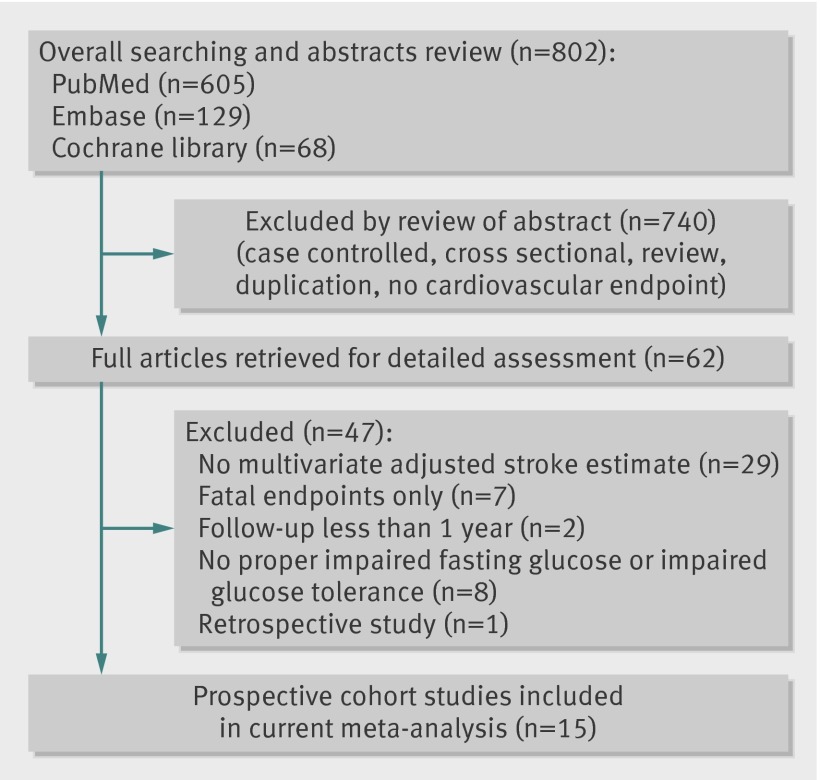
Data sources: A search of Medline, Embase, and the Cochrane Library (1947 to 16 July 2011) was supplemented by manual searches of bibliographies of key retrieved articles and relevant reviews.
Selection criteria: Prospective cohort studies that reported multivariate adjusted relative risks and corresponding 95% confidence intervals for stroke with respect to baseline pre-diabetes were included.
Data extraction: Two independent reviewers extracted data on pre-diabetes status at baseline, risk estimates of stroke, study quality, and methods used to assess pre-diabetes and stroke. Relative risks were pooled using random effects models when appropriate. Associations were tested in subgroups representing different characteristics of participants and studies. Publication bias was evaluated with funnel plots.
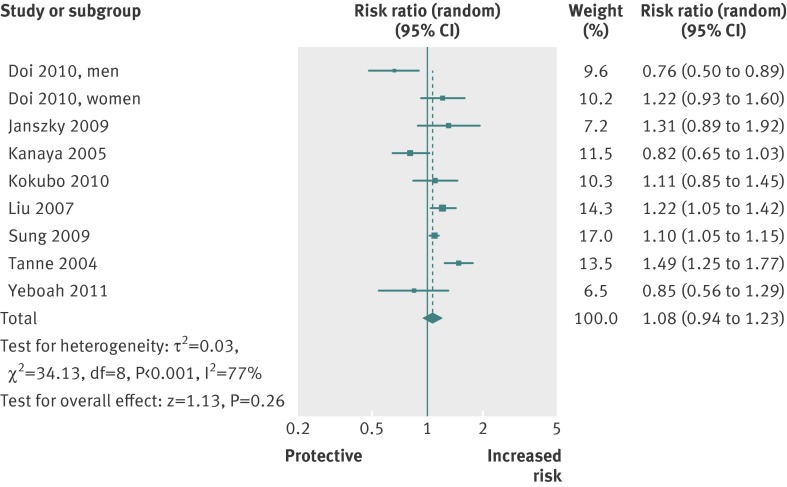
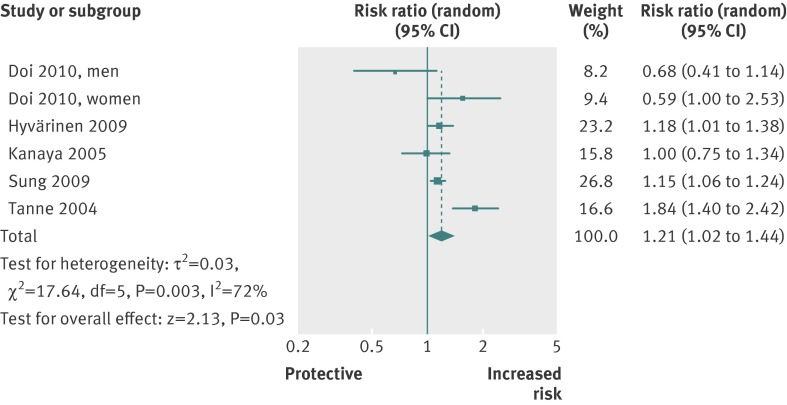
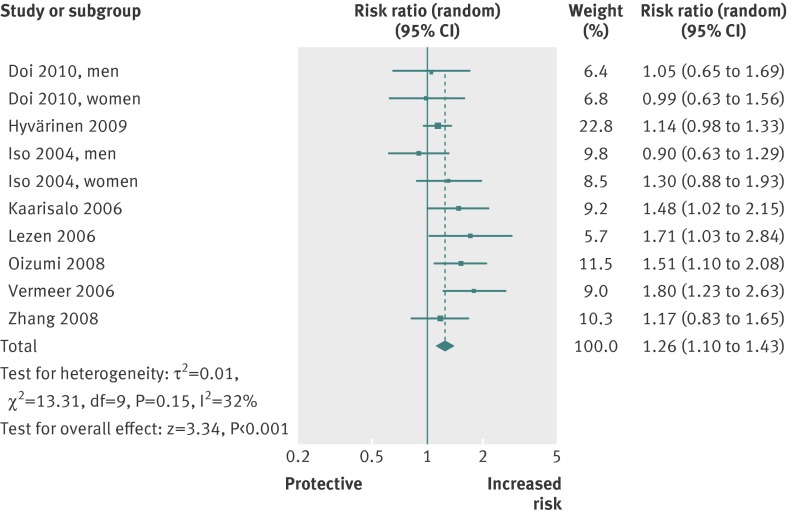
Results: The search yielded 15 prospective cohort studies including 760,925 participants. In 8 studies analysing pre-diabetes defined as fasting glucose 100-125 mg/dL (5.6-6.9 mmol/L), the random effects summary estimate did not show an increased risk of stroke after adjustment for established cardiovascular risk factors (1.08, 95% confidence interval 0.94 to 1.23; P = 0.26). In 5 studies analysing pre-diabetes defined as fasting glucose 110-125 mg/dL (6.1-6.9 mmol/L), the random effects summary estimate showed an increased risk of stroke after adjustment for established cardiovascular risk factors (1.21, 1.02 to 1.44; P = 0.03). In 8 studies with information about impaired glucose tolerance or combined impaired glucose tolerance and impaired fasting glucose, the random effects summary estimate showed an increased risk of stroke after adjustment for established cardiovascular risk factors (1.26, 1.10 to 1.43; P < 0.001). When studies that might have enrolled patients with undiagnosed diabetes were excluded, only impaired glucose tolerance or a combination of impaired fasting glucose and impaired glucose tolerance independently raised the future risk of stroke (1.20, 1.07 to 1.35; P = 0.002).
Conclusion: Pre-diabetes, defined as impaired glucose tolerance or a combination of impaired fasting glucose and impaired glucose tolerance, may be associated with a higher future risk of stroke, but the relative risks are modest and may reflect underlying confounding.
Conflict of interest statement
Competing interests: All authors have completed the Unified Competing Interest form at
Figures
Comment in
-
Pre-diabetes as a contributor to stroke.BMJ. 2012 Jun 7;344:e3285. doi: 10.1136/bmj.e3285. BMJ. 2012. PMID: 22677794 No abstract available.
References
-
- Garber AJ, Handelsman Y, Einhorn D, Bergman DA, Bloomgarden ZT, Fonseca V, et al. Diagnosis and management of prediabetes in the continuum of hyperglycemia: when do the risks of diabetes begin? A consensus statement from the American College of Endocrinology and the American Association of Clinical Endocrinologists. Endocr Pract 2008;14:933-46. - PubMed
-
- Centers for Disease Control. National diabetes fact sheet, 2011. www.cdc.gov/diabetes/pubs/pdf/ndfs_2011.pdf.
-
- Geiss LS, James C, Gregg EW, Albright A, Williamson DF, Cowie CC. Diabetes risk reduction behaviors among U.S. adults with prediabetes. Am J Prev Med 2010;38:403-9. - PubMed
-
- Report of the Expert Committee on the Diagnosis and Classification of Diabetes Mellitus. Diabetes Care 1997;20:1183-97. - PubMed
Publication types
MeSH terms
Substances
Grants and funding
LinkOut - more resources
Full Text Sources
Medical