


Speed and incline during thoroughbred horse racing: racehorse speed supports a metabolic power constraint to incline running but not to decline running
- PMID: 22678967
- PMCID: PMC3424062
- DOI: 10.1152/japplphysiol.00560.2011
Speed and incline during thoroughbred horse racing: racehorse speed supports a metabolic power constraint to incline running but not to decline running
Abstract
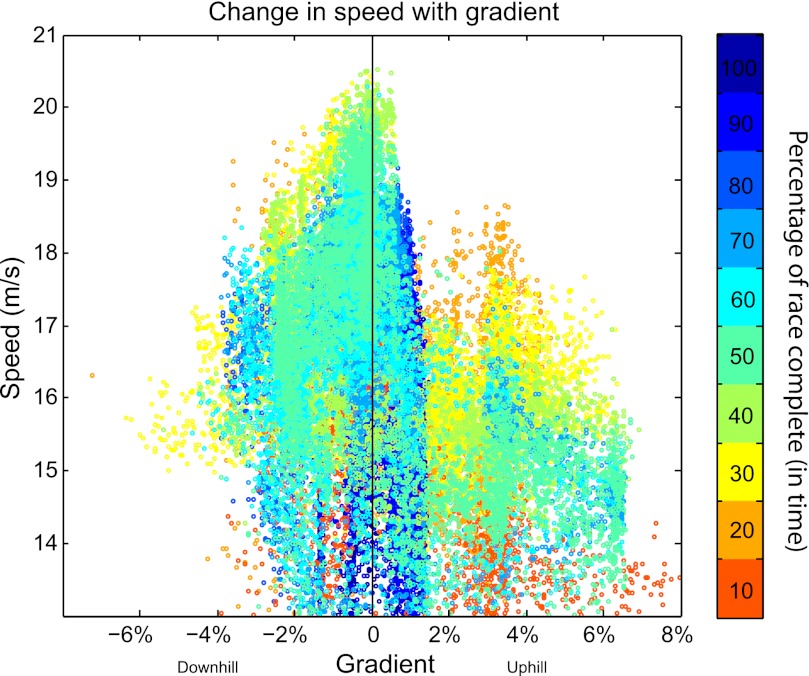
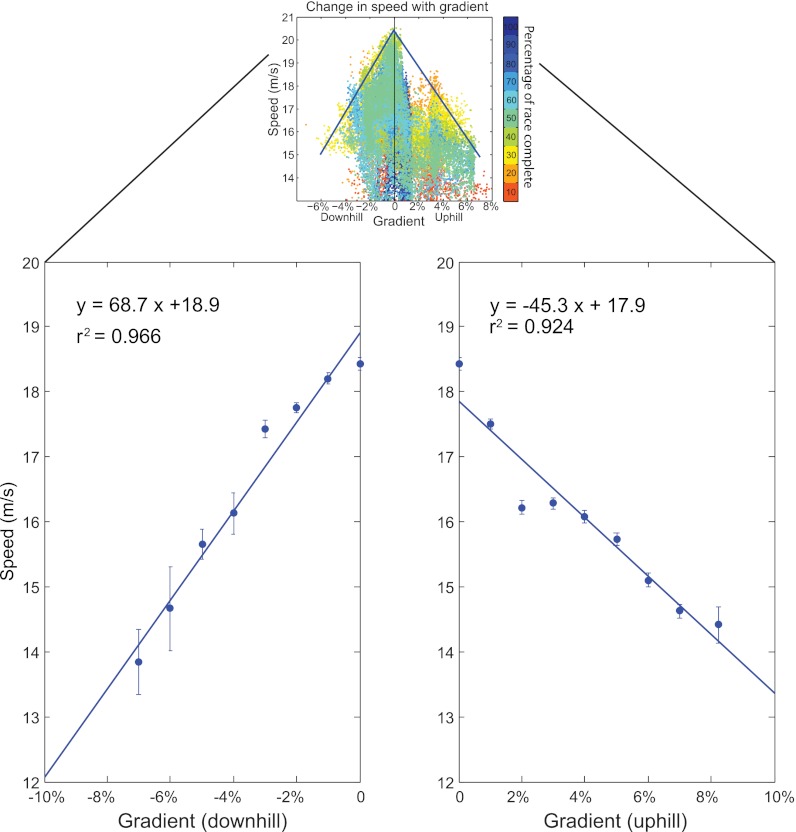
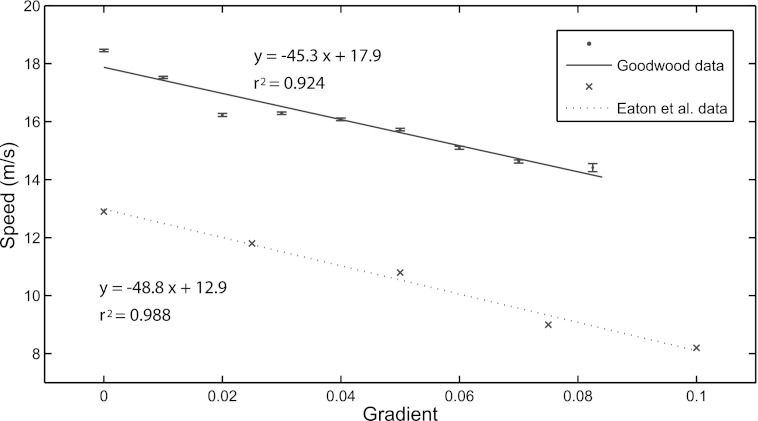
We used a radio tracking system to examine the speed of 373 racehorses on different gradients on an undulating racecourse during 33 races, each lasting a few minutes. Horses show a speed detriment on inclines (0.68 m · s(-1) · 1% gradient(-1), r(2) = 0.97), the magnitude of which corresponds to trading off the metabolic cost (power) of height gain with the metabolic cost (power) of horizontal galloping. A similar relationship can be derived from published data for human runners. The horses, however, were also slower on the decline (-0.45 m · s(-1) · 1% gradient(-1), r(2) = 0.92). Human athletes run faster on a decline, which can be explained by the energy gained by the center of mass from height loss. This study has shown that horses go slower, which may be attributable to the anatomical simplicity of their front legs limiting weight support and stability when going downhill. These findings provide insight into limits to athletic performance in racehorses, which may be used to inform training regimens, as well as advancing knowledge from both veterinary and basic science perspectives.
Figures
References
-
- Davies CT, Thompson MW. Aerobic performance of female marathon and male ultramarathon athletes. Eur J Appl Physiol Occup Physiol 41: 233–245, 1979 - PubMed
-
- Davies CTM. Effects of wind assistance and resistance on the forward motion of a runner. J Appl Physiol 48: 702–709, 1980 - PubMed
-
- Dutto DJ, Hoyt DF, Cogger EA, Wickler SJ. Ground reaction forces in horses trotting up an incline and on the level over a range of speeds. J Exp Biol 207: 3507–3514, 2004 - PubMed
-
- Eaton MD, Evans DL, Hodgson DR, Rose RJ. Effect of treadmill incline and speed on metabolic-rate during exercise in thoroughbred horses. J Appl Physiol 79: 951–957, 1995 - PubMed
-
- Elliott JM, Davison W. Energy equivalents of oxygen-consumption in animal energetics. Oecologia (Berl) 19: 195–201, 1975 - PubMed
Publication types
MeSH terms
Grants and funding
LinkOut - more resources
Full Text Sources
