


Exercise training and muscle microvascular oxygenation: functional role of nitric oxide
- PMID: 22678970
- PMCID: PMC3424059
- DOI: 10.1152/japplphysiol.00151.2012
Exercise training and muscle microvascular oxygenation: functional role of nitric oxide
Abstract
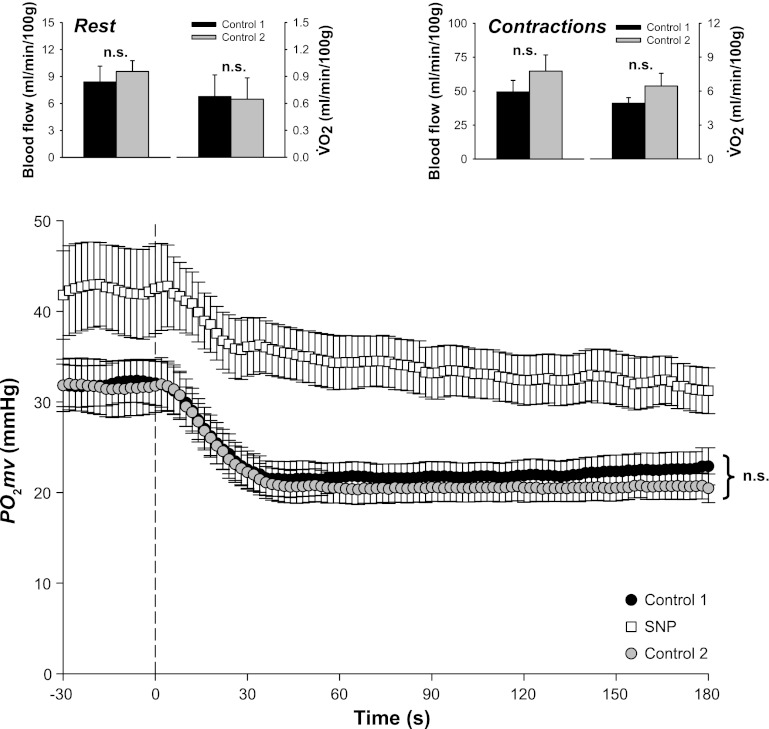
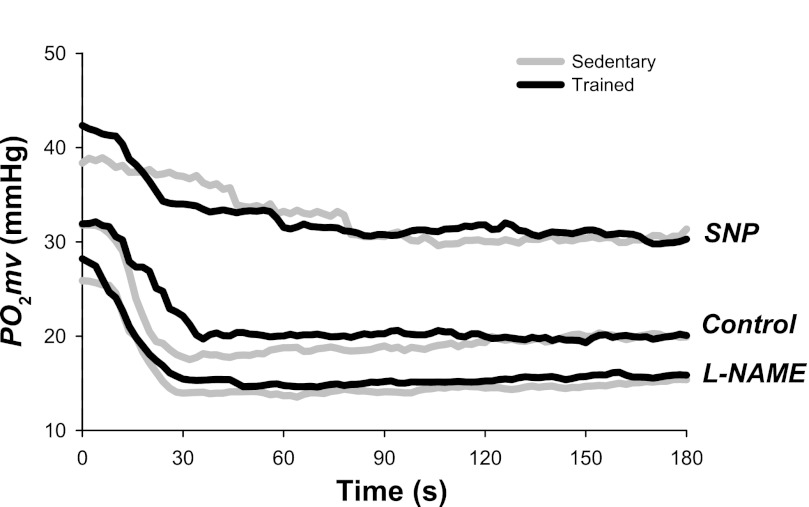
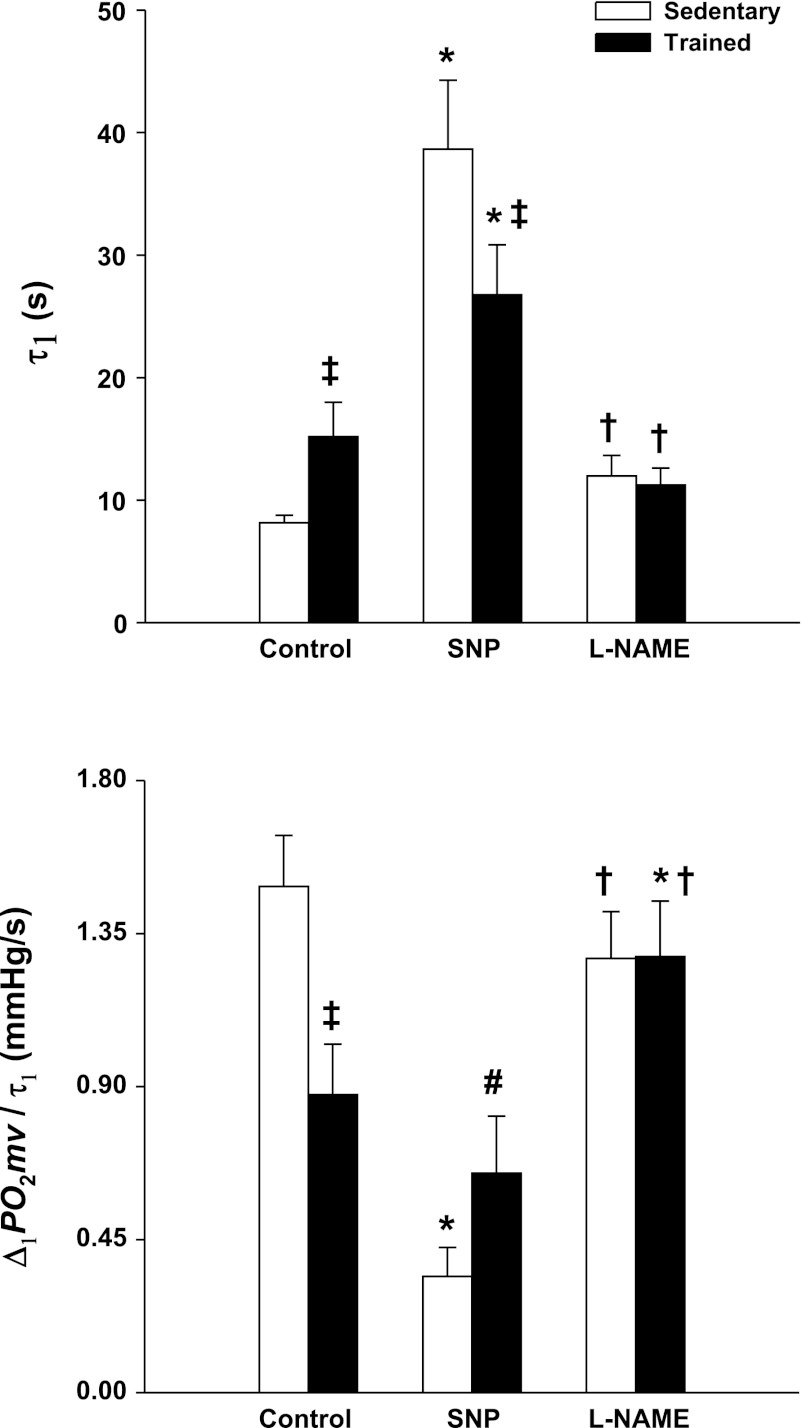
Exercise training induces multiple adaptations within skeletal muscle that may improve local O(2) delivery-utilization matching (i.e., Po(2)mv). We tested the hypothesis that increased nitric oxide (NO) function is intrinsic to improved muscle Po(2)mv kinetics from rest to contractions after exercise training. Healthy young Sprague-Dawley rats were assigned to sedentary (n = 18) or progressive treadmill exercise training (n = 10; 5 days/wk, 6-8 wk, final workload of 60 min/day at 35 m/min, -14% grade) groups. Po(2)mv was measured via phosphorescence quenching in the spinotrapezius muscle at rest and during 1-Hz twitch contractions under control (Krebs-Henseleit solution), sodium nitroprusside (SNP, NO donor; 300 μM), and N(G)-nitro-L-arginine methyl ester (l-NAME, nonspecific NO synthase blockade; 1.5 mM) superfusion conditions. Exercise-trained rats had greater peak oxygen uptake (Vo(2 peak)) than their sedentary counterparts (81 ± 1 vs. 72 ± 2 ml · kg(-1) · min(-1), respectively; P < 0.05). Exercise-trained rats had significantly slower Po(2)mv fall throughout contractions (τ(1); time constant for the first component) during control (sedentary: 8.1 ± 0.6; trained: 15.2 ± 2.8 s). Compared with control, SNP slowed τ(1) to a greater extent in sedentary rats (sedentary: 38.7 ± 5.6; trained: 26.8 ± 4.1 s; P > 0.05) whereas l-NAME abolished the differences in τ(1) between sedentary and trained rats (sedentary: 12.0 ± 1.7; trained: 11.2 ± 1.4 s; P < 0.05). Our results indicate that endurance exercise training leads to greater muscle microvascular oxygenation across the metabolic transient following the onset of contractions (i.e., slower Po(2)mv kinetics) partly via increased NO-mediated function, which likely constitutes an important mechanism for training-induced metabolic adaptations.
Figures
References
-
- Altman PL, Dittmer DS. Biology Data Book. Bethesda, MD: FASEB, 1974
-
- Armstrong RB, Laughlin MH. Exercise blood flow patterns within and among rat muscles after training. Am J Physiol Heart Circ Physiol 246: H59–H68, 1984 - PubMed
-
- Bailey JK, Kindig CA, Behnke BJ, Musch TI, Schmid-Schoenbein GW, Poole DC. Spinotrapezius muscle microcirculatory function: effects of surgical exteriorization. Am J Physiol Heart Circ Physiol 279: H3131–H3137, 2000 - PubMed
-
- Bebout DE, Hogan MC, Hempleman SC, Wagner PD. Effects of training and immobilization on V̇o2 and Do2 in dog gastrocnemius muscle in situ. J Appl Physiol 74: 1697–1703, 1993 - PubMed
-
- Behnke BJ, Barstow TJ, Kindig CA, McDonough P, Musch TI, Poole DC. Dynamics of oxygen uptake following exercise onset in rat skeletal muscle. Respir Physiol Neurobiol 133: 229–239, 2002 - PubMed
Publication types
MeSH terms
Substances
Grants and funding
LinkOut - more resources
Full Text Sources
Miscellaneous
