Non-nutritive sweeteners and their role in the gastrointestinal tract
- PMID: 22679063
- PMCID: PMC3410280
- DOI: 10.1210/jc.2012-1475
Non-nutritive sweeteners and their role in the gastrointestinal tract
Abstract
Context: Non-nutritive sweeteners can bind to sweet-taste receptors present not only in the oral cavity, but also on enteroendocrine and pancreatic islet cells. Thus, these sweeteners may have biological activity by eliciting or inhibiting hormone secretion. Because consumption of non-nutritive sweeteners is common in the United States, understanding the physiological effects of these substances is of interest and importance.
Evidence acquisition: A PubMed (1960-2012) search was performed to identify articles examining the effects of non-nutritive sweeteners on gastrointestinal physiology and hormone secretion.
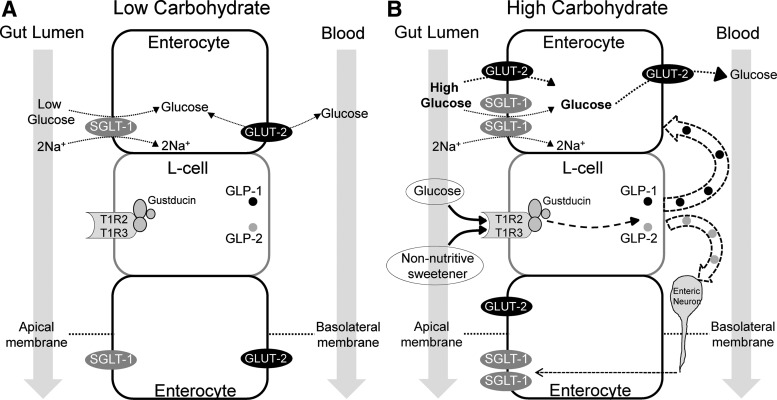
Evidence synthesis: The majority of in vitro studies showed that non-nutritive sweeteners can elicit secretion of gut hormones such as glucagon-like peptide 1 and glucose-dependent insulinotropic peptide in enteroendocrine or islet cells. In rodents, non-nutritive sweeteners increased the rate of intestinal glucose absorption, but did not alter gut hormone secretion in the absence of glucose. Most studies in humans have not detected effects of non-nutritive sweeteners on gut hormones or glucose absorption. Of eight human studies, one showed increased glucose-stimulated glucagon-like peptide 1 secretion after diet soda consumption, and one showed decreased glucagon secretion after stevia ingestion.
Conclusions: In humans, few studies have examined the hormonal effects of non-nutritive sweeteners, and inconsistent results have been reported, with the majority not recapitulating in vitro data. Further research is needed to determine whether non-nutritive sweeteners have physiologically significant biological activity in humans.
Figures
References
-
- Colditz GA, Willett WC, Stampfer MJ, London SJ, Segal MR, Speizer FE. 1990. Patterns of weight change and their relation to diet in a cohort of healthy women. Am J Clin Nutr 51:1100–1105 - PubMed
-
- Dhingra R, Sullivan L, Jacques PF, Wang TJ, Fox CS, Meigs JB, D'Agostino RB, Gaziano JM, Vasan RS. 2007. Soft drink consumption and risk of developing cardiometabolic risk factors and the metabolic syndrome in middle-aged adults in the community. Circulation 116:480–488 - PubMed
-
- Fowler SP, Williams K, Resendez RG, Hunt KJ, Hazuda HP, Stern MP. 2008. Fueling the obesity epidemic? Artificially sweetened beverage use and long-term weight gain. Obesity 16:1894–1900 - PubMed
-
- Lutsey PL, Steffen LM, Stevens J. 2008. Dietary intake and the development of the metabolic syndrome: the Atherosclerosis Risk in Communities study. Circulation 117:754–761 - PubMed
Publication types
MeSH terms
Substances
LinkOut - more resources
Full Text Sources
Other Literature Sources
Medical