


Implicit learning of what comes when and where within a sequence: The time-course of acquiring serial position-item and item-item associations to represent serial order
- PMID: 22679464
- PMCID: PMC3367904
- DOI: 10.2478/v10053-008-0106-0
Implicit learning of what comes when and where within a sequence: The time-course of acquiring serial position-item and item-item associations to represent serial order
Abstract
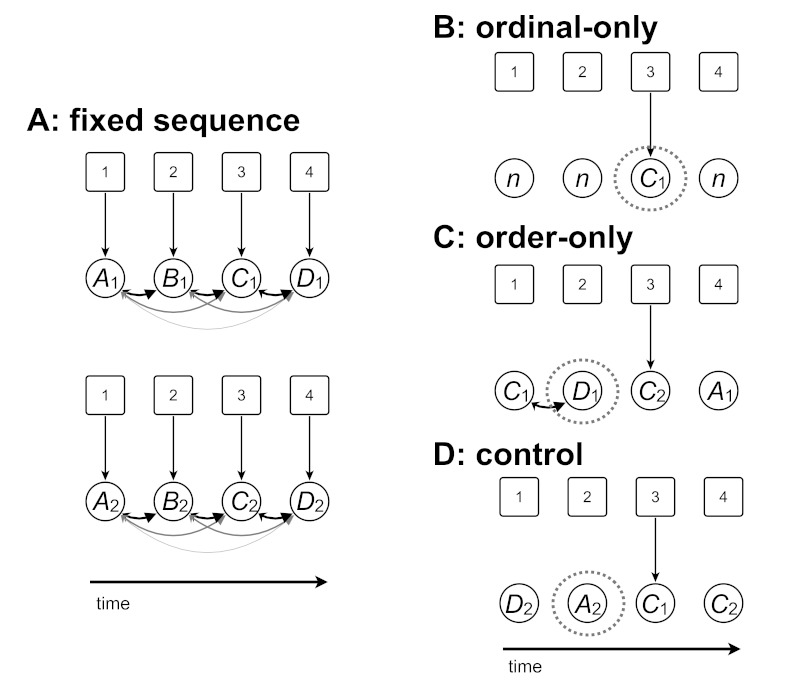
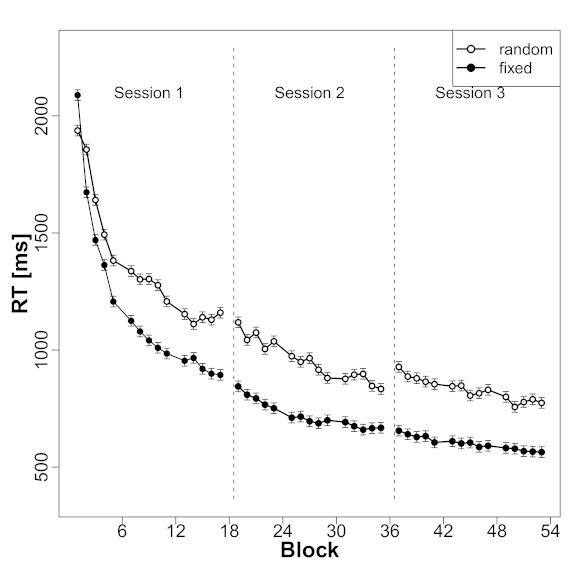
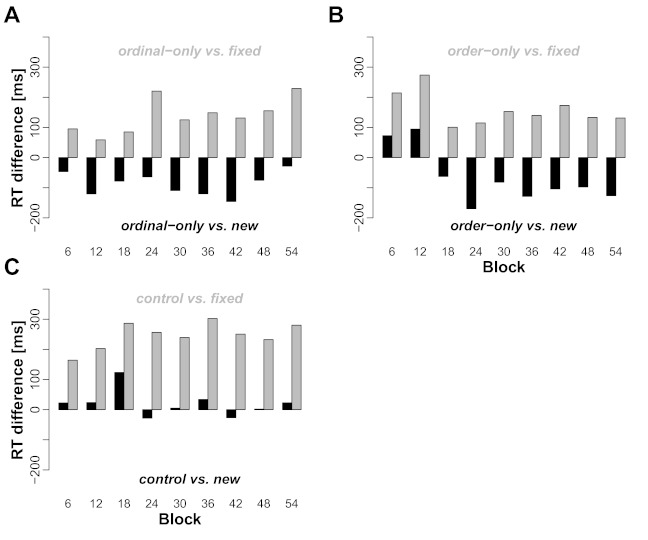
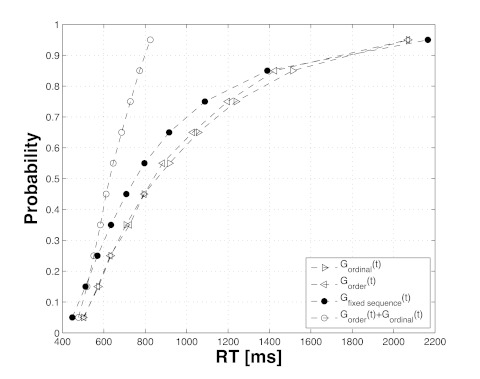
Much research has been conducted aimed at the representations and mechanisms that enable learning of sequential structures. A central debate concerns the question whether item-item associations (i.e., in the sequence A-B-C-D, B comes after A) or associations of item and serial list position (i.e., B is the second item in the list) are used to represent serial order. Previously, we showed that in a variant of the implicit serial reaction time task, the sequence representation contains associations between serial position and item information (Schuck, Gaschler, Keisler, & Frensch, 2011). Here, we applied models and research methods from working memory research to implicit serial learning to replicate and extend our findings. The experiment involved three sessions of sequence learning. Results support the view that participants acquire knowledge about order structure (item-item associations) and about ordinal structure (serial position-item associations). Analyses suggest that only the simultaneous use of the two types of knowledge acquisition can explain learning-related performance increases. Additionally, our results indicate that serial list position information plays a role very early in learning and that inter-item associations increasingly control behavior in later stages.
Keywords: SRT; chaining; implicit sequence learning; race model; serial order.
Figures
References
-
- Bengtsson S. L., Ehrsson H. H., Forssberg H., Ullen F. Dissociating brain regions controlling the temporal and ordinal structure of learned movement sequences. European Journal of Neuroscience. 2004;19:2591–2602. - PubMed
-
- Berner M. P., Hoffmann J. Effector-related sequence learning in a bimanual-bisequential serial reaction time task. Psychological Research. 2008;72:138–154. - PubMed
-
- Berner M. P., Hoffmann J. Acquisition of effector-specific and effector-independent components of sequencing skill. Journal of Motor Behavior. 2009;41:30–44. - PubMed
-
- Burgess N., Hitch G. J. Memory for serial order: A network model of the phonological loop and its timing. Psychological Review. 1999;106:551–581.
LinkOut - more resources
Full Text Sources