. 2012;7(6):e38214.
doi: 10.1371/journal.pone.0038214. Epub 2012 Jun 5.

Interleukin-6 is a potential biomarker for severe pandemic H1N1 influenza A infection

Affiliations

Interleukin-6 is a potential biomarker for severe pandemic H1N1 influenza A infection

Stéphane G Paquette et al. PLoS One. 2012.

Abstract

Pandemic H1N1 influenza A (H1N1pdm) is currently a dominant circulating influenza strain worldwide. Severe cases of H1N1pdm infection are characterized by prolonged activation of the immune response, yet the specific role of inflammatory mediators in disease is poorly understood. The inflammatory cytokine IL-6 has been implicated in both seasonal and severe pandemic H1N1 influenza A (H1N1pdm) infection. Here, we investigated the role of IL-6 in severe H1N1pdm infection. We found IL-6 to be an important feature of the host response in both humans and mice infected with H1N1pdm. Elevated levels of IL-6 were associated with severe disease in patients hospitalized with H1N1pdm infection. Notably, serum IL-6 levels associated strongly with the requirement of critical care admission and were predictive of fatal outcome. In C57BL/6J, BALB/cJ, and B6129SF2/J mice, infection with A/Mexico/4108/2009 (H1N1pdm) consistently triggered severe disease and increased IL-6 levels in both lung and serum. Furthermore, in our lethal C57BL/6J mouse model of H1N1pdm infection, global gene expression analysis indicated a pronounced IL-6 associated inflammatory response. Subsequently, we examined disease and outcome in IL-6 deficient mice infected with H1N1pdm. No significant differences in survival, weight loss, viral load, or pathology were observed between IL-6 deficient and wild-type mice following infection. Taken together, our findings suggest IL-6 may be a potential disease severity biomarker, but may not be a suitable therapeutic target in cases of severe H1N1pdm infection due to our mouse data.


Conflict of interest statement

Competing Interests: The authors have declared that no competing interests exist.

Figures

Figure 1
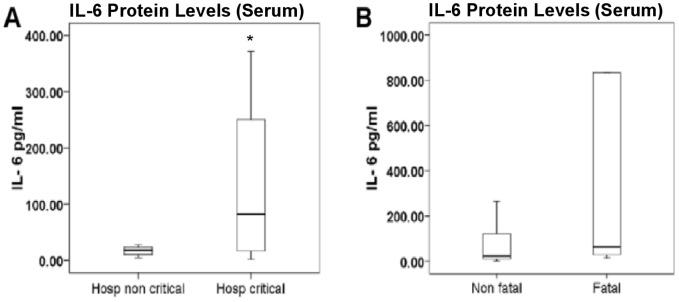
Figure 1. IL-6 levels associated strongly with disease severity in patients hospitalized with H1N1pdm infection.
Serum IL-6 levels in hospitalized patients with laboratory-confirmed H1N1pdm infection. Comparison between different groups: between patients requiring critical (n = 35) or non-critical (n = 10) care (A) and between patients who survived (n = 35) or died (n = 10) (B). Mann-Whitney U test was applied to assess statistical significance of differences between groups; p-values <0.05 are indicated by an asterisk (*).
Figure 2
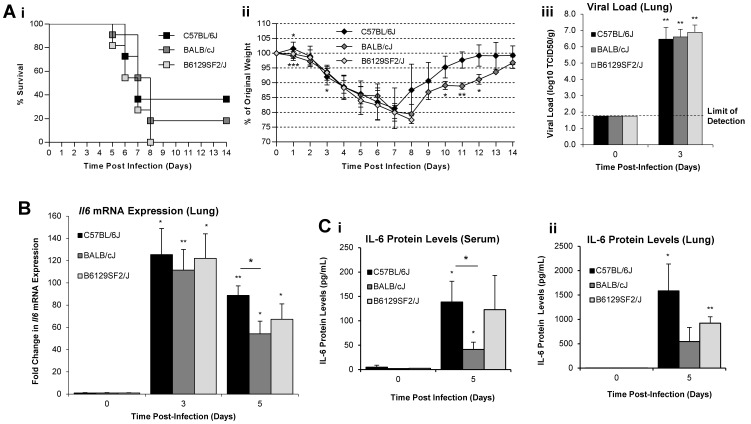
Figure 2. Severe A/Mexico/4108/2009 (H1N1pdm) infection triggered increased IL-6 expression in C57BL/6J, BALB/cJ, and B6129SF2/J mice.
Survival curves for C57BL/6J (closed squares), BALB/cJ (grey squares), and B6129SF2/J (open squares) mice infected intranasally with 104 EID50 A/Mexico/4108/2009 (H1N1pdm). n = 11 for all three groups. The logrank test (α = 0.05) was used to ascertain significance in differences in survival (Ai) . Average weight curve for C57BL/6J (closed diamonds), BALB/cJ (grey diamonds), and B6129SF2/J (open diamonds) mice. Vertical error bars indicate ±1 standard deviation. n = 17 for all groups. Asterisks below the curves indicate significant difference between C57BL/6J weights and BALB/cJ weights, asterisks above the curves indicate significant difference between C57BL/6J weights and B6129SF2/J weights. No significant differences between BALB/cJ and B6129SF2/J weights (Aii). Viral load in lung homogenates collected at days 0 and 3 pi. n = 3 for all groups. Infection of Madin-Darby Canine Kidney cells was employed to measure viral titers. The assay had a limit of detection of 101.75 TCID50/g of lung tissue, indicated by the dashed line. Vertical error bars indicate +1 standard deviation (Aiii). Il6 mRNA expression profiling in lung homogenates by qRT-PCR. Results are expressed as fold changes over expression in uninfected day 0 pi controls. n = 3 for each group. Vertical error bars indicate +1 standard deviation. (B). IL-6 expression levels in serum and lung homogenates. n = 3 for each group. Vertical error bars indicate +1 standard deviation (Ci&ii). The two-tailed, two-sample unequal variances Student’s t-test was used to ascertain significance (p-value <0.05 = *, p-value <0.01 = **, p-value <0.001 = ***).
Figure 3
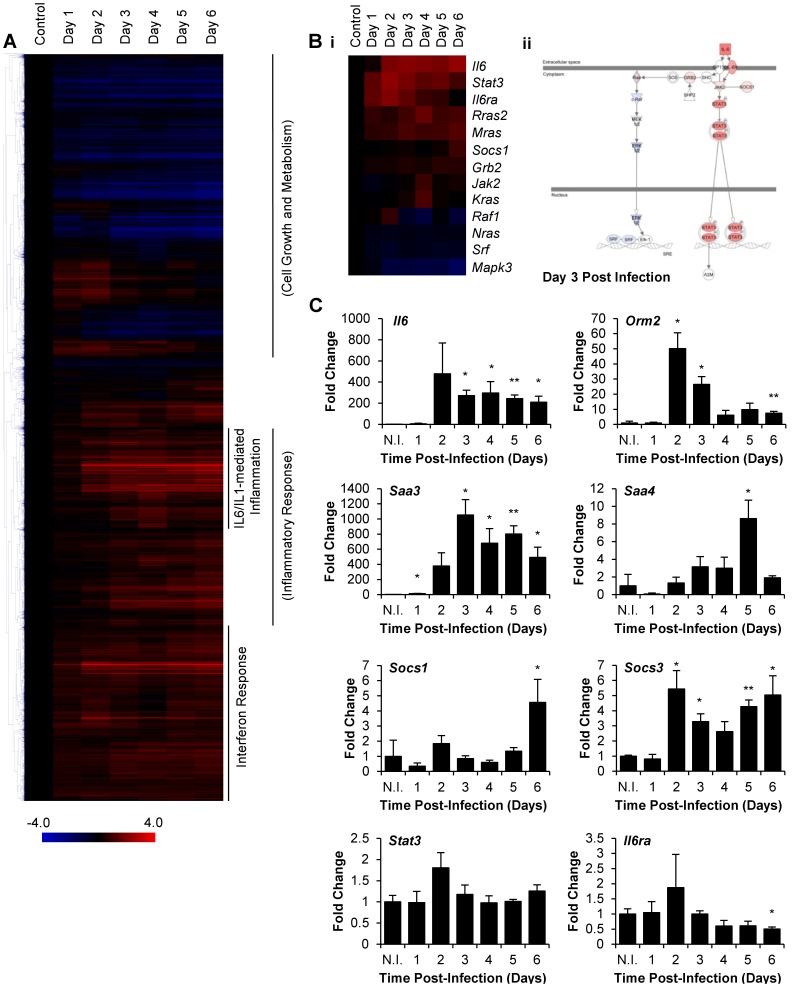
Figure 3. C57BL/6J mice elicited IL-6 associated inflammatory response to A/Mexico/4108/2009 (H1N1pdm) infection.
Global gene expression profiling in lungs of C57BL/6J mice infected intranasally with 105 EID50 A/Mexico/4108/2009 (H1N1pdm). Probes for significantly differentially expressed genes were subjected to one-way hierarchical clustering analysis (Pearson’s correlation). The most significant gene networks (Inflammatory Response, Cell Growth and Metabolism) or most prominent represented canonical pathways (IL-1 and IL-6-mediated Inflammation, Interferon Response), as determined by IPA, are indicated for each cluster (A). Expression data of genes associated with IL-6 signalling, as determined by IPA, profiled over the course of infection (Bi). Visual representation of IL-6 signalling pathway, as represented by IPA, at day 3 pi. Overlaid colors represent gene regulation status; upregulated genes are red, downregulated genes are blue. Color intensity correlates with the magnitude of change in gene expression (Bii). Gene expression data validation by qRT-PCR for Il6, IL-6 signalling genes Stat3 and Il6ra, and IL-6 response genes Orm2, Saa3, Saa4, Socs1, and Socs3. Results are expressed as fold changes over expression in non-infected controls. Reported values for each time point are the average of three samples with +1 standard deviation indicated by vertical error bars. N.I. indicates non-infected controls. The two-tailed, two-sample unequal variances Student’s t-test was used to ascertain significance (p-value <0.05 = *, p-value <0.01 = **) (C).
Figure 4
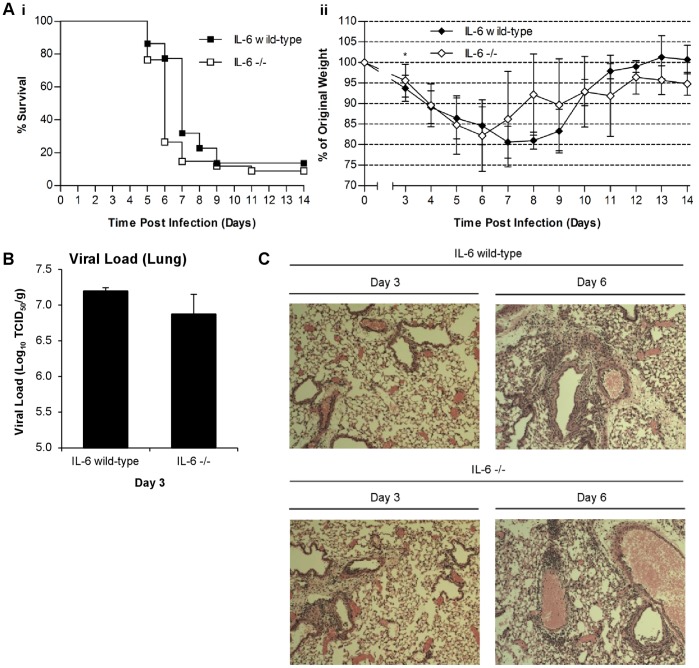
Figure 4. Loss of IL-6 expression in IL-6−/− mice did not significantly impact disease severity following A/Mexico/4108/2009 (H1N1pdm) infection.
Survival curves for IL-6 wild-type (closed squares) and IL-6−/− (open squares) mice infected intranasally with 104 EID50 A/Mexico/4108/2009 (H1N1pdm). n = 34 for IL-6−/− mice and n = 22 for IL-6 wild-type mice. The logrank test (α = 0.05) was used to ascertain significance in differences in survival (Ai) . Average weight curve for IL-6 wild-type (closed diamonds) and IL-6−/− (open diamonds) mice. Vertical error bars indicate ±1 standard deviation. The two-tailed, two-sample unequal variances Student’s t-test was used to ascertain significance (p-value <0.05 = *). n = 40 for IL-6−/− mice and n = 35 for IL-6 wild-type mice (Aii). Viral load in lung homogenates of IL-6−/− and IL-6 wild-type mice. Lung tissue collected at day 3 pi. n = 3 for IL-6−/− mice and n = 3 for IL-6 wild-type mice. Vertical error bars indicate +1 standard deviation. The two-tailed, two-sample unequal variances Student’s t-test was used to ascertain significance. Viral load expressed in log10 (B). Lung histology collected from IL-6 wild-type and IL-6−/−. Samples collected at both day 3 and day 6 pi (C).

References

    1. Steinhauer DA, Skehel JJ. Genetics of influenza viruses. Annu Rev Genet. 2002;36:305–332. - PubMed
    1. Perez-Padilla R, Rosa-Zamboni D, Ponce dL, Hernandez M, Quinones-Falconi F, et al. Pneumonia and respiratory failure from swine-origin influenza A (H1N1) in Mexico. N Engl J Med. 2009;361:680–689. - PubMed
    1. Kmietowicz Z. WHO declares that H1N1 pandemic is over. BMJ. 2010;341:c4393. - PubMed
    1. Gilsdorf A, Poggensee G Working Group Pandemic Influenza A(H1N1)v. Euro Surveill 14: pii; 2009. Influenza A(H1N1)v in Germany: the first 10,000 cases.19318 - PubMed
    1. Nicoll A, Coulombier D. Euro Surveill 14: pii; 2009. Europe’s initial experience with pandemic (H1N1) 2009 - mitigation and delaying policies and practices.19279 - PubMed

Publication types

Associated data