Up-regulated aldo-keto reductase family 1 member B10 in chronic hepatitis C: association with serum alpha-fetoprotein and hepatocellular carcinoma
- PMID: 22681639
- PMCID: PMC3466415
- DOI: 10.1111/j.1478-3231.2012.02827.x
Up-regulated aldo-keto reductase family 1 member B10 in chronic hepatitis C: association with serum alpha-fetoprotein and hepatocellular carcinoma
Abstract
Background: Elevated serum alpha-fetoprotein (AFP) is not only a diagnostic marker for hepatocellular carcinoma (HCC), but is also a risk factor for HCC in chronic hepatitis C patients who do not have HCC.
Aim: The aim was to analyse the hepatic gene expression signature in chronic hepatitis C patients with elevated AFP, who were at high risk for HCC.
Methods: Liver tissue samples from 48 chronic hepatitis C patients were stratified by their serum AFP levels and analysed for gene expression profiles. The association between aldo-keto reductase family 1 member B10 (AKR1B10) expression and serum AFP was confirmed by quantitative real-time reverse transcription polymerase chain reaction (qRT-PCR) and immunohistochemical analyses. A matched case-control study was performed to evaluate the risk of AKR1B10 expression for HCC development.
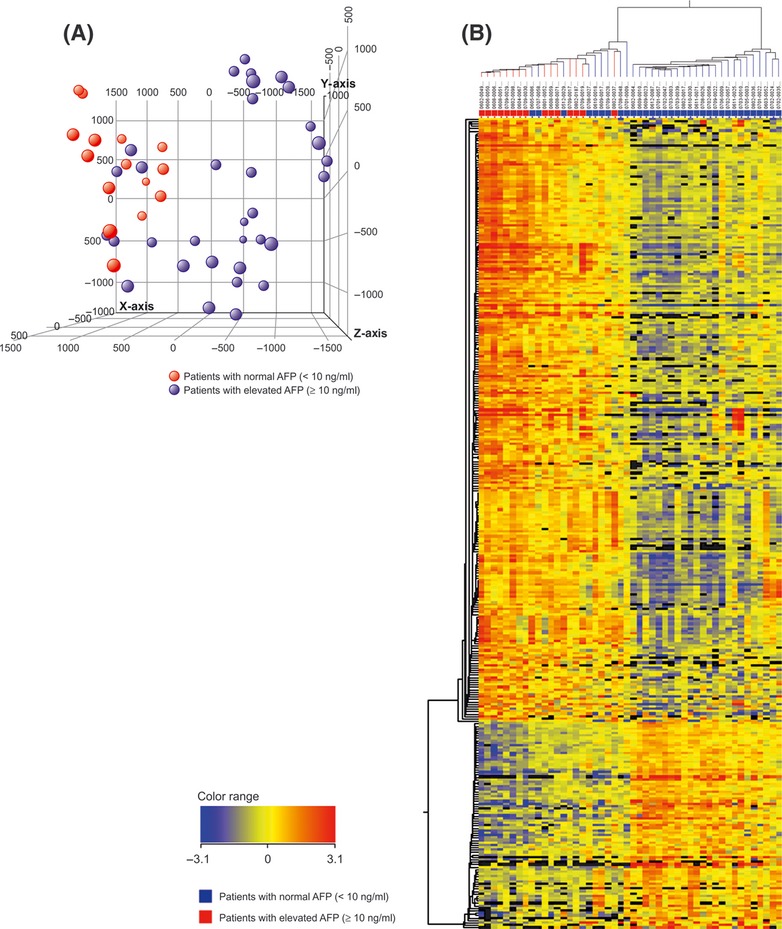
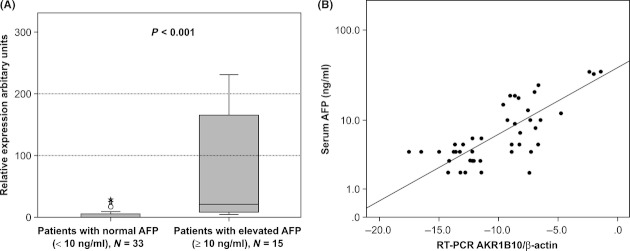
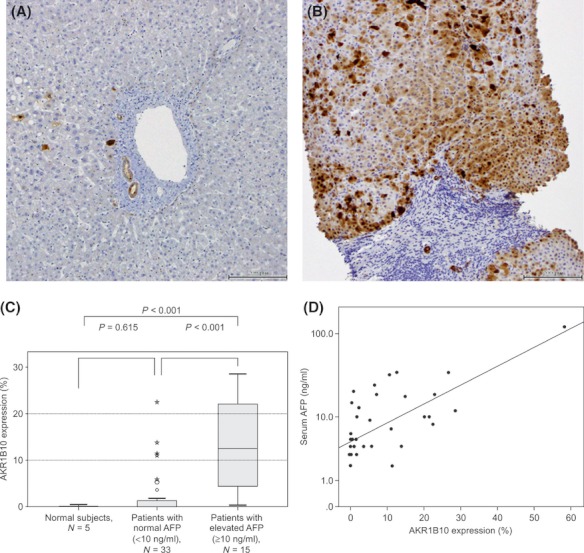
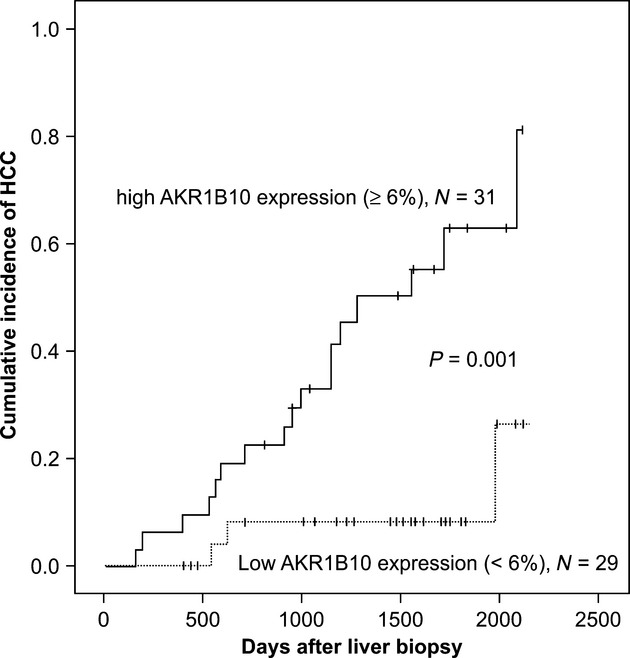
Results: Distinct hepatic gene expression patterns were demonstrated in patients with elevated AFP (≥10 ng/mL) and normal AFP (<10 ng/mL). Of the 627 differently expressed genes, the most abundantly expressed gene in patients with elevated AFP was AKR1B10 (fold change, 26.2; P < 0.001), which was originally isolated as an overexpressed gene in human HCC. The qRT-PCR and immunohistochemical studies confirmed a proportional correlation between AKR1B10 expression and serum AFP. A matched case-control study identified that AKR1B10 up-regulation (>6%) was an independent risk factor for HCC development (hazard ratio, 21.4; P = 0.001).
Conclusion: AKR1B10 was up-regulated in association with serum AFP, and was an independent risk factor for HCC in chronic hepatitis C patients, suggesting its possible involvement at a very early stage of hepatocarcinogenesis.
© 2012 John Wiley & Sons A/S.
Figures
References
-
- EI-Serag HB, Rudolph KL. Hepatocellular carcinoma: epidemiology and molecular carcinogenesis. Gastroenterology. 2007;132:2557–76. - PubMed
-
- Fattovich G, Stroffolini T, Zagni I, Donato F. Hepatocellular carcinoma in cirrhosis: incidence and risk factors. Gastroenterology. 2004;127:S35–50. - PubMed
-
- Kiyosawa K, Umemura T, Ichijo T, et al. Hepatocellular carcinoma: recent trends in Japan. Gastroenterology. 2004;127:S17–26. - PubMed
-
- Fattovich G, Giustina G, Degos F, et al. Morbidity and mortality in compensated cirrhosis type C: a retrospective follow-up study of 384 patients. Gastroenterology. 1997;112:463–72. - PubMed
-
- Niederau C, Lange S, Heintges T, et al. Prognosis of chronic hepatitis C: results of a large prognostic cohort study. Hepatology. 1998;28:1687–95. - PubMed
Publication types
MeSH terms
Substances
LinkOut - more resources
Full Text Sources
Medical