


Enhanced efficiency of the executive attention network after training in preschool children: immediate changes and effects after two months
- PMID: 22682908
- PMCID: PMC6987678
- DOI: 10.1016/j.dcn.2011.09.004
Enhanced efficiency of the executive attention network after training in preschool children: immediate changes and effects after two months
Erratum in
- Dev Cogn Neurosci. 2012 Apr;2(2):291
Abstract
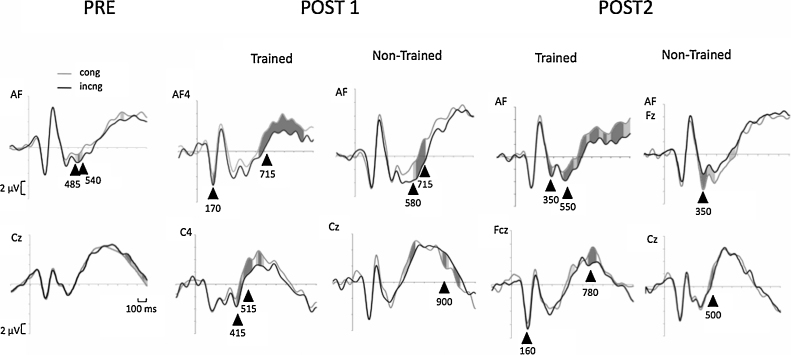
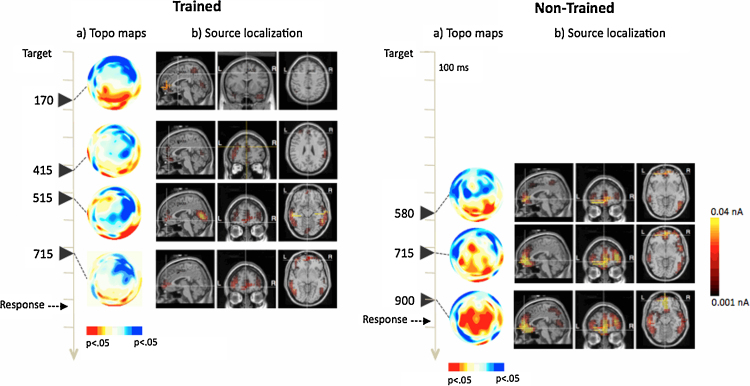
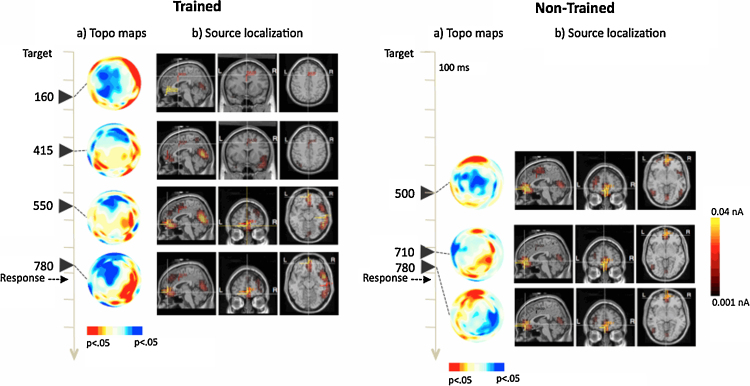
Executive attention is involved in the regulation of thoughts, emotions and responses. This function experiences major development during preschool years and is associated to a neural network involving the anterior cingulate cortex and prefrontal structures. Recently, there have been some attempts to improve attention and other executive functions through training. In the current study, a group of 5 years old children (n=37) were assigned to either a training-group who performed ten sessions of computerized training of attention or a non-trained control group. Assessment of performance in a range of tasks, targeting attention, intelligence and regulation of affect was carried out in three occasions: (1) before, (2) after, and (3) two months after completion of training. Also, brain function was examined with a high-density electroencephalogram system. Results demonstrate that trained children activate the executive attention network faster and more efficiently than untrained children, an effect that was still observed two months after without further training. Also, evidence of transfer of attention training to fluid intelligence and, to a lesser degree, to regulation of affect was observed. Results show that efficiency of the brain system underlying self-regulation can be enhanced by experience during development, providing opportunities for curricular improvement.
Copyright © 2011 Elsevier Ltd. All rights reserved.
Figures
References
-
- Blair C., Razza R.P. Relating effortful control, executive function, and false belief understanding to emerging math and literacy ability in kindergarten. Child Development. 2007;78(2 (March–April)):647–663. - PubMed
-
- Blair C., Ursache A. A bidirectional model of executive functions and self-regulation. In: Vohs K.D., Baumeister R.F., editors. Handbook of Self-regulation: Research, Theory and Applications. 2nd ed. The Guilford Press; New York: 2011. pp. 300–320.
-
- Botvinick M.M., Cohen J.D., Carter C.S. Conflict monitoring and anterior cingulate cortex: an update. Trends in Cognitive Sciences. 2004;8(12):539–546. - PubMed
-
- Bull R., Scerif G. Executive functioning as a predictor of children's mathematics ability: inhibition, switching, and working memory. Developmental Neuropsychology. 2001;19(3):273–293. - PubMed
Publication types
MeSH terms
LinkOut - more resources
Full Text Sources
