


Soil strength and macropore volume limit root elongation rates in many UK agricultural soils
- PMID: 22684682
- PMCID: PMC3394656
- DOI: 10.1093/aob/mcs118
Soil strength and macropore volume limit root elongation rates in many UK agricultural soils
Abstract
Background and aims: Simple indicators of crop and cultivar performance across a range of soil types and management are needed for designing and testing sustainable cropping practices. This paper determined the extent to which soil chemical and physical properties, particularly soil strength and pore-size distribution influences root elongation in a wide range of agricultural top soils, using a seedling-based indicator.
Methods: Intact soil cores were sampled from the topsoil of 59 agricultural fields in Scotland, representing a wide geographic spread, range of textures and management practices. Water release characteristics, dry bulk density and needle penetrometer resistance were measured on three cores from each field. Soil samples from the same locations were sieved, analysed for chemical characteristics, and packed to dry bulk density of 1.0 g cm(-3) to minimize physical constraints. Root elongation rates were determined for barley seedlings planted in both intact field and packed soil cores at a water content close to field capacity (-20 kPa matric potential).
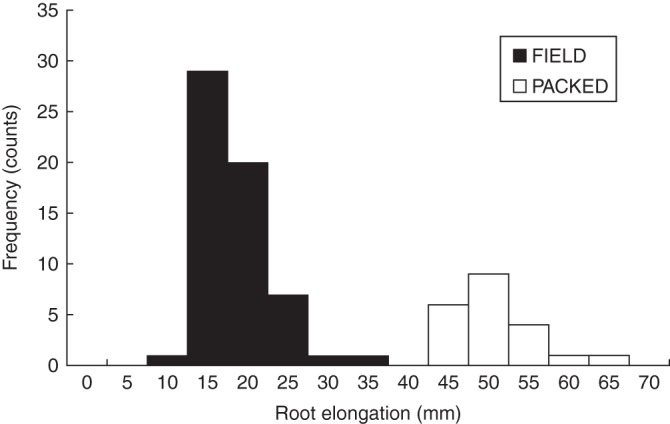
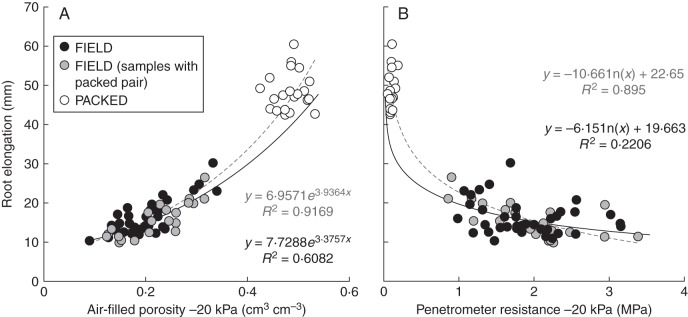
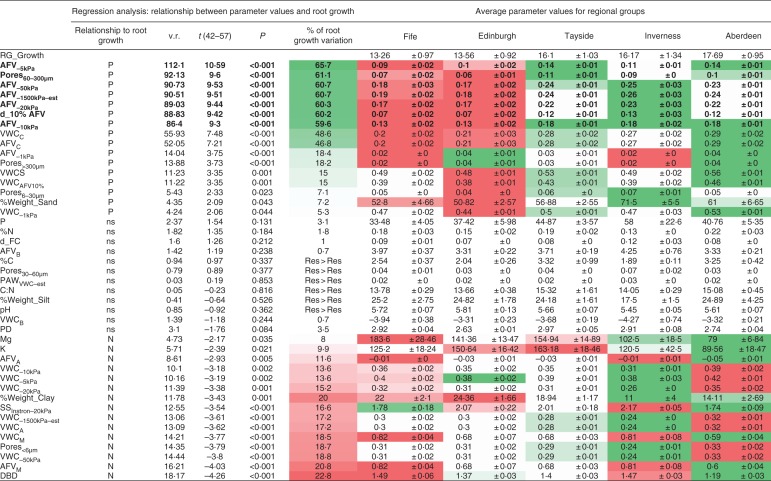
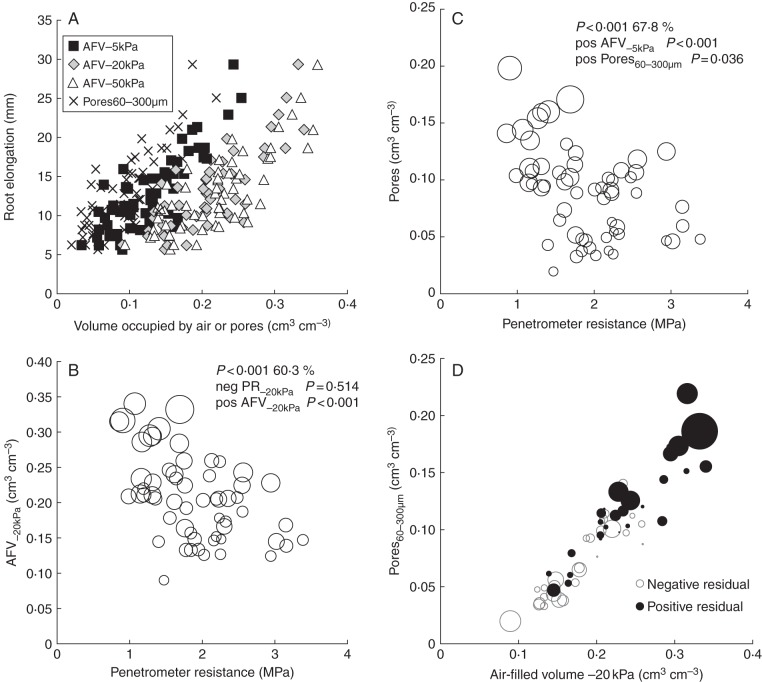
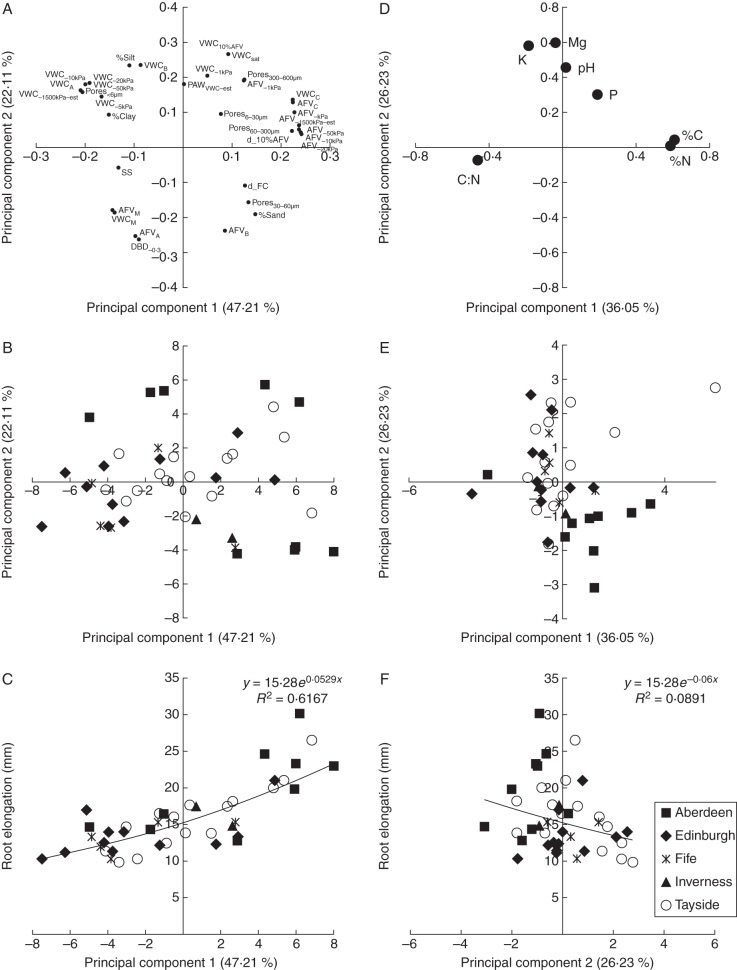
Key results: Root elongation in field soil was typically less than half of that in packed soils. Penetrometer resistance was typically between 1 and 3 MPa for field soils, indicating the soils were relatively hard, despite their moderately wet condition (compared with <0.2 MPa for packed soil). Root elongation was strongly linked to differences in physical rather than chemical properties. In field soil root elongation was related most closely to the volume of soil pores between 60 µm and 300 µm equivalent diameter, as estimated from water-release characteristics, accounting for 65.7 % of the variation in the elongation rates.
Conclusions: Root elongation rate in the majority of field soils was slower than half of the unimpeded (packed) rate. Such major reductions in root elongation rates will decrease rooting volumes and limit crop growth in soils where nutrients and water are scarce.
Figures
References
-
- Atkinson BS, Sparkes DL, Mooney SJ. Effect of seedbed cultivation and soil macrostructure on the establishment of winter wheat (Triticum aestivum) Soil & Tillage Research. 2009a;103:291–301.
-
- Atkinson BS, Sparkes DL, Mooney SJ. The impact of soil structure on the establishment of winter wheat (Triticum aestivum) European Journal of Agronomy. 2009b;30:243–257.
-
- Bengough AG. Root growth and function in relation to soil structure, composition, and strength. In: de Kroon H, Visser EJW, editors. Root ecology – ecological studies. Vol. 168. New York, NY: Springer-Verlag; 2003. pp. 151–171.
-
- Bengough AG, Mullins CE. Mechanical impedance to root growth: a review of experimental techniques and root growth responses. Journal of Soil Science. 1990;41:341–358.
-
- Bengough AG, Mullins CE. Penetrometer resistance, root penetration resistance and root elongation rate in two sandy loam soils. Plant and Soil. 1991;131:59–66.
