


Intervention to reduce secondhand smoke exposure among children with cancer: a controlled trial
- PMID: 22684982
- PMCID: PMC3491144
- DOI: 10.1002/pon.3117
Intervention to reduce secondhand smoke exposure among children with cancer: a controlled trial
Abstract
Objective: This randomized controlled trial tested the efficacy of parent-based behavioral counseling for reducing secondhand smoke exposure (SHSe) among children with cancer. It also examined predictors of smoking and SHSe outcomes.
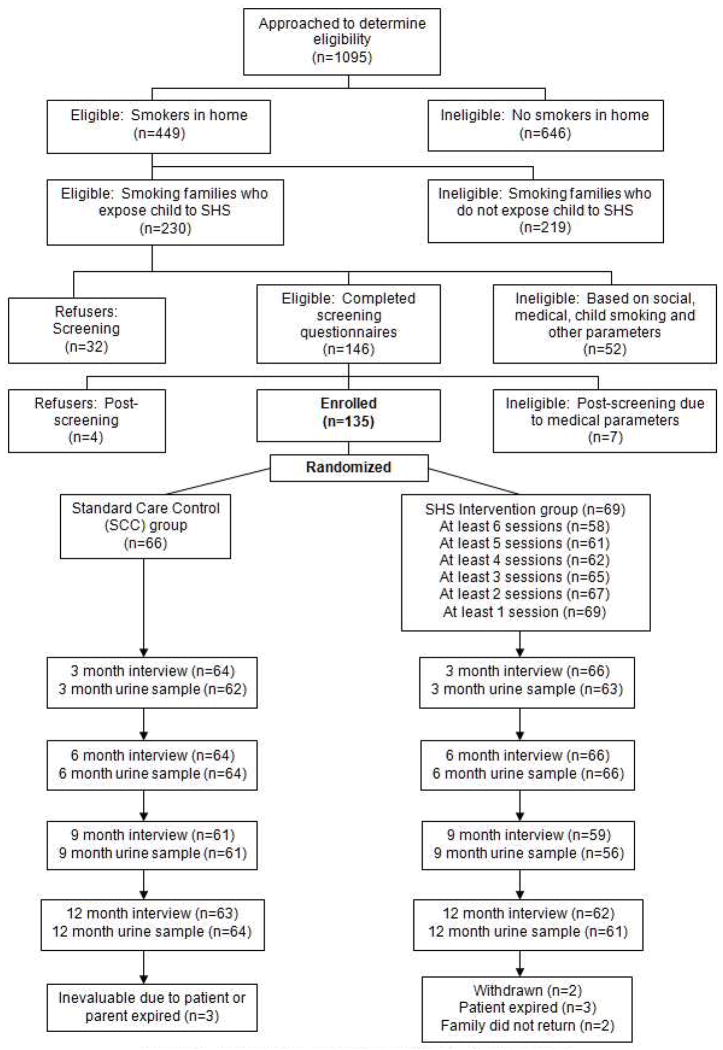
Methods: Participants were 135 parents or guardians of nonsmoking children with cancer, <18 years, at least 30 days postdiagnosis, and living with at least one adult smoker. Parents were randomized to either a standard care control group or an intervention consisting of six counseling sessions delivered over 3 months. Parent-reported smoking and child SHSe levels were obtained at baseline, 3, 6, 9, and 12 months. Children provided urine samples for cotinine analyses.
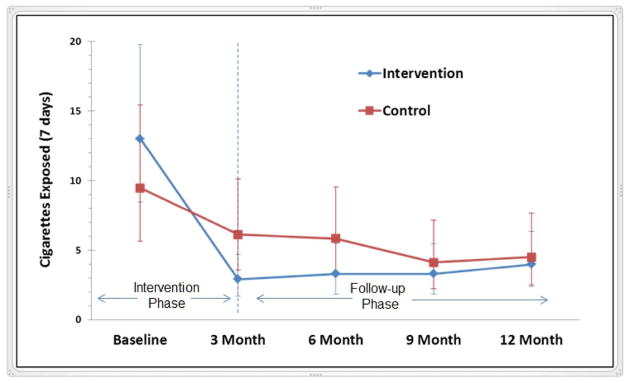
Results: Reductions in parent-reported smoking and exposure were observed in both the intervention and control conditions. There was a significantly greater reduction in parent-reported smoking and child SHSe at 3 months for the intervention group compared with the control group. Child SHSe was significantly lower at 12 months relative to baseline in both groups. Children's cotinine levels did not show significant change over time in either group. Exposure outcomes were influenced by the number of smokers at home, smoking status of the parent participating in the trial, and the child's environment (home versus hospital) the day before the assessment.
Conclusions: Children's SHSe can be reduced by advising parents to protect their child from SHSe, combined with routine reporting of their child's exposure and cotinine testing, when delivered in the context of the pediatric cancer setting. More intensive interventions may be required to achieve greater reductions in SHSe.
Copyright © 2012 John Wiley & Sons, Ltd.
Conflict of interest statement
The authors declare that they have no conflict of interest.
Figures
References
-
- United States Department of Health and Human Services (USDHHS) The health consequences of involuntary exposure to tobacco smoke: A report of the Surgeon General. Atlanta, GA: US Department of Health and Human Services, CDC; 2006.
-
- Etzel RA. Environmental Tobacco Smoke. Immunol Allergy Clin North Am. 1994;14:621–633.
-
- National Research Council. Environmental tobacco smoke: Measuring exposures and assessing health effects. Washington, DC: National Academy Press; 1986. pp. 209–211. - PubMed
-
- Office of Health and Environmental Assessment, Office of Research and Development, Environmental Protection Agency. Respiratory health effects of passive smoking: Lung cancer and other disorders. Washington, D.C: 1993.
Publication types
MeSH terms
Substances
Grants and funding
LinkOut - more resources
Full Text Sources
Medical
