


doi: 10.1128/AEM.00530-12.
Epub 2012 Jun 8.
Cloning, production, and functional expression of the bacteriocin enterocin A, produced by Enterococcus faecium T136, by the yeasts Pichia pastoris, Kluyveromyces lactis, Hansenula polymorpha, and Arxula adeninivorans
Affiliations
- PMID: 22685156
- PMCID: PMC3406115
- DOI: 10.1128/AEM.00530-12
Item in Clipboard
Cloning, production, and functional expression of the bacteriocin enterocin A, produced by Enterococcus faecium T136, by the yeasts Pichia pastoris, Kluyveromyces lactis, Hansenula polymorpha, and Arxula adeninivorans
Appl Environ Microbiol.
2012 Aug.
Abstract
The bacteriocin enterocin A (EntA) produced by Enterococcus faecium T136 has been successfully cloned and produced by the yeasts Pichia pastoris X-33EA, Kluyveromyces lactis GG799EA, Hansenula polymorpha KL8-1EA, and Arxula adeninivorans G1212EA. Moreover, P. pastoris X-33EA and K. lactis GG799EA produced EntA in larger amounts and with higher antimicrobial and specific antimicrobial activities than the EntA produced by E. faecium T136.
Figures
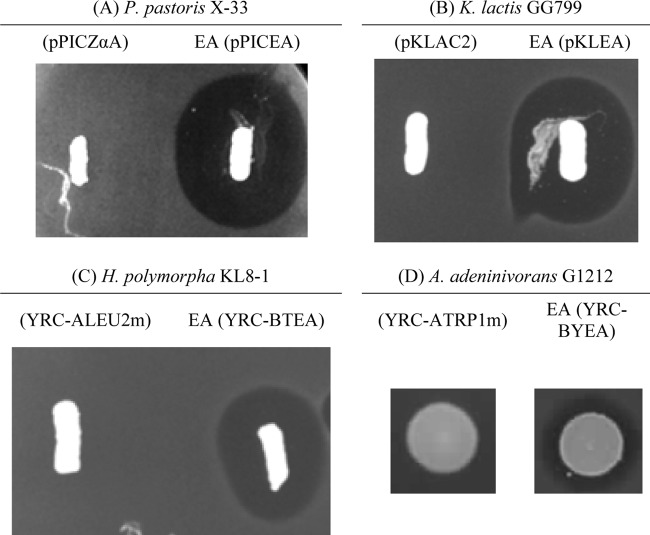
Antimicrobial activities of recombinant yeasts as determined by a SOAT. Panels: A, P. pastoris X-33 (pPICZαA) and X-33EA (pPICEA); B, K. lactis GG799 (pKLAC2) and GG799EA (pKLEA); C, H. polymorpha KL8-1 (YRC-ALEU2m) and KL8-1EA (YRC-BTEA); D, A. adeninivorans G1212 (YRC-ATRP1m) and G1212EA (YRC-BYEA). The P. pastoris X-33 derivatives were streaked onto the surfaces of plates containing 1% yeast extract, 2% peptone, 100 mM potassium phosphate (pH 6), 1.34% yeast nitrogen base without amino acids, 4 × 10⁻⁵% biotin, and 0.5% methanol; the K. lactis GG799 derivatives were streaked onto plates containing 1% yeast extract, 2% peptone, and 2% galactose; the H. polymorpha KL8-1 derivatives were streaked onto yeast extract-peptone-dextrose (Sigma-Aldrich Inc.) plates; and the A. adeninivorans G1212 derivatives were spotted onto YMM-glucose plates containing 20 mM NaNO3 (YMM-NO3) (6). All plates were incubated at 30°C. After growth of the yeast hosts, 40 ml of MRS (Oxoid Ltd.) soft agar containing the indicator microorganism E. faecium P13 at about 1 × 10⁵ CFU/ml was poured over the plates, which were then incubated at 30°C overnight for development of halos of inhibition.
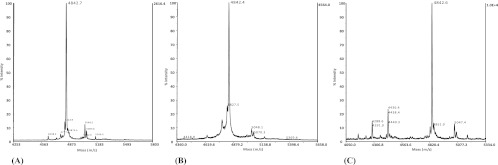
Mass spectrometry analysis of purified EntA from P. pastoris X-33EA (A), K. lactis GG799EA (B), and H. polymorpha KL8-1EA (C).
References
-
- Aymerich MT, et al. 2000. Application of enterocins as biopreservatives against Listeria innocua in meat products. J. Food Prot. 63:721–726 - PubMed
-
- Beaulieu L, et al. 2005. Production of pediocin PA-1 in the methylotrophic yeast Pichia pastoris reveals unexpected inhibition of its biological activity due to the presence of collagen-like material. Protein Expr. Purif. 43:111–125 - PubMed
-
- Böer E, Steinborn G, Kunze G, Gellissen G. 2007. Yeast expression platforms. Appl. Microbiol. Biotechnol. 77:513–523 - PubMed
Publication types
MeSH terms
Substances
LinkOut - more resources
Full Text Sources
Other Literature Sources
