. 2012 Aug;194(16):4355-65.
doi: 10.1128/JB.00706-12. Epub 2012 Jun 8.

Rot and SaeRS cooperate to activate expression of the staphylococcal superantigen-like exoproteins

Affiliations

Rot and SaeRS cooperate to activate expression of the staphylococcal superantigen-like exoproteins

Meredith A Benson et al. J Bacteriol. 2012 Aug.

Abstract

Staphylococcus aureus is a significant human pathogen that is capable of infecting a wide range of host tissues. This bacterium is able to evade the host immune response by utilizing a repertoire of virulence factors. These factors are tightly regulated by various two-component systems (TCS) and transcription factors. Previous studies have suggested that transcriptional regulation of a subset of immunomodulators, known as the staphylococcal superantigen-like proteins (Ssls), is mediated by the master regulators accessory gene regulator (Agr) TCS, S. aureus exoprotein expression (Sae) TCS, and Rot. Here we demonstrate that Rot and SaeR, the response regulator of the Sae TCS, synergize to coordinate the activation of the ssl promoters. We have determined that both transcription factors are required, but that neither is sufficient, for promoter activation. This regulatory scheme is mediated by direct binding of both transcription factors to the ssl promoters. We also demonstrate that clinically relevant methicillin-resistant S. aureus (MRSA) strains respond to neutrophils via the Sae TCS to upregulate the expression of ssls. Until now, Rot and the Sae TCS have been proposed to work in opposition of one another on their target genes. This is the first example of these two regulators working in concert to activate promoters.


Figures
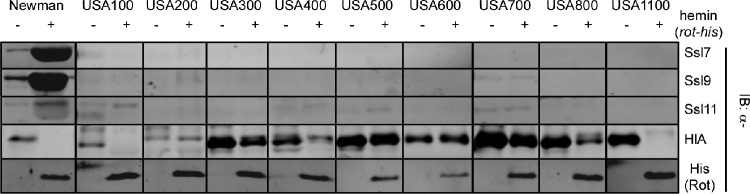
Fig 1
Fig 1
Effect of overproduction of Rot in S. aureus clinical isolates. Immunoblot analysis of early-stationary-phase supernatants from various S. aureus clinical isolates containing a hemin-inducible Rot vector, grown in inducing (+ hemin) or noninducing (− hemin) conditions, is shown. Exoproteins were collected, precipitated, separated using SDS-PAGE, and transferred to nitrocellulose, and the indicated Ssls and Hla were detected by immunoblotting (IB). Corresponding whole-cell lysates were immunoblotted with an anti-6×His antibody to detect Rot-His.
Fig 2
Fig 2
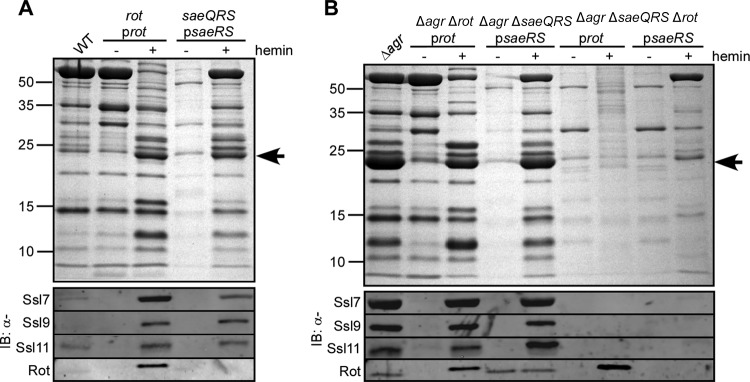
Contribution of Rot and the Sae TCS to Ssl production in strain Newman. The indicated Newman strains were grown to early stationary phase under either inducing (+ hemin) or noninducing (− hemin) conditions. Exoproteins were collected, precipitated, separated using SDS-PAGE, either stained with Coomassie blue (top panels) or transferred to nitrocellulose, and immunoblotted for the indicated Ssls (bottom panel). Corresponding whole-cell lysates were also immunoblotted for Rot. The arrow indicates Ssls.
Fig 3
Fig 3
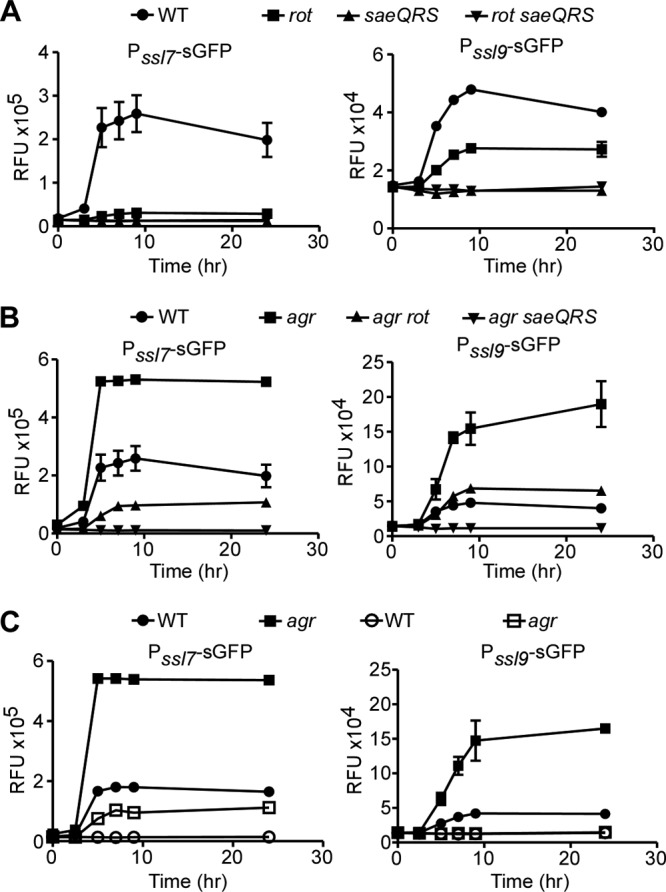
Role of the Sae TCS in the activation of the ssl promoters. (A and B) The indicated Newman strains were transformed with plasmids containing the ssl7 or ssl9 promoter controlling GFP gene expression, and GFP fluorescence was monitored at the indicated time points. Values represent averages from three independent experiments ± standard deviations (SD). (C) Reporter assay as done for panel A. Closed symbols indicate wild-type promoters, and open symbols indicate promoters in which the SaeR binding site has been mutated to impair SaeR binding.
Fig 4
Fig 4
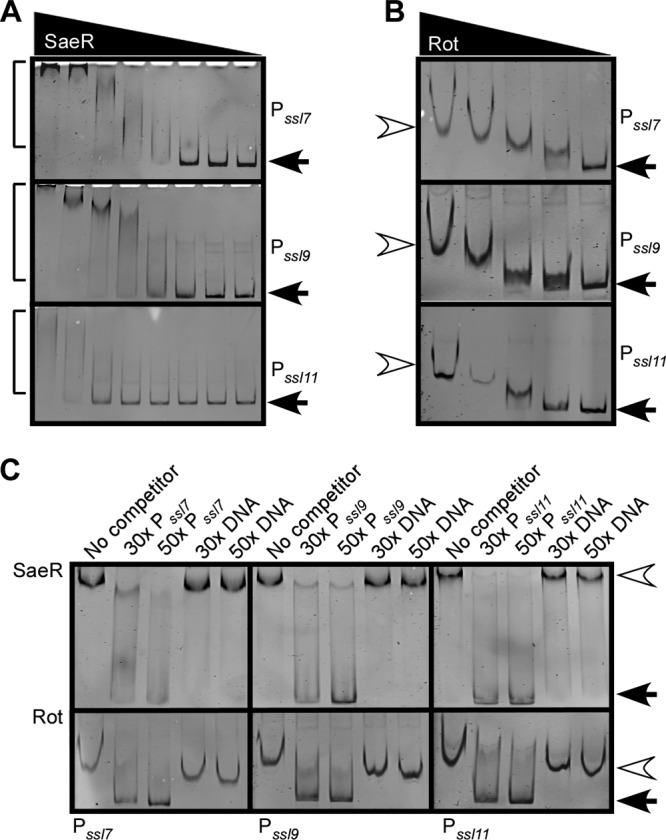
Binding of SaeR or Rot to the ssl7, ssl9, and ssl11 promoters. (A) EMSA of purified phosphorylated SaeR incubated with either the ssl7, ssl9, or ssl11 promoter containing a biotin tag. Two-fold serial dilutions of SaeR, starting with 150 pmol, were incubated with 40 fmol DNA. Protein-DNA complexes were separated by PAGE, and the DNA probe was visualized using streptavidin DyLight. Arrows indicate free probe, and brackets indicate shifted probe. (B) EMSA of purified Rot 2-fold serial dilutions, starting with 4 pmol, incubated with either the ssl7, ssl9, or ssl11 promoter as for panel A. Closed arrows indicate free probe, and open arrowheads indicate shifted probe. (C) EMSA in which 75 pmol of SaeR or 2 pmol of Rot was incubated with 40 fmol of the indicated biotinylated promoter DNA with a 30- or 50-fold molar excess of nonbiotinylated promoter DNA or nonbiotinylated control DNA. The EMSA reaction was performed and visualized as for panel A. Closed arrows indicate free probe, and open arrowheads indicate shifted probe.
Fig 5
Fig 5
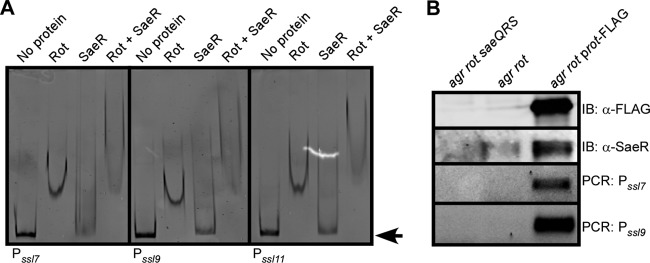
DNA binding properties of Rot, SaeR, and Rot/SaeR complexes. (A) EMSA of 2 pmol of purified Rot, 37.5 pmol of purified phospho-SaeR, or a mixture of Rot and phospho-SaeR incubated with 40 fmol of either the ssl7, ssl9, or ssl11 promoter containing a biotin tag. DNA was visualized using streptavidin DyLight. The arrow indicates free probe. (B) Immunoprecipitation of FLAG-tagged Rot from the indicated S. aureus Newman strains. The samples were separated using SDS-PAGE, transferred to nitrocellulose, and immunoblotted (IB) for FLAG to detect Rot or for SaeR (top) or used as temple for PCR amplification of the ssl7 and ssl9 promoters (bottom).
Fig 6
Fig 6
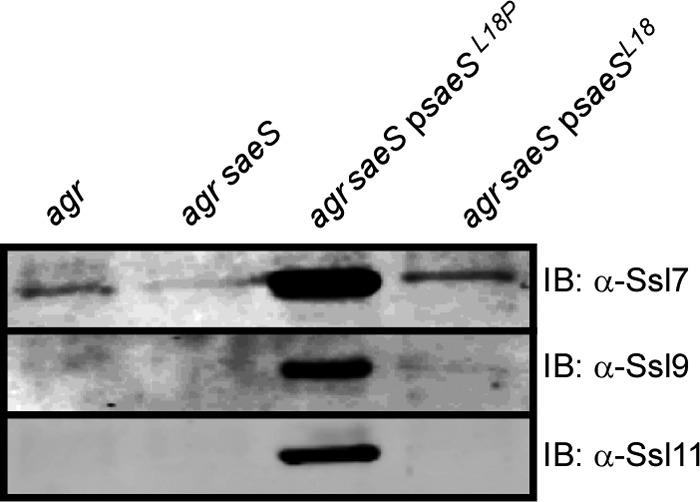
Effect of the SaeS-L18P mutant on the production of Ssls by USA300. The indicated USA300 LAC strains were grown to early stationary phase, and exoproteins were collected, precipitated, separated using SDS-PAGE, and transferred to nitrocellulose. The indicated Ssls were detected by immunoblotting.
Fig 7
Fig 7
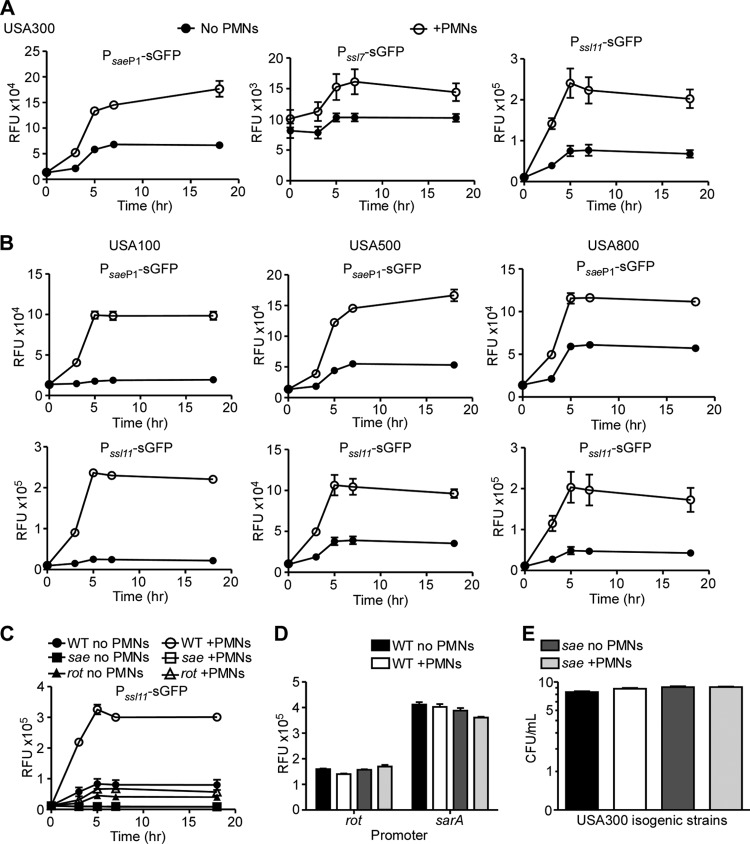
Human neutrophils and activation of the ssl promoters. (A) Reporter assay of S. aureus USA300 containing either the sae P1, ssl7, or ssl11 transcriptional reporter controlling GFP gene expression grown in the absence (closed circles) or presence (open circles) of primary human neutrophils (PMNs). (B) Reporter assay of MRSA USA100, USA500, or USA800 containing the sae P1 or ssl11 transcriptional reporter as for panel A. (C) Reporter assay of wild-type USA300 (WT) (circles), the saeQRS mutant (squares), or the rot mutant (triangles) containing the ssl11 transcriptional reporter grown as for panel A. (D) Reporter assay of WT USA300 containing a rot or sarA transcriptional reporter controlling GFP gene expression grown in the absence (no PMNs) or presence (+PMNs) of primary human neutrophils. (E) CFU counts of WT USA300 or saeQRS mutant growth with or without neutrophils for 5 h. Values represent averages from six (A to C) or three (D and E) independent donors ± SD.

References

    1. Adhikari RP, Novick RP. 2008. Regulatory organization of the staphylococcal sae locus. Microbiology 154: 949–959 - PubMed
    1. Anonymous. 1999. Four pediatric deaths from community-acquired methicillin-resistant Staphylococcus aureus—Minnesota and North Dakota, 1997–1999. MMWR Morb. Mortal. Wkly. Rep. 48: 707–710 - PubMed
    1. Attia AS, Benson MA, Stauff DL, Torres VJ, Skaar EP. 2010. Membrane damage elicits an immunomodulatory program in Staphylococcus aureus. PLoS Pathog. 6: e1000802 doi:. - DOI - PMC - PubMed
    1. Baba T, Bae T, Schneewind O, Takeuchi F, Hiramatsu K. 2008. Genome sequence of Staphylococcus aureus strain Newman and comparative analysis of staphylococcal genomes: polymorphism and evolution of two major pathogenicity islands. J. Bacteriol. 190: 300–310 - PMC - PubMed
    1. Bae T, Schneewind O. 2006. Allelic replacement in Staphylococcus aureus with inducible counter-selection. Plasmid 55: 58–63 - PubMed

Publication types

MeSH terms

LinkOut - more resources