


Approaches to identifying appropriate medication adherence assessments for HIV infected individuals with comorbid bipolar disorder
- PMID: 22686169
- PMCID: PMC3961000
- DOI: 10.1089/apc.2011.0447
Approaches to identifying appropriate medication adherence assessments for HIV infected individuals with comorbid bipolar disorder
Abstract
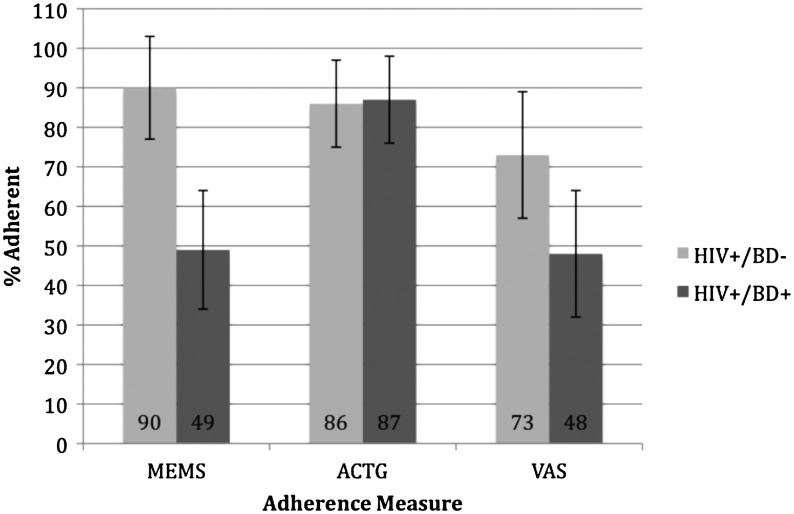
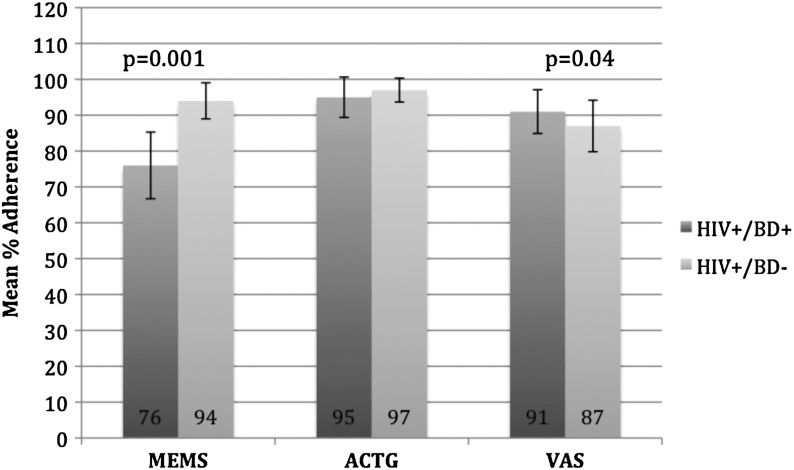
Assessing medication adherence in already difficult-to-treat HIV-infected subpopulations presents a unique challenge. The objective of this study was to compare different approaches to assessing medication adherence: (1) electronic medication monitoring, (2) standardized self-report questionnaire, and (3) self-report visual analogue scale, and to determine whether antiretroviral therapy (ART) adherence measures differed for HIV-infected persons with bipolar disorder (HIV+ /BD+) as compared to HIV-infected persons without bipolar disorder (HIV+ /BD-). ART adherence was assessed for 74 HIV-positive participants using the Medication Event Monitoring System (MEMS), AIDS Clinical Trials Group (ACTG) adherence questionnaire, and visual analogue scale (VAS). Participants were classified as adherent or nonadherent on each measure by previously validated cutscores. Correlations and logistic regressions were used to examine associations between adherence measures and demographic and clinical variables. In the HIV+ /BD- group, significant correlations existed between each self-report measure and the MEMS. Males comprised 81% of the study population. Participants averaged 44 years of age and 13 years of education. No significant correlations were found among adherence measures in the HIV+ /BD+ group. Among participants reporting adherence on either self-report measure but classified as nonadherent based on MEMS, 94% had a diagnosis of bipolar disorder. Bipolar disorder was a significant predictor of adherence classification discordance among self-report measures. Our findings suggest that it remains difficult to assess ART adherence among HIV-positive individuals with bipolar disorder. Combined approaches of self-report and objective measures may be the best way to estimate adherence, and may provide the best basis for interventions designed to improve adherence in difficult-to-treat populations.
Figures
References
-
- Brettle RP. Wilson A. Povey S, et al. Combination therapy for HIV: The effect on inpatient activity, morbidity and mortality of a cohort of patients. Int J STD AIDS. 1998;9:80–87. - PubMed
-
- Morineau G. Vun MC. Barennes H, et al. Survival and quality of life among HIV-positive people on antiretroviral therapy in Cambodia. AIDS Patient Care STDs. 2009;23:669–677. - PubMed
-
- Palella FJ., Jr. Delaney KM. Moorman AC, et al. Declining morbidity and mortality among patients with advanced human immunodeficiency virus infection. HIV Outpatient Study Investigators. N Engl J Med. 1998;338:853–860. - PubMed
-
- Kelly JA. Kalichman SC. Behavioral research in HIV/AIDS primary and secondary prevention: Recent advances and future directions. J Consult Clin Psychol. 2002;70:626–639. - PubMed
