Feasibility and pilot efficacy results from the multisite Cognitive Remediation in the Schizophrenia Trials Network (CRSTN) randomized controlled trial
- PMID: 22687548
- PMCID: PMC3746329
- DOI: 10.4088/JCP.11m07100
Feasibility and pilot efficacy results from the multisite Cognitive Remediation in the Schizophrenia Trials Network (CRSTN) randomized controlled trial
Abstract
Background: The true benefit of pharmacologic intervention to improve cognition in schizophrenia may not be evident without regular cognitive enrichment. Clinical trials assessing the neurocognitive effects of new medications may require engagement in cognitive remediation exercises to stimulate the benefit potential. However, the feasibility of large-scale multisite studies using cognitive remediation at clinical trials sites has not been established.
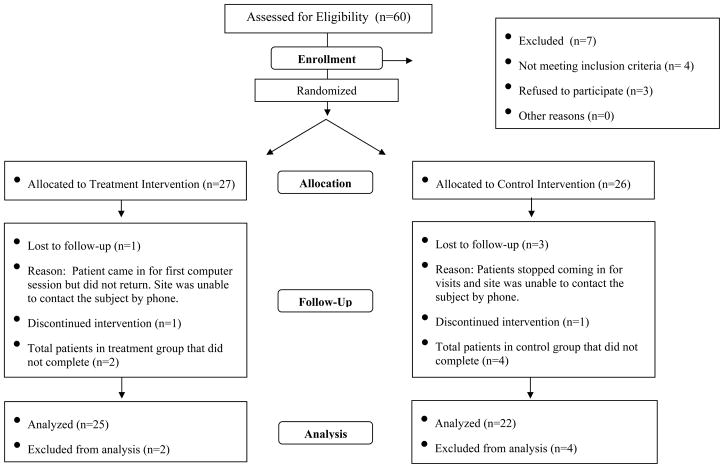
Method: 53 adult patients with DSM-IV schizophrenia from 9 university-affiliated sites were randomized to a cognitive remediation condition that included the Posit Science Brain Fitness auditory training program with weekly Neuropsychological and Educational Approach to Remediation (NEAR) "bridging groups" or a control condition of computer games and weekly healthy lifestyles groups. Patients were expected to complete 3 to 5 one-hour sessions weekly for 40 sessions or 12 weeks, whichever came first. The primary outcomes were feasibility results as measured by rate of enrollment, retention, and completion rate of primary outcome measures. The study was conducted from July 2009 through January 2010.
Results: During a 3-month enrollment period, 53 (of a projected 54) patients were enrolled, and 41 (77%) met criteria for study completion. Thirty-one patients completed all 40 sessions, and all patients completed all primary outcome measures. Preliminary efficacy results indicated that, after 20 sessions, patients in the cognitive remediation condition demonstrated mean MATRICS Consensus Cognitive Battery composite score improvements that were 3.7 (95% CI, 0.05-7.34) T-score points greater than in patients in the computer-games control group (F(1,46) = 4.16, P = .047). At the end of treatment, a trend favoring cognitive remediation was not statistically significant (F(1,47) = 2.26, P = .14).
Conclusion: Multisite clinical trials of cognitive remediation using the Posit Science Brain Fitness auditory training program with the NEAR method of weekly bridging groups at traditional clinical sites appear to be feasible.
Trial registration: ClinicalTrials.gov identifier: NCT00930150.
© Copyright 2012 Physicians Postgraduate Press, Inc.
Comment in
-
Can we incorporate psychosocial treatment interventions into psychopharmacology clinical trials?J Clin Psychiatry. 2012 Jul;73(7):1023-4. doi: 10.4088/JCP.12com07829. J Clin Psychiatry. 2012. PMID: 22901351 No abstract available.
References
-
- Keefe RSE, Eesley CE, Poe M. Defining a cognitive function decrement in schizophrenia. Biol Psychiatry. 2005;57:688–691. - PubMed
-
- Heinrichs RW, Zankanis KK. Neurocognitive deficit in schizophrenia: A quantitative review of the evidence. Neuropsychology. 1998;12:426–444. - PubMed
-
- Green MF. What are the functional consequences of neurocognitive deficits in schizophrenia? Am J Psychiatry. 1996;153:321–330. - PubMed
-
- Green MF, Kern RS, Braff DL, Mintz J. Neurocognitive deficits and functional outcome in schizophrenia: Are we measuring the “right stuff”? Schizophr Bull. 2000;26:119–136. - PubMed
-
- Keefe RSE, Bilder RM, Davis SM, et al. Neurocognitive effects of antipsychotic medications in patients with chronic schizophrenia in the CATIE trial. Arch of Gen Psychiatry. 2007;64:633–647. - PubMed
Publication types
MeSH terms
Associated data
Grants and funding
LinkOut - more resources
Full Text Sources
Medical
Miscellaneous