


Reduction in Hepatic Inflammation Is Associated With Less Fibrosis Progression and Fewer Clinical Outcomes in Advanced Hepatitis C
- PMID: 22688849
- PMCID: PMC3865099
- DOI: 10.1038/ajg.2012.137
Reduction in Hepatic Inflammation Is Associated With Less Fibrosis Progression and Fewer Clinical Outcomes in Advanced Hepatitis C
Abstract
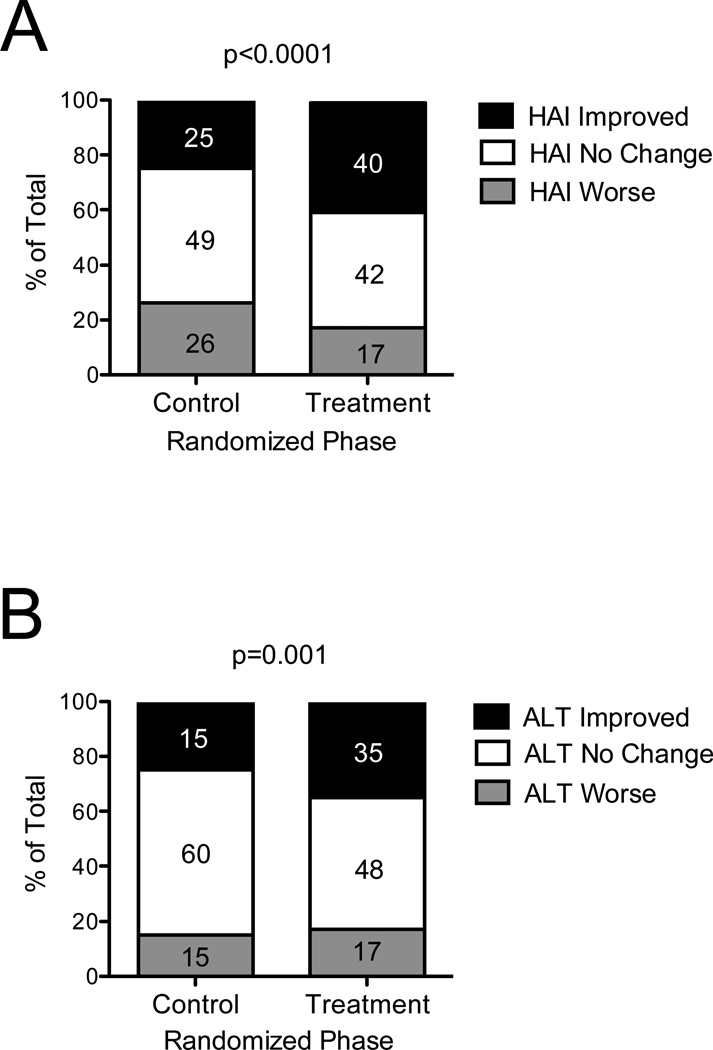
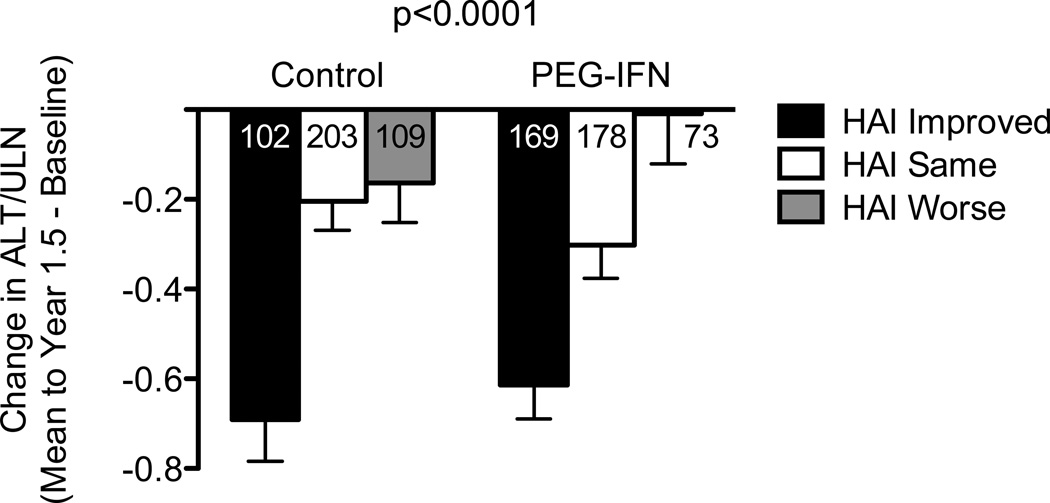
Objectives: During the Hepatitis C Antiviral Long-term Treatment against Cirrhosis Trial, 3.5 years of maintenance peginterferon-alfa-2a therapy did not affect liver fibrosis progression or clinical outcomes among 1,050 previous interferon nonresponders with advanced fibrosis or cirrhosis. We investigated whether reduced hepatic inflammation was associated with clinical benefit in 834 patients with a baseline and follow-up biopsy 1.5 years after randomization to peginterferon or observation.
Methods: Relationships between change in hepatic inflammation (Ishak hepatic activity index, (HAI)) and serum alanine aminotransferase level, fibrosis progression and clinical outcomes after randomization, and hepatitis C virus (HCV) RNA decline before and after randomization were evaluated. Histological change was defined as a ≥ 2-point difference in HAI or Ishak fibrosis score between biopsies.
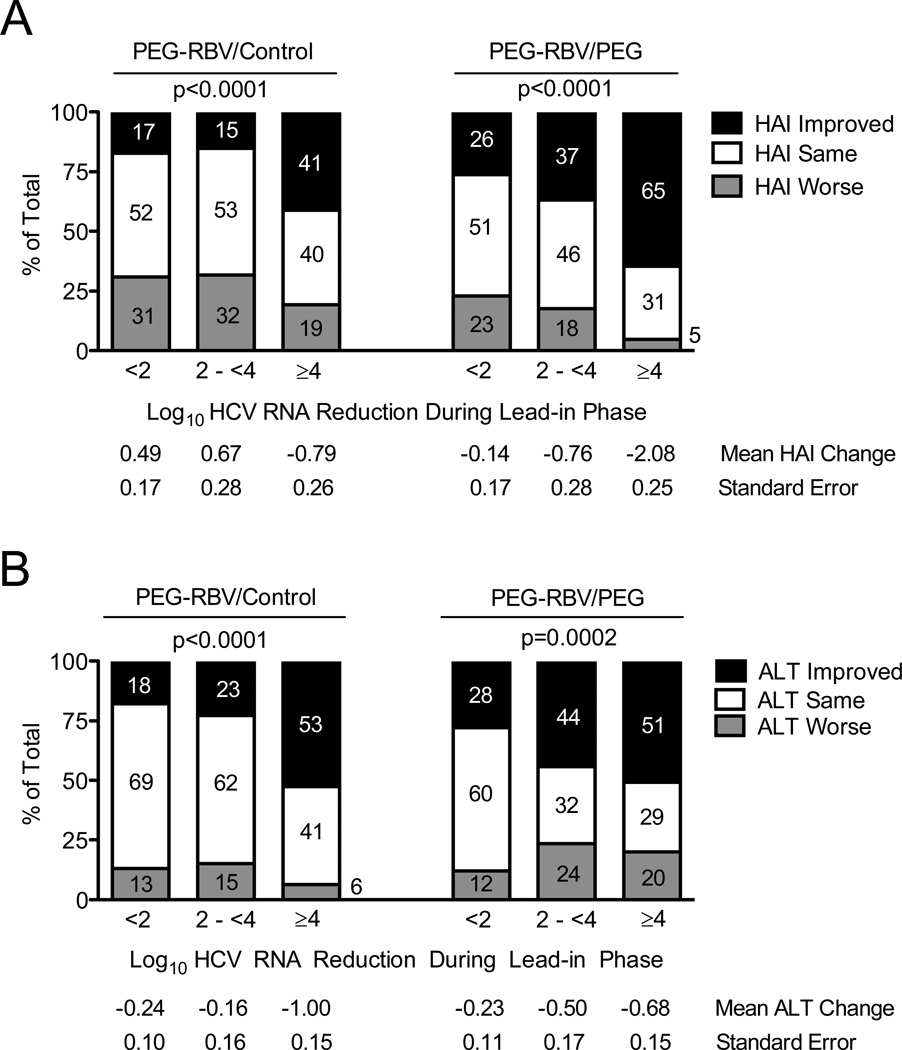
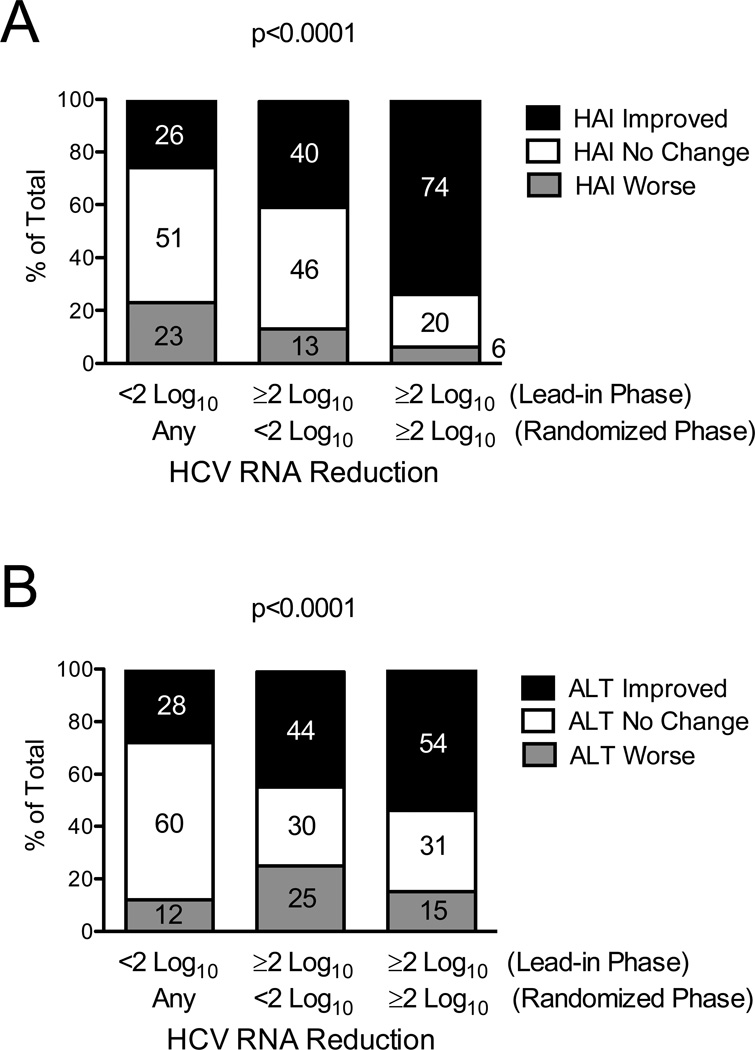
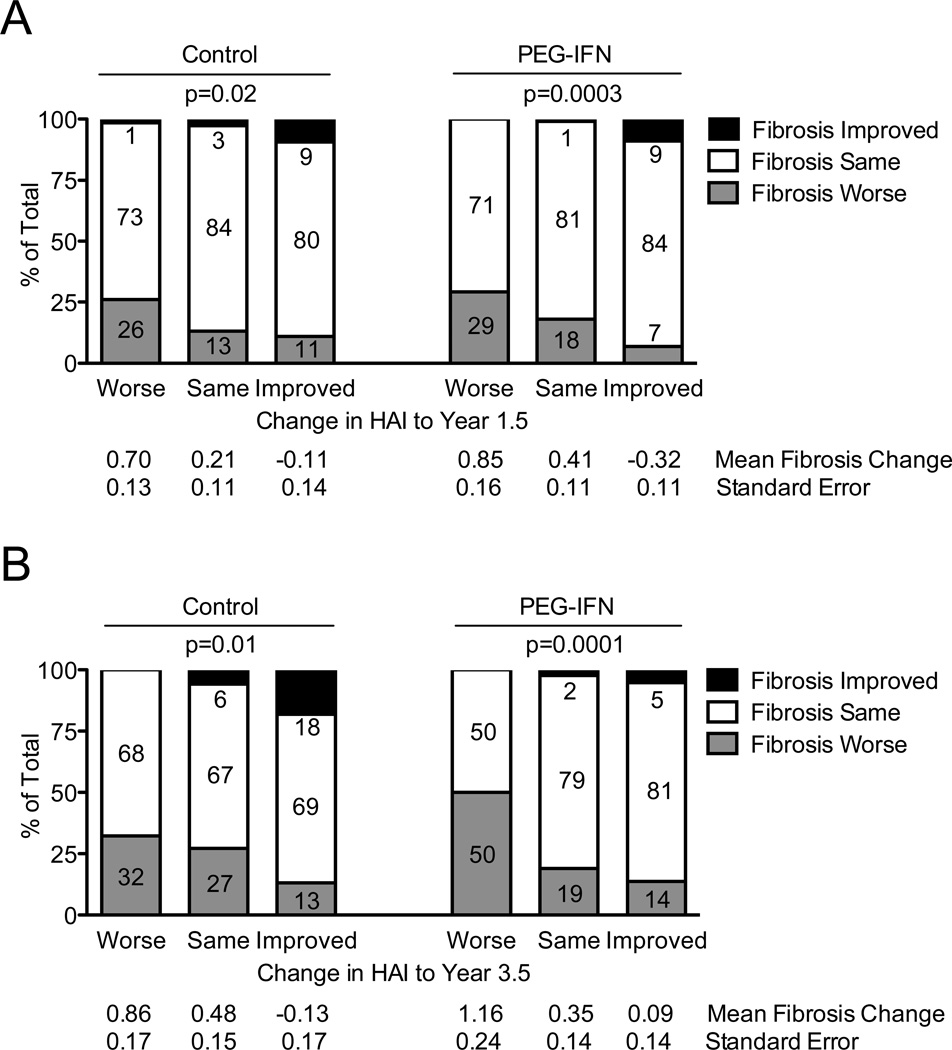
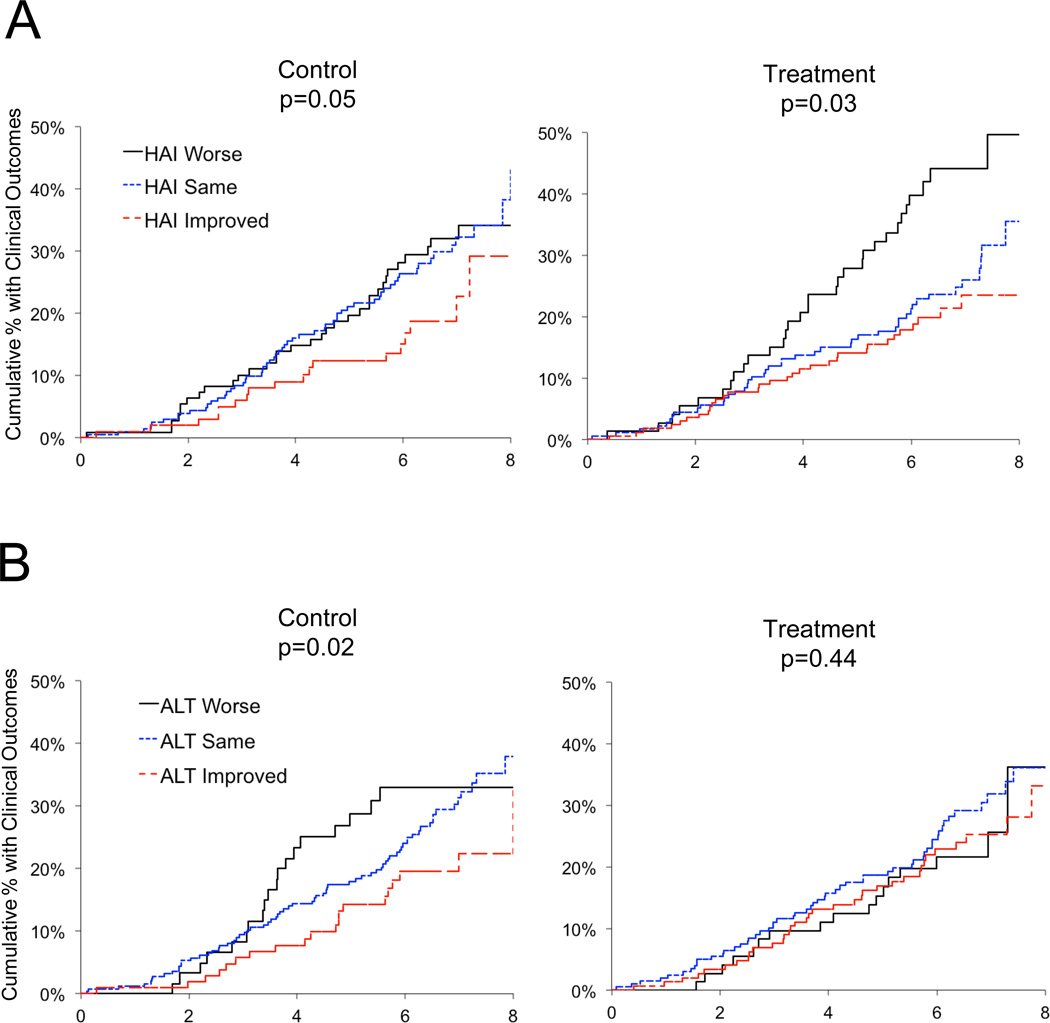
Results: Among 657 patients who received full-dose peginterferon/ribavirin "lead-in" therapy before randomization, year-1.5 HAI improvement was associated with lead-in HCV RNA suppression in both the randomized treated (P<0.0001) and control (P=0.0001) groups, even in the presence of recurrent viremia. This relationship persisted at year 3.5 in both the treated (P=0.001) and control (P=0.01) groups. Among 834 patients followed for a median of 6 years, fewer clinical outcomes occurred in patients with improved HAI at year 1.5 compared with those without such improvement in both the treated (P=0.03) and control (P=0.05) groups. Among patients with Ishak 3-4 fibrosis at baseline, those with improved HAI at year 1.5 had less fibrosis progression at year 1.5 in both the treated (P=0.0003) and control (P=0.02) groups.
Conclusions: Reduced hepatic inflammation (measured 1.5 and 3.5 years after randomization) was associated with profound virological suppression during lead-in treatment with full-dose peginterferon/ribavirin and with decreased fibrosis progression and clinical outcomes, independent of randomized treatment.
Trial registration: ClinicalTrials.gov NCT00006164.
Figures
References
-
- Hoofnagle JH, Seeff LB. Peginterferon and ribavirin for chronic hepatitis C. N Engl J Med. 2006;355:2444–2451. - PubMed
-
- Thomas DL, Seeff LB. Natural history of hepatitis C. Clin Liver Dis. 2005;9:383–398. - PubMed
-
- Veldt BJ, Heathcote EJ, Wedemeyer H, Reichen J, Hofmann WP, Zeuzem S, Manns MP, Hansen BE, Schalm SW, Janssen HL. Sustained virologic response and clinical outcomes in patients with chronic hepatitis C and advanced fibrosis. Ann Intern Med. 2007;147:677–684. - PubMed
-
- Carithers RLJ, Emerson SS. Therapy of hepatitis C: meta-analysis of interferon alfa-2b trials. Hepatology. 1997;26:83S–88S. - PubMed
-
- Poynard T, Leroy V, Cohard M, Thevenot T, Mathurin P, Opolon P, Zarski JP. Meta-Analysis of interferon randomized trials in the treatment of viral hepatitis C: effects of dose and duration. Hepatology. 1996;24:778–789. - PubMed
Publication types
MeSH terms
Substances
Associated data
Grants and funding
- M01RR-00042/RR/NCRR NIH HHS/United States
- 1 UL1 RR024986/RR/NCRR NIH HHS/United States
- U01 DK082871/DK/NIDDK NIH HHS/United States
- N01-DK-9-2320/DK/NIDDK NIH HHS/United States
- M01 RR001066/RR/NCRR NIH HHS/United States
- M01 RR000065/RR/NCRR NIH HHS/United States
- UL1 RR024982/RR/NCRR NIH HHS/United States
- N01-DK-9-2322/DK/NIDDK NIH HHS/United States
- M01 RR000043/RR/NCRR NIH HHS/United States
- UL1 RR024986/RR/NCRR NIH HHS/United States
- 1 UL1RR024982-01/RR/NCRR NIH HHS/United States
- N01-DK-9-2325/DK/NIDDK NIH HHS/United States
- N01 DK092324/DK/NIDDK NIH HHS/United States
- N01 DK092321/DK/NIDDK NIH HHS/United States
- M01RR-00065/RR/NCRR NIH HHS/United States
- N01-DK-9-2328/DK/NIDDK NIH HHS/United States
- N01 DK092320/DK/NIDDK NIH HHS/United States
- N01-DK-9-2318/DK/NIDDK NIH HHS/United States
- N01-DK-9-2324/DK/NIDDK NIH HHS/United States
- N01-DK-9-2319/DK/NIDDK NIH HHS/United States
- N01 DK092318/DK/NIDDK NIH HHS/United States
- M01RR-00051/RR/NCRR NIH HHS/United States
- UL1 RR025780/RR/NCRR NIH HHS/United States
- 1 UL1 RR025758-01/RR/NCRR NIH HHS/United States
- UL1 RR 025780-01/RR/NCRR NIH HHS/United States
- N01-DK-9-2321/DK/NIDDK NIH HHS/United States
- N01 DK092327/DK/NIDDK NIH HHS/United States
- M01RR-00827/RR/NCRR NIH HHS/United States
- N01-DK-9-2327/DK/NIDDK NIH HHS/United States
- M01RR-01066/RR/NCRR NIH HHS/United States
- M01 RR006192/RR/NCRR NIH HHS/United States
- UL1 TR000451/TR/NCATS NIH HHS/United States
- N01 DK092323/DK/NIDDK NIH HHS/United States
- N01 DK092326/DK/NIDDK NIH HHS/United States
- M01 RR000633/RR/NCRR NIH HHS/United States
- M01 RR000051/RR/NCRR NIH HHS/United States
- N01-DK-9-2326/DK/NIDDK NIH HHS/United States
- N01 DK092322/DK/NIDDK NIH HHS/United States
- N01-DK-9-2323/DK/NIDDK NIH HHS/United States
- UL1 RR025758/RR/NCRR NIH HHS/United States
- M01 RR000042/RR/NCRR NIH HHS/United States
- N01 DK092325/DK/NIDDK NIH HHS/United States
- M01 RR000827/RR/NCRR NIH HHS/United States
- N01 DK092319/DK/NIDDK NIH HHS/United States
- N01 DK092328/DK/NIDDK NIH HHS/United States
- M01RR-00633/RR/NCRR NIH HHS/United States
- M01RR-00043/RR/NCRR NIH HHS/United States
- M01RR-06192/RR/NCRR NIH HHS/United States
LinkOut - more resources
Full Text Sources
Medical
Molecular Biology Databases
