. 2013 Apr 25;32(17):2211-9.
doi: 10.1038/onc.2012.232. Epub 2012 Jun 11.

Cooperation between p53 and the telomere-protecting shelterin component Pot1a in endometrial carcinogenesis

Affiliations
Free PMC article

Cooperation between p53 and the telomere-protecting shelterin component Pot1a in endometrial carcinogenesis

E A Akbay et al. Oncogene. .
Free PMC article

Abstract

Type II endometrial cancer (EMCA) represents only 10% of all EMCAs, but accounts for 40% of EMCA-related mortality. Previous studies of human tumors have shown an association between Type II tumors and damaged telomeres. We hypothesized that the lack of murine Type II EMCA models is due to the extremely long telomeres in laboratory mouse strains. We previously showed that telomerase-null mice with critically short telomeres developed endometrial lesions histologically resembling endometrial intraepithelial carcinoma (EIC), the accepted precursor for Type II EMCA. However, these mice did not develop invasive endometrial adenocarcinoma, and instead succumbed prematurely to multi-organ failure. Here, we modeled critical telomere attrition by conditionally inactivating Pot1a, a component of the shelterin complex that stabilizes telomeres, within endometrial epithelium. Inactivation of Pot1a by itself did not stimulate endometrial carcinogenesis, and did not result in detectable DNA damage or apoptosis in endometrium. However, simultaneous inactivation of Pot1a and p53 resulted in EIC-like lesions by 9 months indistinguishable from those seen in late generation telomerase-null mice. These lesions progressed to invasive endometrial adenocarcinomas as early as 9 months of age with metastatic disease in 100% of the animals by 15 months. These tumors were poorly differentiated endometrial adenocarcinomas with prominent nuclear atypia, resembling human Type II cancers. Furthermore, these tumors were aneuploid with double-stranded DNA breaks and end-to-end telomere fusions and most were tetraploid or near-tetraploid. These studies lend further support to the hypothesis that telomeric instability has a critical role in Type II endometrial carcinogenesis and provides an intriguing in-vivo correlate to recent studies implicating telomere-dependent tetraploidization as an important mechanism in carcinogenesis.


Figures
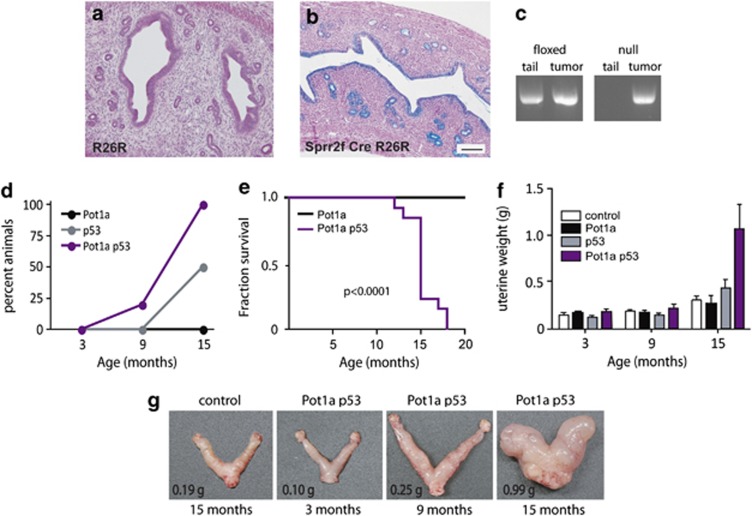
Figure 1
Figure 1
Pot1a and p53 cooperate in endometrial carcinogenesis. X-gal-stained uterine sections from 12-week-old mice. (a) Rosa26 LacZ reporter (R26R). (b) Sprr2f-Cre; R26R, showing Cre activity in both surface and deep endometrial glands. Scale bar=100 μℳ for (a) and (b). (c) PCR for floxed (left) and null (right) Pot1a alleles from Sprr2f-Cre; Pot1aL/L; p53L/L mouse tail and uterine tumor. As expected, both control (tail) and tumor samples harbor floxed alleles, since tumor stroma does not undergo gene deletion. However, only tumor DNA harbors the null allele, consistent with endometrial-specific Cre activity. (d) Tumor incidence in aging cohorts at 3, 9 and 15 months. (e) Kaplan–Meier survival analysis for aging cohorts of Sprr2f-Cre; Pot1aL/L vs. Sprr2f-Cre; Pot1aL/L; p53L/L (P<0.0001 by log-rank test). (f) Uterine weights at 3, 9 and 15 months. (g) Gross uterine pictures representative of n=5 animals analyzed per time point. Weight of uterus shown is indicated in the left lower corner.
Figure 2
Figure 2
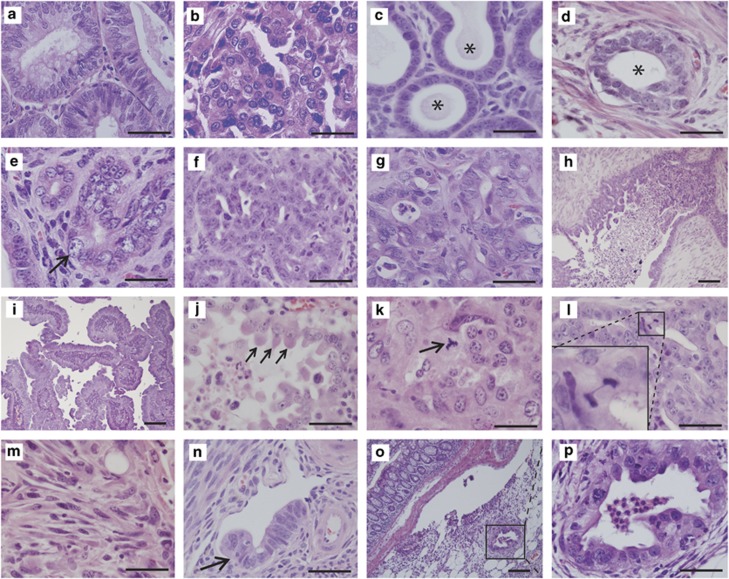
Pot1a p53 tumors resemble human Type II EMCAs. H&E-stained tissue sections. (a) Human Type I endometrioid adenocarcinoma. (b) Human Type II serous carcinoma. (c) Sprr2f-Cre; Pot1aL/L mouse, histologically normal endometrial glands at 9 months of age (asterisks). (d) Sprr2f-Cre; p53L/L invasive EMCA, uterus. Tumor is composed of well-differentiated invasive glands with relatively minor atypia (asterisk). (e) EIC-like lesion with severe atypia in uterus from 9-month-old Sprr2f-Cre; Pot1aL/L; p53L/L mouse. Arrow points to highly atypical cell with large nucleus; other cells in field display varying degrees of pleomorphism and atypia. (fp) Representative histologies from different Sprr2f-Cre; Pot1aL/L; p53L/L animals. (f, g) Representative areas of tumor showing high-grade features. (h) Tumor with focal micropapillary features. (i) Tumor with fibrovascular papillary architecture. (j) Hobnailing of tumor cells (arrows). (k) Representative high-grade tumor with tripolar mitosis consistent with severe aneuploidy (arrow). (l) Anaphase bridge consistent with presence of telomeric end-to-end fusions. (m) Focal sarcomatous differentiation, an example of extreme de-differentiation strongly associated with aggressive behavior. (n) Lymphovascular invasion by tumor away from the main tumor mass (arrow). (o) Colon with metastasis to pericolonic fat. (p) Higher magnification of metastatic gland in (o). Scale bars=20 μℳ for (c) and (e), 100 μℳ for (h), (i) and (o) and 50 μℳ for all other panels.
Figure 3
Figure 3
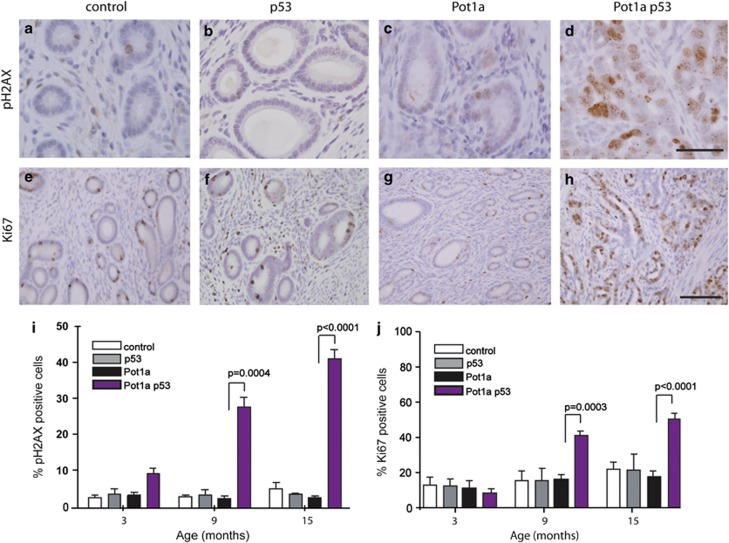
Double-strand DNA breaks in Pot1a p53 tumors. (ad), γ-H2AX immunohistochemistry, 15-month-old animals. (a) Pot1aL/L control. (b) Sprr2f-Cre; p53L/L. (c) Sprr2f-Cre; Pot1aL/L. (d) Sprr2f-Cre; Pot1aL/L; p53L/L. (eh) Ki67 immunohistochemistry, 15-month-old animals. (e) Pot1aL/L controls. (f) Sprr2f-Cre; p53L/L. (g) Sprr2f-Cre; Pot1aL/L. (h) Sprr2f-Cre; Pot1aL/L; p53L/L. (i, j) Percentage of immunopositive nuclei plotted for each genotype at 3, 9 and 15 months (n=5 for each time point). (i) γ-H2AX. (j) Ki67. Size bars=50 μℳ for (ad) and 100 μℳ for (eh).
Figure 4
Figure 4
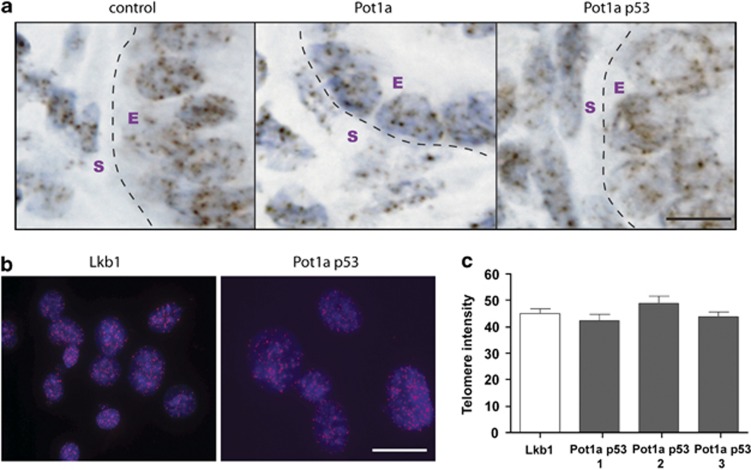
Inactivation of Pot1a and p53 does not result in detectable telomere shortening. (a) Telo-CISH on uterine tumor sections from 15-month-old animals (genotypes as shown); S=stroma, E=epithelium. Size bar=10 μℳ for all panels. (b) Q-FISH on cultured cells derived from Sprr2f-Cre; Lkb1L/L and representative Sprr2f-Cre; Pot1aL/L; p53L/L EMCAs (DAPI counterstain). (c) Average telomere intensity measurements of the four primary cultures analyzed.
Figure 5
Figure 5
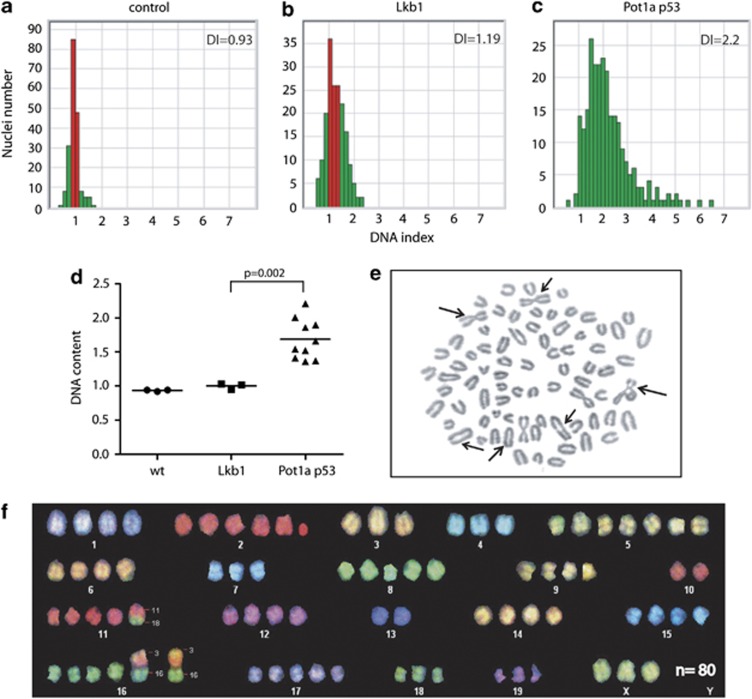
Pot1a p53 tumors exhibit chromosomal instability. (ac) Ploidy determinations of interphase nuclei by image analyses of Feulgen-stained tissue sections. (a) Uterus from 20-week-old Pot1aL/L control mouse. (b) Uterine tumor from 20-week-old Sprr2f-Cre; Lkb1L/L mouse. (c) Uterine tumor from Sprr2f-Cre; Pot1aL/L; p53L/L mouse. DNA index (DI) represents ratio of analyzed DNA content to reference nuclei in GO/G1 phase. (d) Summary of interphase ploidy analyses. Average DNA indices are shown for each genotype. (e) Metaphase spread from cultured cells derived from an Sprr2f-Cre; Pot1aL/L; p53L/L tumor. Arrows show fused bi-armed chromosomes. (f) Spectral karyotype of this cell line shows aneuploidy (near-tetraploidy) and reciprocal translocations.

References

    1. Jemal A, Siegel R, Ward E, Hao Y, Xu J, Thun MJ. Cancer statistics, 2009. CA Cancer J Clin. 2009;59:225–249. - PubMed
    1. Bokhman JV. Two pathogenetic types of endometrial carcinoma. Gynecol Oncol. 1983;15:10–17. - PubMed
    1. Di Cristofano A, Ellenson LH. Endometrial carcinoma. Annu Rev Pathol. 2007;2:57–85. - PubMed
    1. Clement PB, Young RH. Non-endometrioid carcinomas of the uterine corpus: a review of their pathology with emphasis on recent advances and problematic aspects. Adv Anat Pathol. 2004;11:117–142. - PubMed
    1. Ueda SM, Kapp DS, Cheung MK, Shin JY, Osann K, Husain A, et al. Trends in demographic and clinical characteristics in women diagnosed with corpus cancer and their potential impact on the increasing number of deaths. Am J Obstet Gynecol. 2008;198:218e1–218e6. - PubMed

Publication types

MeSH terms