. 2012 Oct;18(10):477-88.
doi: 10.1093/molehr/gas025. Epub 2012 Jun 11.

The pluripotency factor LIN28 in monkey and human testes: a marker for spermatogonial stem cells?

Affiliations

The pluripotency factor LIN28 in monkey and human testes: a marker for spermatogonial stem cells?

N Aeckerle et al. Mol Hum Reprod. 2012 Oct.

Abstract

Mammalian spermatogenesis is maintained by spermatogonial stem cells (SSCs). However, since evidentiary assays and unequivocal markers are still missing in non-human primates (NHPs) and man, the identity of primate SSCs is unknown. In contrast, in mice, germ cell transplantation studies have functionally demonstrated the presence of SSCs. LIN28 is an RNA-binding pluripotent stem cell factor, which is also strongly expressed in undifferentiated mouse spermatogonia. By contrast, two recent reports indicated that LIN28 is completely absent from adult human testes. Here, we analyzed LIN28 expression in marmoset monkey (Callithrix jacchus) and human testes during development and adulthood and compared it with that in mice. In the marmoset, LIN28 was strongly expressed in migratory primordial germ cells and gonocytes. Strikingly, we found a rare LIN28-positive subpopulation of spermatogonia also in adult marmoset testis. This was corroborated by western blotting and quantitative RT-PCR. Importantly, in contrast to previous publications, we found LIN28-positive spermatogonia also in normal adult human and additional adult NHP testes. Some seasonal breeders exhibit a degenerated (involuted) germinal epithelium consisting only of Sertoli cells and SSCs during their non-breeding season. The latter re-initiate spermatogenesis prior to the next breeding-season. Fully involuted testes from a seasonal hamster and NHP (Lemur catta) exhibited numerous LIN28-positive spermatogonia, indicating an SSC identity of the labeled cells. We conclude that LIN28 is differentially expressed in mouse and NHP spermatogonia and might be a marker for a rare SSC population in NHPs and man. Further characterization of the LIN28-positive population is required.


Figures
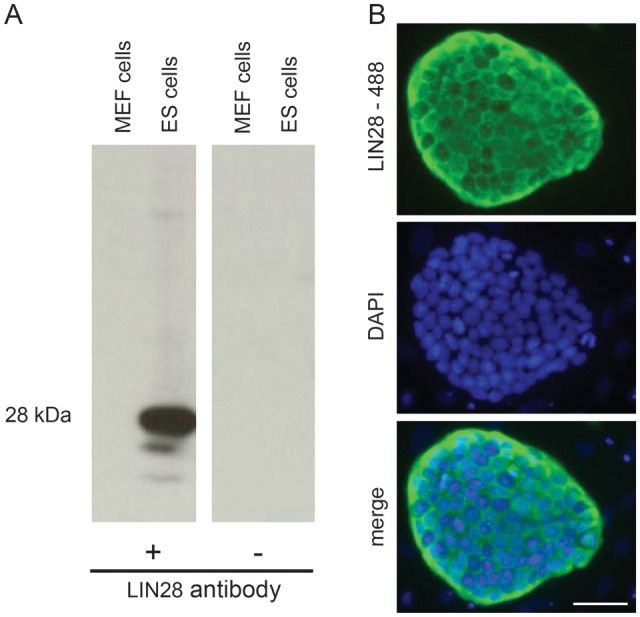
Figure 1
Figure 1
The LIN28 antibody detects marmoset monkey LIN28 protein in pluripotent ES cells. (A) Western blot analysis. Marmoset ES cells cultured on mouse embryonic feeder (MEF) cells showed a strong signal of the expected size of ∼28 kDa. Protein from MEF cells alone contains no LIN28. Omission of the primary antibody also resulted in no signal verifying the specificity of the LIN28 antibody. (B) Immunofluorescent staining of LIN28 in an undifferentiated colony of marmoset ES cells cultured on MEF cells. LIN28 is specifically detected in the cytoplasm of ES cells. The scale bar represents 50 µm.
Figure 2
Figure 2
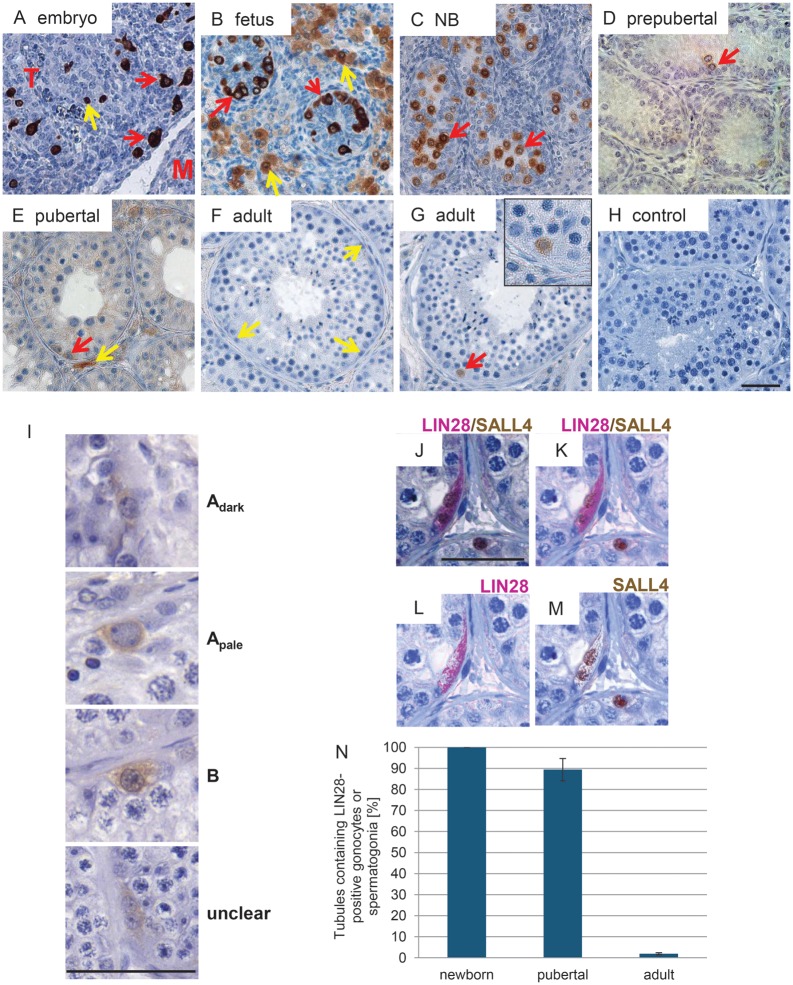
LIN28 expression in prenatal, post-natal and adult marmoset monkey testes. (A) LIN28-positive PGCs enter the developing testis at gestational day 75. Some stained cells are inside the forming testicular cords (yellow arrows), while other PGCs are still in the stromal compartment (red arrows). Many cells have extensions suggesting migratory activity. T, testis; M, mesonephros (B) Fetal testis at gestational day 90. Testicular cords clearly display an epithelium and the germ cells within the cords are LIN28-positive. Most of the germ cells have contact with the basal membrane of the developing germinal epithelium (red arrows). LIN28 signals in the cells of the interstitium (yellow arrows) become weaker compared with the germ cells’ signal. (C) Newborn testis after ∼145 days of gestation. Most germ cells detached again from the basal membrane (red arrow). LIN28 signal intensity became heterogenous with some germ cells showing strong signals and others exhibiting only very faint staining. (D) Prepubertal testis at post-natal week 20. LIN28 staining is restricted to few germ cells (red arrows). (E) Pubertal testis showing first meiotic cells. Few spermatogonia (red arrow) and some interstitial cells (yellow arrow) express LIN28. (F) Typical adult seminiferous tubule lacking LIN28-positive cells. Faint staining can be seen in some interstitial cells. (G) One of the rare tubular cross sections containing a LIN28-positive spermatogonium (for quantification see Fig. 2N and Supplementary data). The inset highlights the morphology of the stained cell. (H) Negative control. LIN28 antibody was replaced by non-specific rabbit IgG at the same protein concentration as the LIN28 antibody was used. (I) Representative examples of different spermatogonial subtypes in the marmoset monkey testis expressing LIN28. Shown are an Adark spermatogonium, an Apale spermatogonium, a B spermatogonium as well as LIN28-positive spermatogonia that cannot be assigned to one specific spermatogonial subtype. (J–M) LIN28-positive spermatogonia co-express SALL4. The brightfield-picture J) shows two LIN28+/SALL4+ spermatogonia and one LIN28-negative spermatogonium expressing SALL4 (K-M) show the same picture false-colored as an overlay (K) or highlighting only LIN28 (L) or SALL4 (M) staining. All scale bars represent 50 µm.
Figure 3
Figure 3
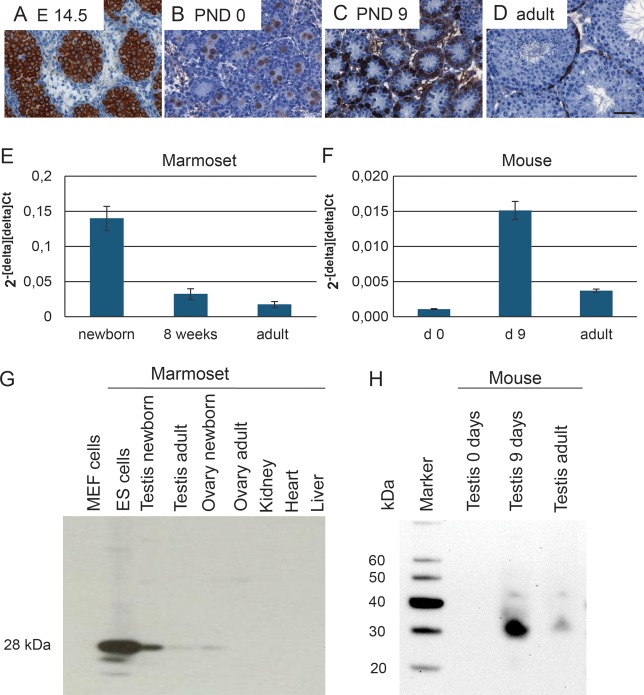
LIN28 protein and mRNA in marmoset and mouse testes. (A) LIN28 is present in the cytoplasm of mouse gonocytes and (B and C) immature spermatogonia, as well as in adult spermatogonia (D). The scale bar represents 50 µm. Quantitative RT–PCR with marmoset (E) and mouse (F) whole testis RNA. (E) Newborn, 8 weeks-old, and adult marmoset testes. There is a strong and significant decrease in the relative mRNA abundance during testicular development. (F) The expression profile of the mouse testis shows a strong increase from birth to PND9 and subsequent decrease to adulthood. The adult relative expression levels were still above the newborn levels. (G) Western blot analysis of LIN28 in newborn and adult marmoset monkey testis and control tissues. Omission of the primary antibody resulted in no signal (data not shown). (H) Western blot analysis of LIN28 in neonatal, post-natal day 9 and adult mouse testes.
Figure 4
Figure 4
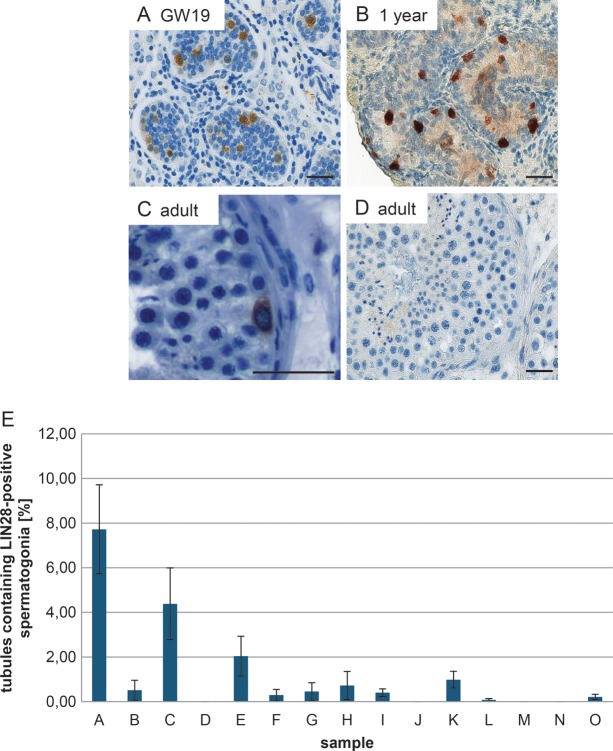
LIN28 expression in human germ cells during testis development. LIN28 is present in human gonocytes (A) and immature spermatogonia (B). Very few spermatogonia in the adult testis are LIN28-positive (C); for quantification see (E), however, the vast majority of all tubules showed no LIN28-positive spermatogonia. (D) Negative control. The scale bar represents 50 µm. (E) Percentage of tubular cross sections containing at least one LIN28-positive cell in adult testis. Bars A–J represent histologically normal samples from patients with germ cell tumors in the contra-lateral testis, K–O represent normal testis samples from prostate carcinoma patients without any evidence of germ cell tumors undergoing orchiectomy for therapeutic purposes.
Figure 5
Figure 5
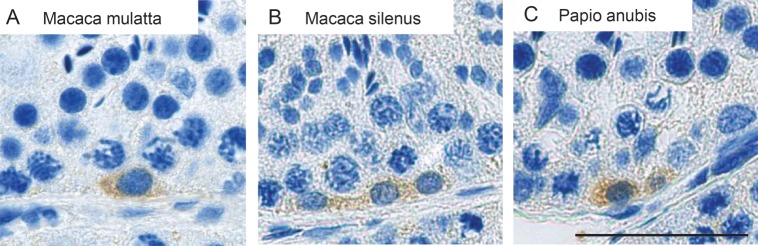
LIN28 in additional NHP species. LIN28 is present in single or paired spermatogonia in the rhesus monkey (Macacca mulatta) (A) and the lion-tailed macaque (Macacca silenus) (B) as well as in the baboon (Papio anubis) (C). The scale bar represents 50 µm.
Figure 6
Figure 6
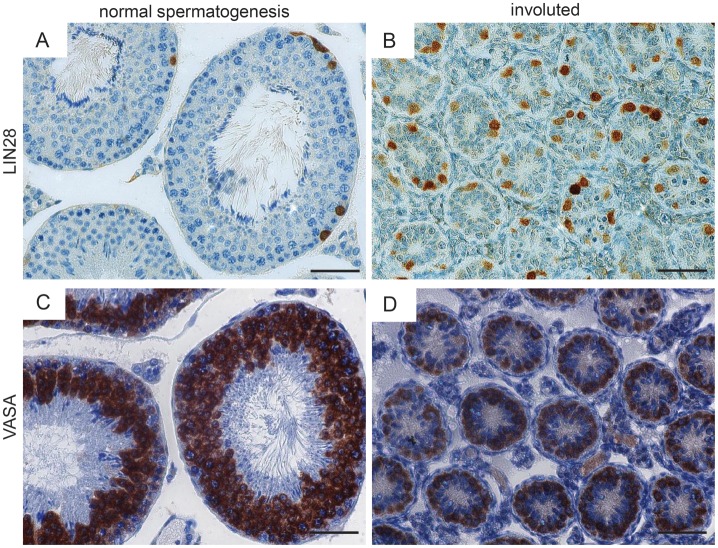
Spermatogonia in involuted hamster testes are LIN28-positive. (A) Djungarian hamster testis with normal full spermatogenesis. Few spermatogonia are intensely LIN28-positve. (B) Fully involuted hamster testis showing LIN28-positive spermatogonia, which are present at very high density in this condition. (C) Germ cells including most spermatogonia in the normal testis are also positive for VASA. (D) Also in the involuted testis the germ cells are VASA-positive. There are more VASA- than LIN28-positive cells. The scale bar represents 50 µm.
Figure 7
Figure 7
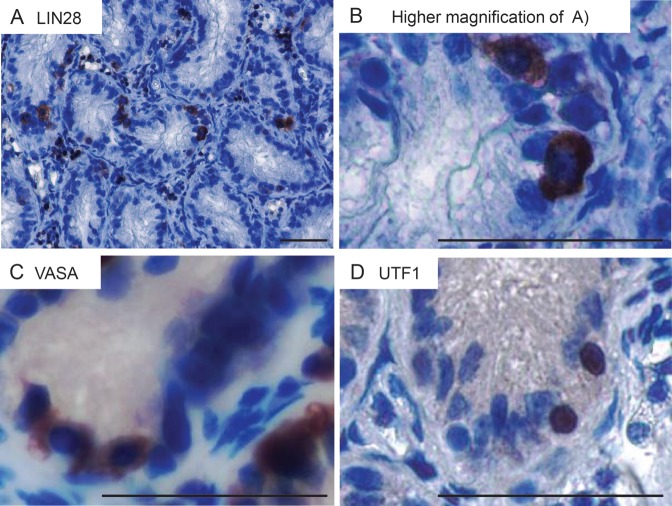
Spermatogonia in involuted primate testes are LIN28-positive. (A) Fully involuted monkey (Lemur catta) testis showing only very few germ cells in the inactive germinal epithelium consisting mainly of somatic Sertoli cells. However, many of the germ cells present are clearly LIN28-positive. (B) Higher magnification of (A). The germ cells also express VASA (C) and UTF1 (D). The scale bar represents 50 µm.

References

    1. Aponte PM, van Bragt MP, de Rooij DG, van Pelt AM. Spermatogonial stem cells: characteristics and experimental possibilities. APMIS. 2005;113:727–742. - PubMed
    1. Barroca V, Lassalle B, Coureuil M, Louis JP, Le Page F, Testart J, Allemand I, Riou L, Fouchet P. Mouse differentiating spermatogonia can generate germinal stem cells in vivo. Nat Cell Biol. 2009;11:190–196. - PubMed
    1. Behr R, Deller C, Godmann M, Muller T, Bergmann M, Ivell R, Steger K. Kruppel-like factor 4 expression in normal and pathological human testes. Mol Hum Reprod. 2007;13:815–820. - PubMed
    1. Brinster RL, Zimmermann JW. Spermatogenesis following male germ-cell transplantation. Proc Natl Acad Sci USA. 1994;91:11298–11302. - PMC - PubMed
    1. Cao D, Allan RW, Cheng L, Peng Y, Guo CC, Dahiya N, Akhi S, Li J. RNA-binding protein LIN28 is a marker for testicular germ cell tumors. Hum Pathol. 2011;42:710–718. - PubMed

Publication types