RUNX1 mutations in cytogenetically normal acute myeloid leukemia are associated with a poor prognosis and up-regulation of lymphoid genes
- PMID: 22689681
- PMCID: PMC3590097
- DOI: 10.3324/haematol.2012.064667
RUNX1 mutations in cytogenetically normal acute myeloid leukemia are associated with a poor prognosis and up-regulation of lymphoid genes
Abstract
Background: The RUNX1 (AML1) gene is a frequent mutational target in myelodysplastic syndromes and acute myeloid leukemia. Previous studies suggested that RUNX1 mutations may have pathological and prognostic implications.
Design and methods: We screened 93 patients with cytogenetically normal acute myeloid leukemia for RUNX1 mutations by capillary sequencing of genomic DNA. Mutation status was then correlated with clinical data and gene expression profiles.
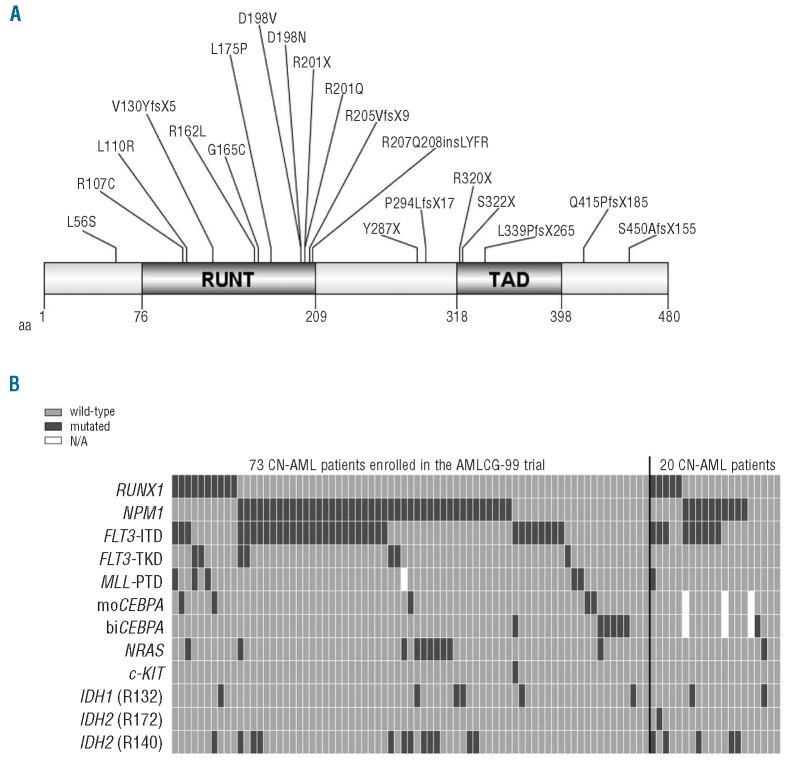
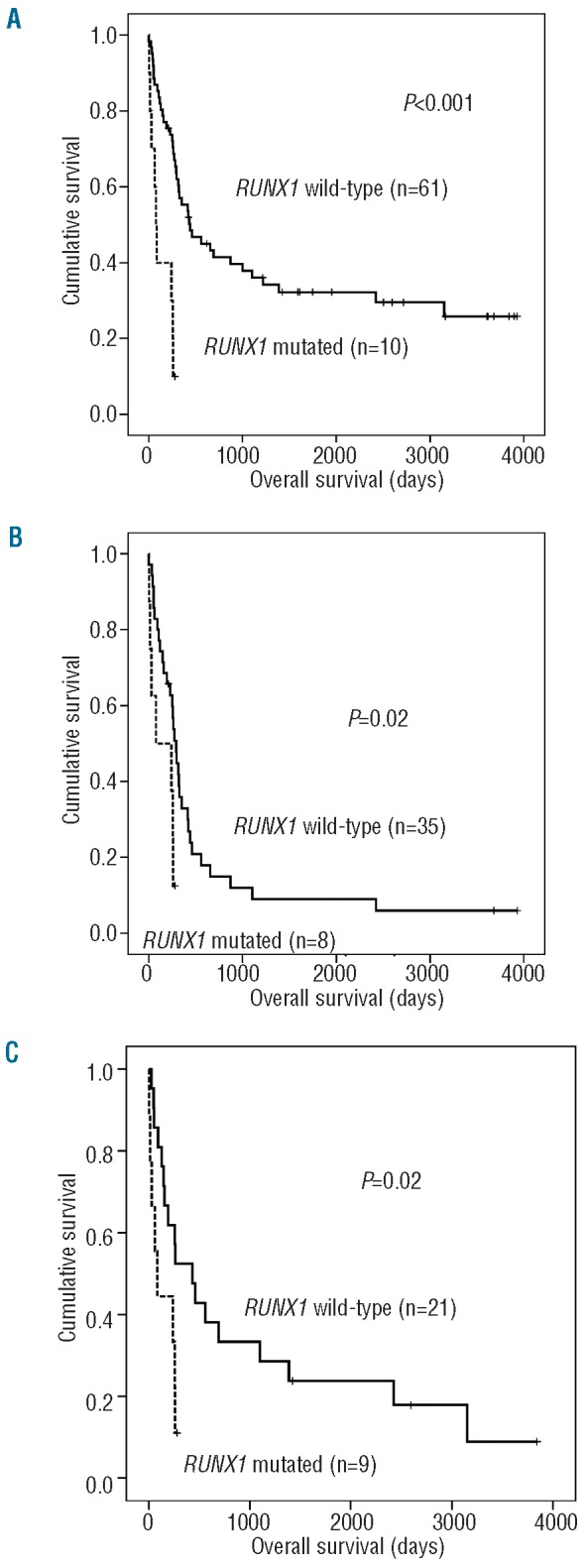
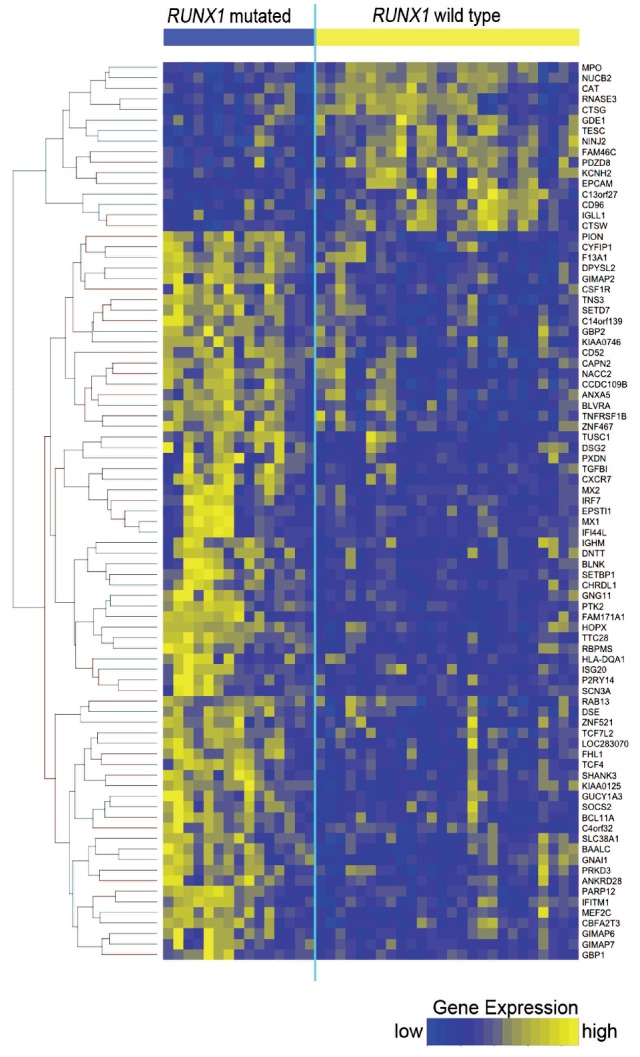
Results: We found that 15 out of 93 (16.1%) patients with cytogenetically normal acute myeloid leukemia had RUNX1 mutations. Seventy-three patients were enrolled in the AMLCG-99 trial and carried ten RUNX1 mutations (13.7%). Among these 73 patients RUNX1 mutations were significantly associated with older age, male sex, absence of NPM1 mutations and presence of MLL-partial tandem duplications. Moreover, RUNX1-mutated patients had a lower complete remission rate (30% versus 73% P=0.01), lower relapse-free survival rate (3-year relapse-free survival 0% versus 30.4%; P=0.002) and lower overall survival rate (3-year overall survival 0% versus 34.4%; P<0.001) than patients with wild-type RUNX1. RUNX1 mutations remained associated with shorter overall survival in a multivariate model including age and the European Leukemia Net acute myeloid leukemia genetic classification as covariates. Patients with RUNX1 mutations showed a unique gene expression pattern with differential expression of 85 genes. The most prominently up-regulated genes in patients with RUNX1-mutated cytogenetically normal acute myeloid leukemia include lymphoid regulators such as HOP homeobox (HOPX), deoxynucleotidyltransferase (DNTT, terminal) and B-cell linker (BLNK), indicating lineage infidelity.
Conclusions: Our findings firmly establish that RUNX1 mutations are a marker of poor prognosis and provide insights into the pathogenesis of RUNX1 mutation-positive acute myeloid leukemia.
Figures
References
-
- Peterson LF, Zhang DE. The 8;21 translocation in leukemogenesis. Oncogene. 2004;23(24):4255-62 - PubMed
-
- Harada Y, Harada H. Molecular pathways mediating MDS/AML with focus on AML1/RUNX1 point mutations. J Cell Physiol. 2009;220(1):16-20 - PubMed
-
- Osato M. Point mutations in the RUNX1/AML1 gene: another actor in RUNX leukemia. Oncogene. 2004;23(24):4284-96 - PubMed
-
- Gaidzik VI, Bullinger L, Schlenk RF, Zimmermann AS, Rock J, Paschka P, et al. RUNX1 mutations in acute myeloid leukemia: results from a comprehensive genetic and clinical analysis from the AML study group. J Clin Oncol. 2011;29(10):1364-72 - PubMed
Publication types
MeSH terms
Substances
LinkOut - more resources
Full Text Sources
Medical
Research Materials