


Editorial
doi: 10.1161/HYPERTENSIONAHA.112.195628.
Epub 2012 Jun 11.
Breathe, breathe in the air: the ins and outs of hypoxia take their toll
- PMID: 22689744
- PMCID: PMC3665357
- DOI: 10.1161/HYPERTENSIONAHA.112.195628
Item in Clipboard
Editorial
Breathe, breathe in the air: the ins and outs of hypoxia take their toll
Hypertension.
2012 Jul.
No abstract available
Figures
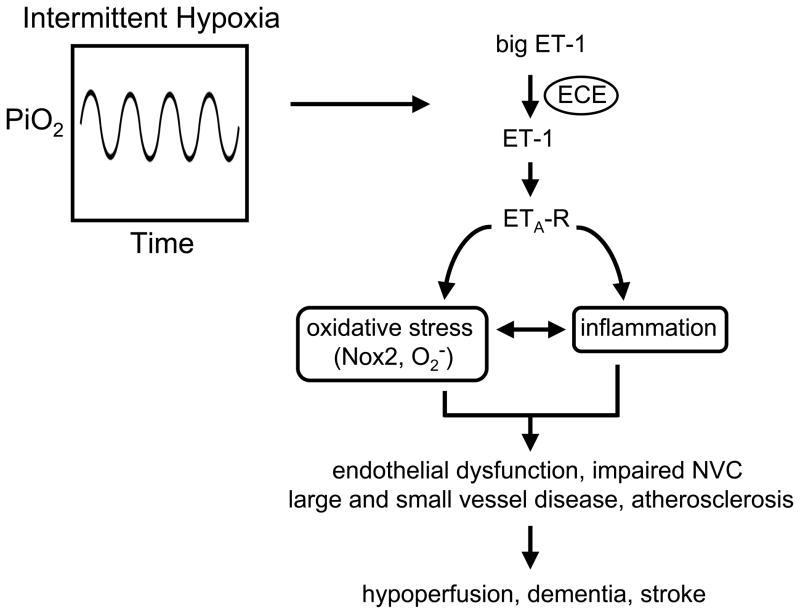
Cerebrovascular effects of intermittent hypoxia. In response chronic intermittent hypoxia, increased production of endothelin-1 (ET-1) by endothelin-converting enzyme (ECE) activates ETA receptors (ETA-R) resulting in oxidative stress. ET-1 or oxidative stress may also activate components of the inflammatory response. Key consequences of intermittent hypoxia for the vessel wall and mechanisms that regulate cerebral blood flow are shown on the bottom. Nox2 = Nox2 component of NADPH oxidase; O2− = superoxide anion; PiO2 = inspired PO2; NVC = neurovascular coupling. See text for additional details.
Comment on
-
Endothelin 1-dependent neurovascular dysfunction in chronic intermittent hypoxia.Hypertension. 2012 Jul;60(1):106-13. doi: 10.1161/HYPERTENSIONAHA.112.193672. Epub 2012 Jun 11. Hypertension. 2012. PMID: 22689747 Free PMC article.
References
-
- Cipolla MJ. The Cerebral Circulation. In: Granger DN, Granger J, editors. Integrated Systems Physiology: From Molecule to Function. Morgan & Claypool Life Sciences; San Rafael: 2010. pp. 1–59.
-
- Hurn P, Traystman RJ. Changes in Arterial Gas Tension. In: Edvinsson L, Krause D, editors. Cerebral Blood Flow and Metabolism. 2. Chapter 24. Lippincott: Williams & Wilkens; pp. 384–394.pp. 2001
-
- Levy P, Pepin J-L, Arnaud C, Tamisier R, Borel J-C, Dematteis M, Godin-Ribuot D, Ribuot C. Intermittent hypoxia and sleep-disordered breathing: Current concepts and perspectives. Eur Respir J. 2008;32:1082–1095. - PubMed
-
- Roger VL, Go AS, Lloyd-Jones DM, Benjamin EJ, Berry JD, Borden WB, Bravata DM, Dai S, Ford ES, Fox CS, Fullerton HJ, Gillespie C, Hailpern SM, Heit JA, Howard VJ, Kissela BM, Kittner SJ, Lackland DT, Lichtman JH, Lisabeth LD, Makuc DM, Marcus GM, Marelli A, Matchar DB, Moy CS, Mozaffarian D, Mussolino ME, Nichol G, Paynter NP, Soliman EZ, Sorlie PD, Sotoodehnia N, Turan TN, Virani SS, Wong ND, Woo D, Turner MB American Heart Association Statistics Committee and Stroke Statistics Subcommittee. Heart disease and stroke statistics - 2012 update: a report from the American Heart Association. Circulation. 2012;125:e2–e220. - PMC - PubMed
-
- Veasey S. Insight from animal models into the cognitive consequences of adult sleep-disordered breathing. ILAR J. 2009;50:307–311. - PubMed
Publication types
MeSH terms
Substances
Grants and funding
LinkOut - more resources
Full Text Sources
