. 2012 Sep;80(9):2997-3007.
doi: 10.1128/IAI.06185-11. Epub 2012 Jun 11.

Sequential Plasmodium chabaudi and Plasmodium berghei infections provide a novel model of severe malarial anemia

Affiliations

Sequential Plasmodium chabaudi and Plasmodium berghei infections provide a novel model of severe malarial anemia

Juliana V Harris et al. Infect Immun. 2012 Sep.

Abstract

Lack of an adequate animal model of Plasmodium falciparum severe malarial anemia (SMA) has hampered the understanding of this highly lethal condition. We developed a model of SMA by infecting C57BL/6 mice with P. chabaudi followed after recovery by P. berghei infection. P. chabaudi/P. berghei-infected mice had an initial 9- to 10-day phase of relatively low parasitemia and severe anemia, followed by a second phase of hyperparasitemia, more profound anemia, reticulocytosis, and death 14 to 21 days after infection. P. chabaudi/P. berghei-infected animals had more intense splenic hematopoiesis, higher interleukin-10 (IL-10)/tumor necrosis factor alpha and IL-12/gamma interferon (IFN-γ) ratios, and higher antibody levels against P. berghei and P. chabaudi antigens than P. berghei-infected or P. chabaudi-recovered animals. Early treatment with chloroquine or artesunate did not prevent the anemia, suggesting that the bulk of red cell destruction was not due to the parasite. Red cells from P. chabaudi/P. berghei-infected animals had increased surface IgG and C3 by flow cytometry. However, C3(-/-) mice still developed anemia. Tracking of red cells labeled ex vivo and in vivo and analysis of frozen tissue sections by immunofluorescence microscopy showed that red cells from P. chabaudi/P. berghei-infected animals were removed at an accelerated rate in the liver by erythrophagocytosis. This model is practical and reproducible, and its similarities with P. falciparum SMA in humans makes it an appealing system with which to study the pathogenesis of this condition and explore potential immunomodulatory interventions.


Figures
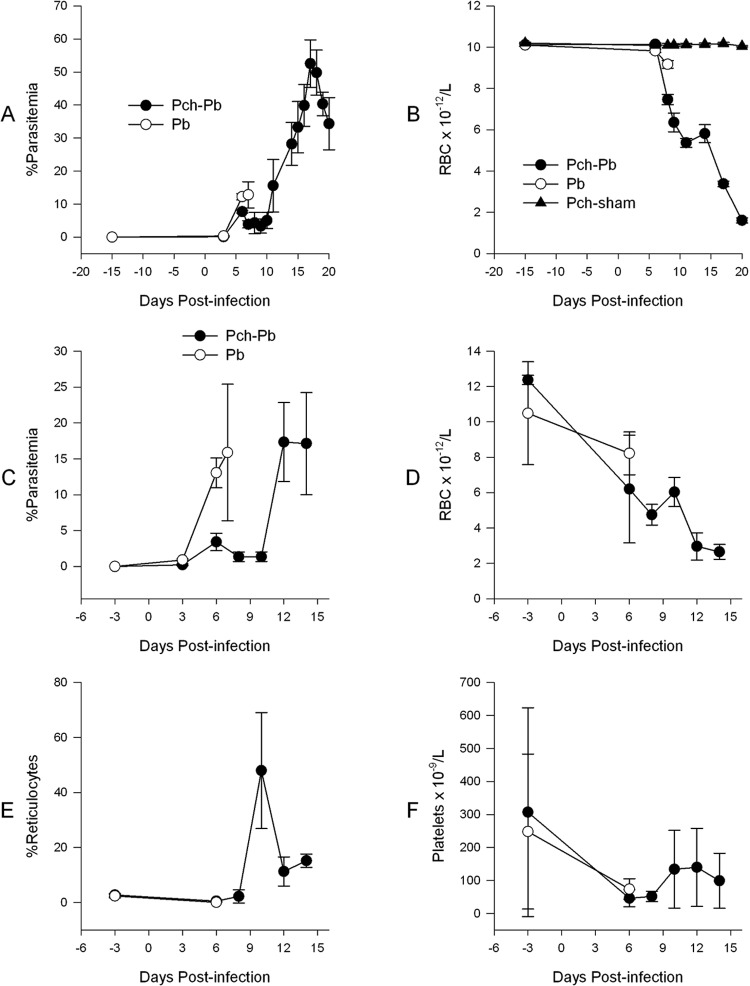
Fig 1
Fig 1
P. chabaudi/P. berghei infection results in anemia with low parasitemia. C57BL/6 mice were infected with 106 P. berghei IRBCs when naïve (P. berghei infected) or following recovery from P. chabaudi infection (Pch-Pb). P. chabaudi- and sham-infected mice received RPMI 1640 i.p. Day 0 designates the day of infection with P. berghei (Pb). (A and B) Parasitemia and RBC density of an infection allowed to proceed to conclusion; (C to F) abbreviated infection. Data points are means with standard deviations. n = 4 to 5 mice per group.
Fig 2
Fig 2
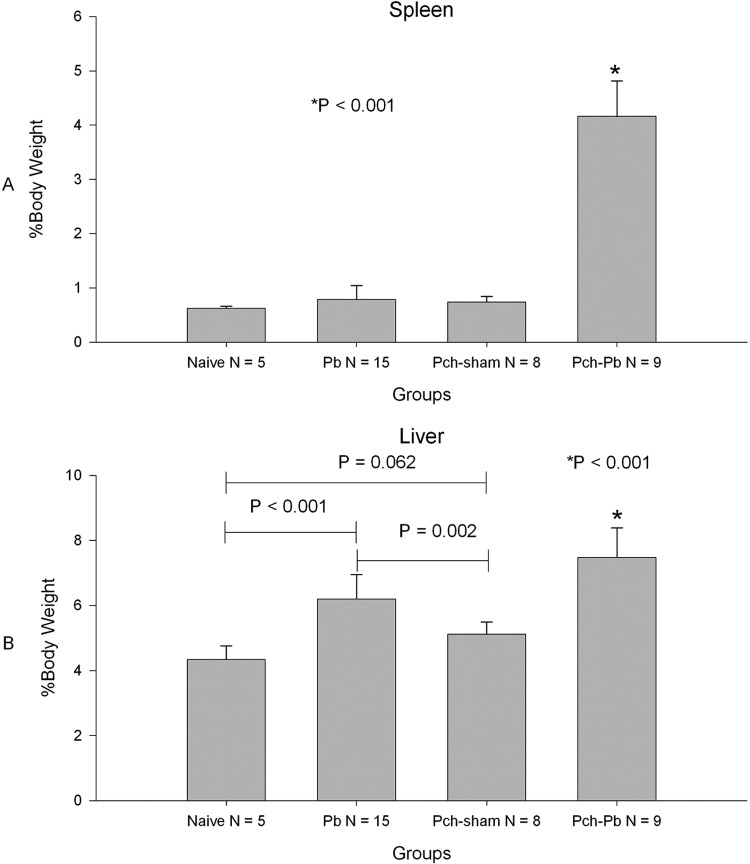
P. chabaudi/P. berghei-infected animals have enlarged spleens and livers. Bars represent mean weights expressed as percentage of total body weight. Organs were harvested on day 6 or 7 postinfection for P. berghei-infected animals and day 9 for P. chabaudi- and sham-infected animals and P. chabaudi/P. berghei-infected animals. Error bars represent SDs. P values are based on analysis of variance with adjustment for multiple comparisons.
Fig 3
Fig 3
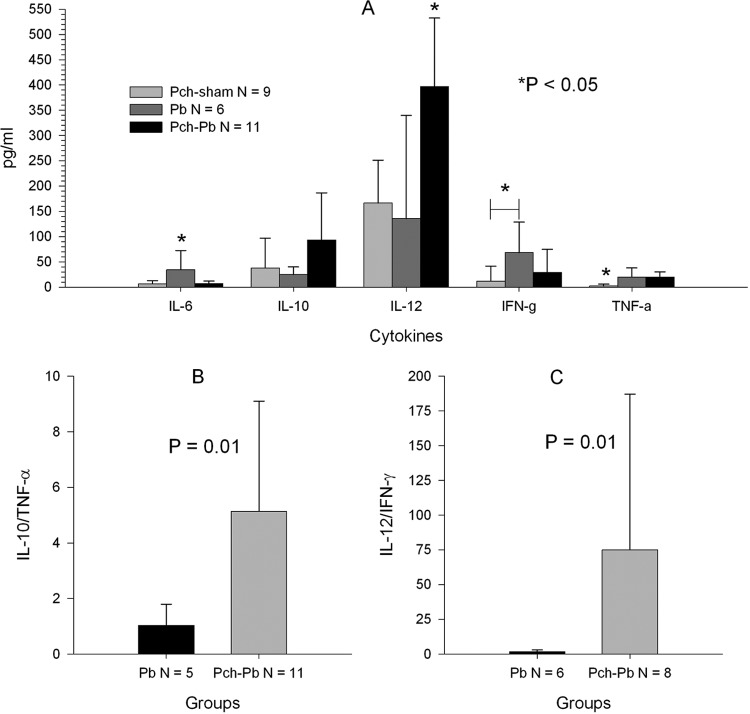
P. chabaudi/P. berghei-infected animals have increased IL-10/TNF-α and IL-12/IFN-γ ratios. Plasma samples from 3 separate experiments, obtained 9 or 10 days postinfection for P. chabaudi- and sham-infected animals and P. chabaudi/P. berghei-infected animals or 6 or 7 days postinfection for P. berghei-infected animals, were analyzed with a multiplex cytokine assay. (A) Mean cytokine concentrations across groups. The P value was obtained by analysis of variance with a post hoc test for multiple comparisons. *, significant difference when comparing that group to each of the other groups except when a horizontal bar is present, in which case the difference for a single comparison was significant. (B and C) IL-10/TNF-α and IL-12/IFN-γ ratios. Only ratios where the denominator was >0 were used for this analysis. The P value was obtained using the Mann-Whitney test. All error bars represent SDs.
Fig 4
Fig 4
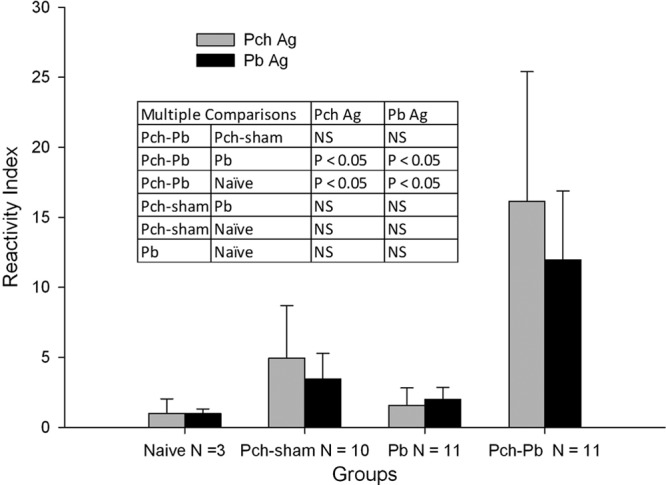
P. chabaudi/P. berghei-infected animals have increased parasite-specific IgG responses. Serum samples from 3 separate experiments, obtained at the time of euthanasia, were measured by ELISA. IgG responses to P. chabaudi (Pch) and P. berghei (Pb) antigens (Ag) are presented as mean reactivity indexes, the ratio of the OD405 for each sample to the mean OD405 for naïve sera. Error bars are standard deviations. Comparisons between two groups were by unpaired t test. There were no significant differences in reactivity to P. berghei or P. chabaudi antigen within groups. The table shows the results of the multiple-comparison testing between groups. NS, not significant.
Fig 5
Fig 5
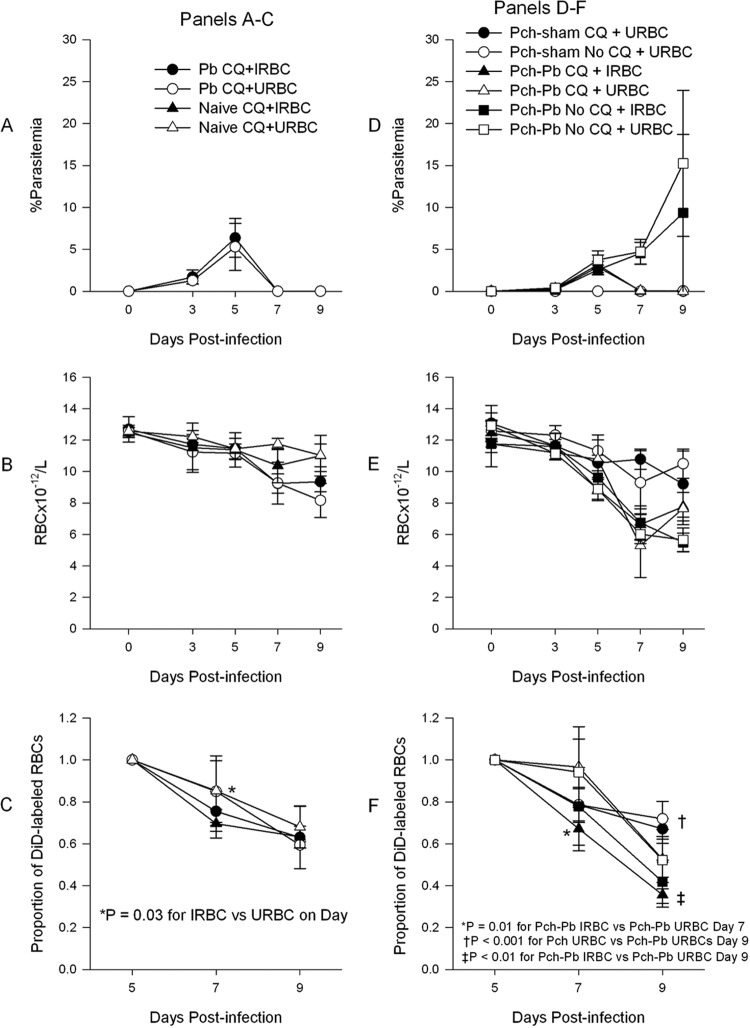
Chloroquine (CQ) treatment does not prevent the development of anemia, and IRBCs are removed at an accelerated rate compared to URBCs. (A) P. berghei-infected mice were treated with chloroquine on day 5 postinfection, which resulted in rapid clearance of parasitemia and mild anemia (B). (C) DiD-labeled RBCs from P. chabaudi/P. berghei-infected animals at 3% parasitemia (IRBCs) or from uninfected mice (URBCs) were injected on day 5 postinfection into mice whose results are shown in panel A, and the clearance was tracked by flow cytometry. The data present the decline in the percentage of labeled RBCs from baseline. At 48 h, IRBCs (filled symbols) disappeared from the circulation faster than URBCs. (D) P. chabaudi/P. berghei-infected and P. chabaudi- and sham-infected mice were infected with P. berghei, and some groups of animals were treated with chloroquine on day 5 postinfection. P. chabaudi/P. berghei-infected animals developed severe anemia, despite treatment with chloroquine (E). (F) DiD-labeled RBCs, as for panel C, were injected on day 5 postinfection into P. chabaudi/P. berghei-infected animals or P. chabaudi- and sham-infected animals whose results are shown in panel D. IRBCs injected into P. chabaudi/P. berghei-infected animals disappeared from the circulation than faster URBCs. Data points are means ± SDs. P values were obtained using unpaired t test.
Fig 6
Fig 6
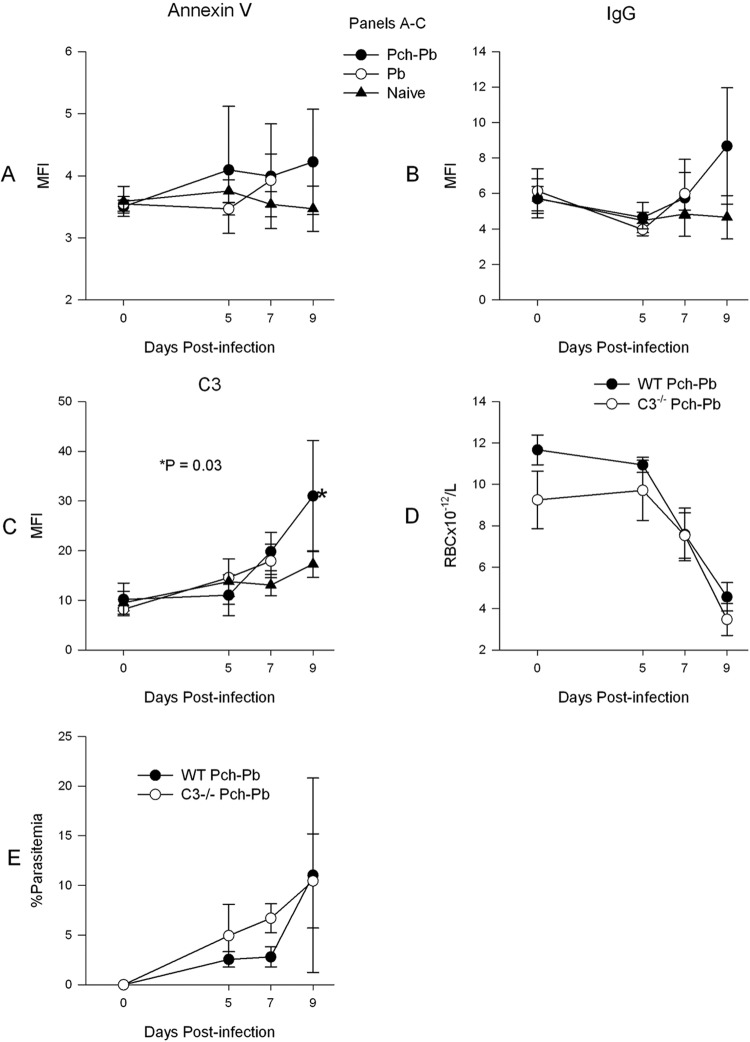
RBCs of P. chabaudi/P. berghei-infected animals develop increased surface IgG and C3, but C3−/− mice develop anemia. RBCs from naïve, P. berghei-infected, or P. chabaudi/P. berghei-infected animals were obtained at various time points after infection and stained with annexin V–FITC (A), FITC-labeled goat anti-mouse IgG (B), or rat anti-mouse C3 monoclonal, followed by FITC-labeled anti-rat IgG (C). C3−/− mice developed severe anemia like wild-type mice (D). (E) The parasitemia of C3−/− mice is slightly higher than that of wild-type mice in the early phases of infection. MFI, mean fluorescence intensity.
Fig 7
Fig 7
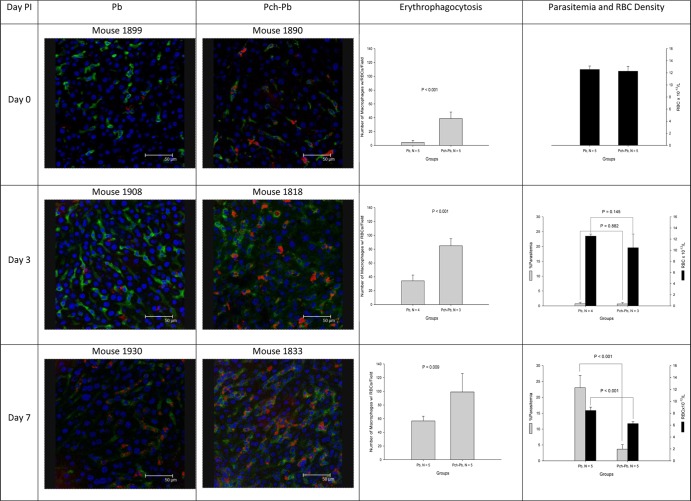
P. chabaudi/P. berghei-infected mice have increased erythrophagocytosis in the liver. Animals were injected into a retro-orbital plexus with Dylight 633 NHS ester, which bound to RBCs. Animals were euthanized at predefined intervals. After euthanasia, livers and spleens were snap-frozen and sections were stained with Hoechst 33342 and monoclonal antibody F4/80, followed by FITC-labeled goat anti-rat IgG. The pictures show liver Kupffer cells in green with intracellular RBCs in red. Little or no erythrophagocytosis was observed in livers from uninfected animals (data not shown). PI, postinfection.

References

    1. Abdalla SH, Weatherall DJ, Wickramasinghe SN, Hughes M. 1980. The anaemia of P. falciparum malaria. Br. J. Haematol. 46:171–183 - PubMed
    1. Akanmori BD, et al. 2000. Distinct patterns of cytokine regulation in discrete clinical forms of Plasmodium falciparum malaria. Eur. Cytokine Netw. 11:113–118 - PubMed
    1. Boutlis CS, et al. 2003. Plasma interleukin-12 in malaria-tolerant Papua New Guineans: inverse correlation with Plasmodium falciparum parasitemia and peripheral blood mononuclear cell nitric oxide synthase activity. Infect. Immun. 71:6354–6357 - PMC - PubMed
    1. Camacho LH, et al. 1998. The course of anaemia after the treatment of acute, falciparum malaria. Ann. Trop. Med. Parasitol. 92:525–537 - PubMed
    1. Chang KH, Tam M, Stevenson MM. 2004. Modulation of the course and outcome of blood-stage malaria by erythropoietin-induced reticulocytosis. J. Infect. Dis. 189:735–743 - PubMed

Publication types