


Rates of nonsuicidal self-injury in youth: age, sex, and behavioral methods in a community sample
- PMID: 22689875
- PMCID: PMC3382916
- DOI: 10.1542/peds.2011-2094
Rates of nonsuicidal self-injury in youth: age, sex, and behavioral methods in a community sample
Abstract
Objective: The goal was to assess the rate and behavioral methods of nonsuicidal self-injury (NSSI) in a community sample of youth and examine effects of age and sex.
Methods: Youth in the third, sixth, and ninth grades (ages 7-16) at schools in the community were invited to participate in a laboratory study. A total of 665 youth (of 1108 contacted; 60% participation rate) were interviewed about NSSI over their lifetime via the Self-Injurious Thoughts and Behaviors Interview.
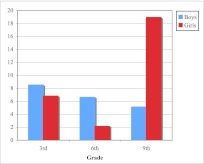
Results: Overall, 53 (8.0%) of the 665 youth reported engaging in NSSI; 9.0% of girls and 6.7% of boys reported NSSI engagement; 7.6% of third-graders, 4.0% of sixth-graders, and 12.7% of ninth-graders reported NSSI engagement. There was a significant grade by gender interaction; girls in the ninth grade (19%) reported significantly greater rates of NSSI than ninth-grade boys (5%). Behavioral methods of NSSI differed by gender. Girls reported cutting and carving skin most often, whereas boys reported hitting themselves most often. Finally, 1.5% of youth met some criteria for the proposed fifth edition of the Diagnostic and Statistical Manual of Mental Disorders (DSM-5) diagnosis of NSSI.
Conclusions: Children and adolescents engage in NSSI. Ninth-grade girls seem most at risk, as they engage in NSSI at 3 times the rate of boys. Behavioral methods of NSSI also vary by grade and gender. As possible inclusion of an NSSI diagnosis in the fifth edition of the DSM-5 draws near, it is essential to better understand NSSI engagement across development and gender.
Figures
References
-
- Nock MK, Favazza AR. Nonsuicidal self-injury: definition and classification. In: Nock ML, ed. Understanding Non-Suicidal Self-Injury: Origins, Assessment, and Treatment. Washington, DC: American Psychological Association; 2009:9–18
-
- Rodham K, Hawton K. Epidemiology and phenomenology of nonsuicidal self-injury. In: Nock ML, ed. Understanding Non-Suicidal Self-Injury: Origins, Assessment, and Treatment. Washington, DC: American Psychological Association; 2009:37–62
-
- Hilt LM, Nock MK, Lloyd-Richardson EE, Prinstein MJ. Longitudinal study of nonsuicidal self-injury among young adolescents. J Early Adolesc. 2008;28(3):455–469
-
- Muehlenkamp JJ, Gutierrez PM. An investigation of differences between self-injurious behavior and suicide attempts in a sample of adolescents. Suicide Life Threat Behav. 2004;34(1):12–23 - PubMed
-
- Jacobson CM, Muehlenkamp JJ, Miller AL, Turner JB. Psychiatric impairment among adolescents engaging in different types of deliberate self-harm. J Clin Child Adolesc Psychol. 2008;37(2):363–375 - PubMed
Publication types
MeSH terms
Grants and funding
LinkOut - more resources
Full Text Sources
Medical
Research Materials
Miscellaneous
