. 2012 Jul 17;109(29):11723-8.
doi: 10.1073/pnas.1204566109. Epub 2012 Jun 11.

Conserved genetic determinant of motor organ identity in Medicago truncatula and related legumes

Affiliations

Conserved genetic determinant of motor organ identity in Medicago truncatula and related legumes

Jianghua Chen et al. Proc Natl Acad Sci U S A. .

Abstract

Plants exhibit various kinds of movements that have fascinated scientists and the public for centuries. Physiological studies in plants with the so-called motor organ or pulvinus suggest that cells at opposite sides of the pulvinus mediate leaf or leaflet movements by swelling and shrinking. How motor organ identity is determined is unknown. Using a genetic approach, we isolated a mutant designated elongated petiolule1 (elp1) from Medicago truncatula that fails to fold its leaflets in the dark due to loss of motor organs. Map-based cloning indicated that ELP1 encodes a putative plant-specific LOB domain transcription factor. RNA in situ analysis revealed that ELP1 is expressed in primordial cells that give rise to the motor organ. Ectopic expression of ELP1 resulted in dwarf plants with petioles and rachises reduced in length, and the epidermal cells gained characteristics of motor organ epidermal cells. By identifying ELP1 orthologs from other legume species, namely pea (Pisum sativum) and Lotus japonicus, we show that this motor organ identity is regulated by a conserved molecular mechanism.


Conflict of interest statement

The authors declare no conflict of interest.

Figures
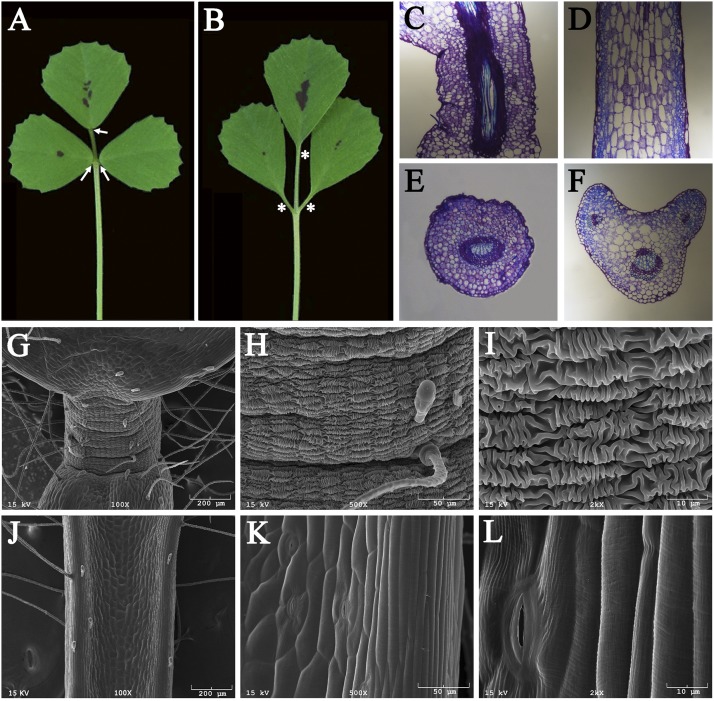
Fig. 1.
Fig. 1.
M. truncatula elongated petiolule 1 (elp1) mutant lacks motor organs. (A and B) Morphologies of trifoliate leaves of wild type (A) and the elp1-1 mutant (B). Arrows indicate pulvini in A and asterisks the equivalent positions in B. (C and D) Longitudinal sections of a pulvinus of WT (C) or the replacement organ of the elp1 mutant (D). (E and F) Cross sections of a pulvinus of WT (E) or the replacement organ of the elp1 mutant (F). (G–L) Scanning electron microscope images of a pulvinus of WT (GI) or the replacement organ of the elp1 mutant (JL) with different magnifications.
Fig. 2.
Fig. 2.
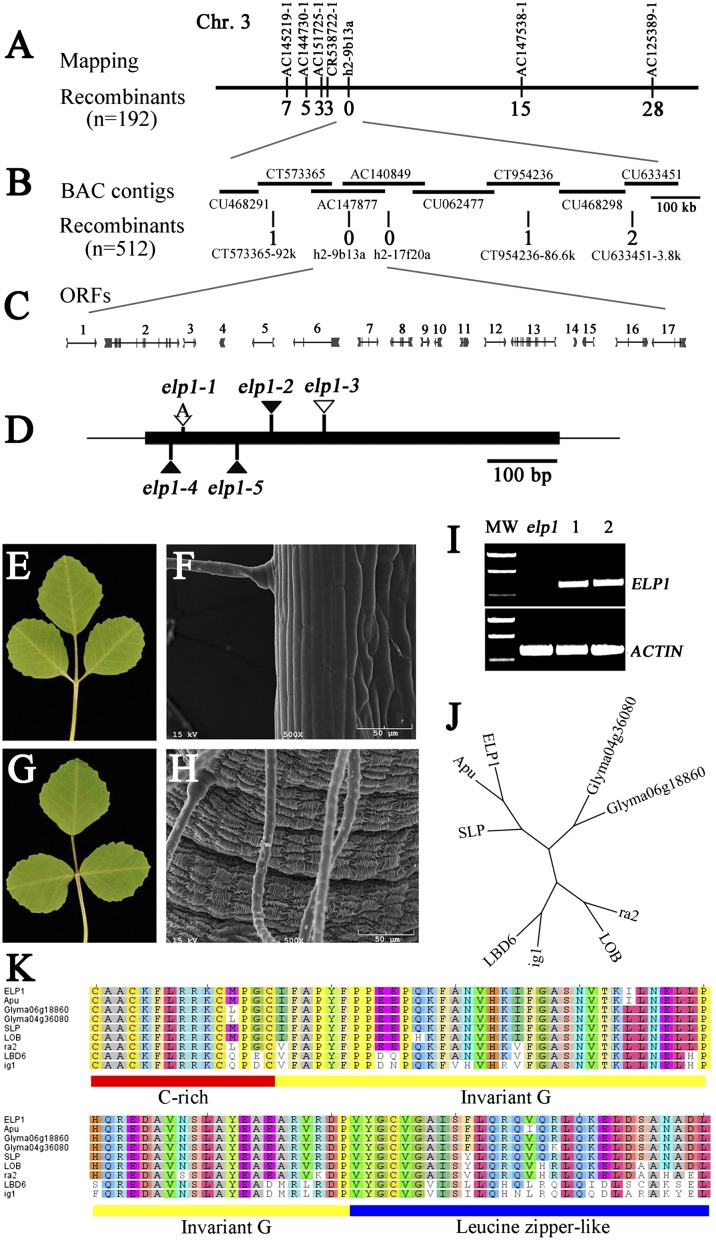
Map-based cloning, genetic complementation, and phylogenetic analysis of the M. truncatula ELP1 gene. (A) The elp1 locus was mapped to the lower arm of chromosome 3 and tightly linked to the SSR marker h2-9b13a. (B) Fine genetic mapping using a large F2 population further narrowed the elp1 map position. Horizontal lines represent BAC contigs in the mapped region. The number of recombinants with respect to elp1 is provided below each marker in A and B. (C) Predicted genes and gene structures in the mapped region. (D) Mutation sites in ORF4 identified in elp1 mutant alleles. (E–H) Genetic complementation of elp1-3. Shown are representative elp1-3 mutant trifoliate leaf (E) and SEM image of the base of a leaflet (F) and representative trifoliate leaf (G) and SEM image of the base of a leaflet (H) of the elp1-3 mutant transformed with 35S:GFP-ELP1. (I) RT-PCR analysis of ELP1 expression. MW, molecular weight markers; elp1, elp1–3; lanes 1 and 2, two independent transgenic lines in which ELP1 gene expression was restored. M. truncatula ACTIN gene was used as a loading control. (J) Phylogenetic relationship analysis of ELP1 and its closely related homologs, Apu from pea (P. sativum), SLP from L. japonicus, LOB (At5g63090), and LBD6/AS2 (At1g65620) from A. thaliana, Glyma04g36080 and Glyma06g18860 from soybean (G. max), and ra2 and indeterminate ig1 from maize (Zea mays). (K) Amino acid sequence alignments of N-terminal LOB domains of ELP1 and its homologs. The underlined LOB domain includes cysteine (C)-rich (red), invariant glycine (G; yellow), and leucine-zipper–like (blue) motifs.
Fig. 3.
Fig. 3.
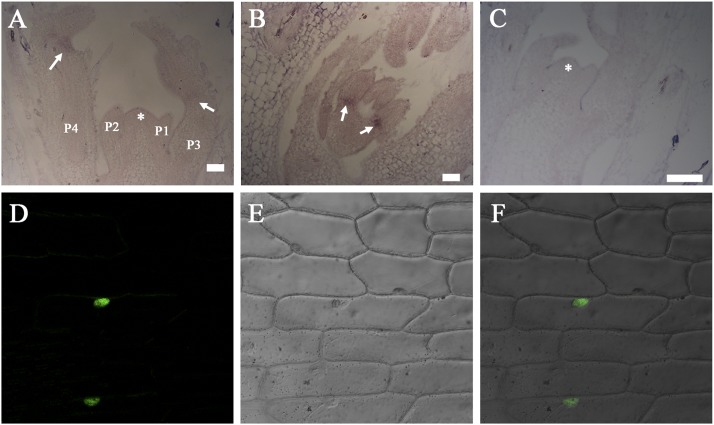
RNA in situ hybridization and subcellular protein localization. (A and B) Longitudinal sections of vegetative shoot bud (A) and leaf primordium (B) showing that ELP1 transcripts were detected in a small number of cells at the basal region of young leaflets (arrows). (C) No hybridization signals were detected in an adjacent section hybridized with an ELP1 sense probe. Asterisks denote the shoot apical meristem and P represents the plastochron. (D–F) Nuclear localization of GFP-ELP1 fusion protein driven by the CaMV35S promoter in onion epidermal cells. Shown are a representative confocal image of the GFP signal (D), a Normaski image of onion epidermal cells (E), and an overlay of the two images (F).
Fig. 4.
Fig. 4.
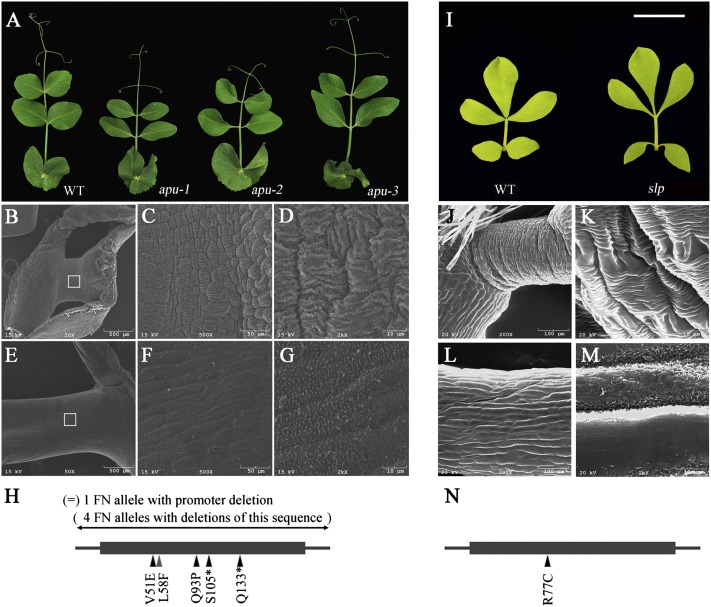
Phenotypic analysis and molecular cloning of apu mutants of pea (P. sativum) and a slp mutant of L. japonicus. (A) Representative images of compound leaves of WT, apu-1, apu-2, and apu-3 alleles (from left to right). (B–G) SEM images with different magnifications of the pulvinus of a WT plant (B–D) and the replacement organ of apu-1 mutant (EG). Open boxes in B and E indicate areas shown in C and F. (H) Different apu alleles and mutation sites. (I) Representative images of compound leaves of WT (Gifu B-129; Left) and slp mutant (Right). (JM) SEM images of the pulvinus of a WT plant (J and K) and the replacement organ of a slp mutant (L and M). (N) The mutation site of the slp mutant.
Fig. 5.
Fig. 5.
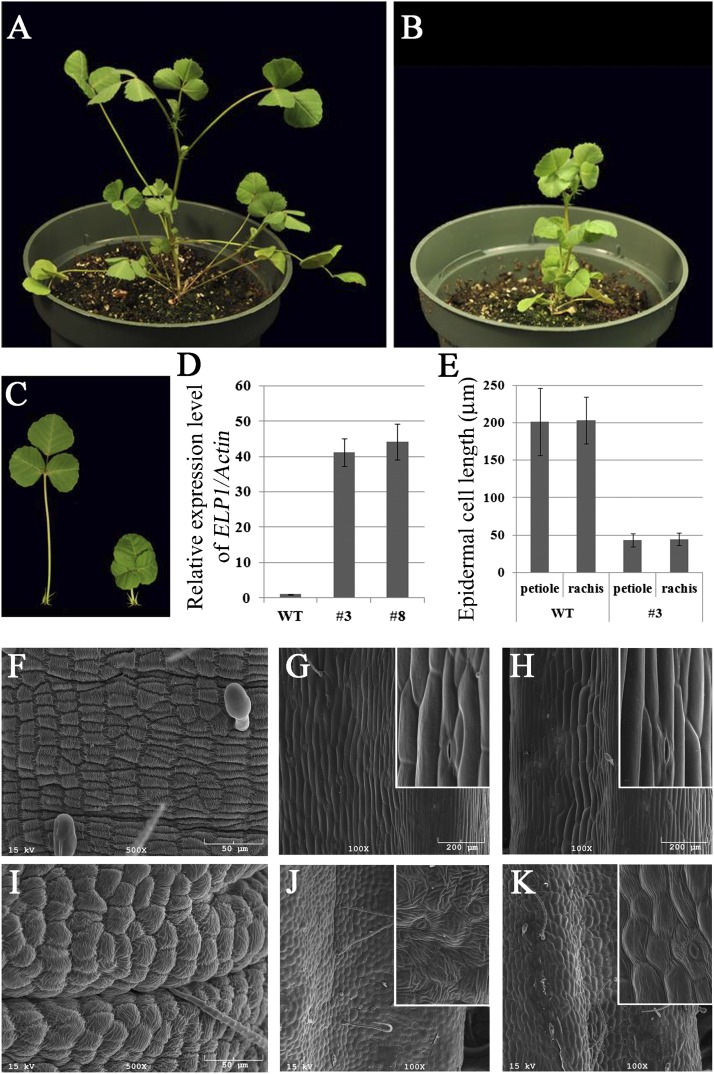
Ectopic expression of ELP1 in M. truncatula. (A and B) Images of 1-mo-old WT plant (cv. R108; A) and a transgenic plant transformed with 35S:GFP-ELP1 (B) showing a severe dwarf phenotype of the transgenic line. (C) Close-up images of trifoliate leaves of WT (Left) and the 35S:GFP-ELP1 line (Right). (D) Quantitative RT-PCR analysis of ELP1 gene expression in WT and two independent 35S:GFP-ELP1 lines, 3 and 8. ELP1 gene expression was normalized with the M. truncatula ACTIN gene. (E) Measurements of epidermal cell length of petiole and rachis in WT and the 35S:GFP-ELP1 line 3. Shown are means ± SD; n = 60. (FK) SEM images of pulvini (F and I), petioles (G and J), rachises (H and K) of WT (FH), and the 35S:GFP-ELP1 line 3 (IK). Insets are magnified images.

Comment in

  • Genetic basis of the "sleeping leaves" revealed.
    Cortizo M, Laufs P. Cortizo M, et al. Proc Natl Acad Sci U S A. 2012 Jul 17;109(29):11474-5. doi: 10.1073/pnas.1209532109. Epub 2012 Jul 6. Proc Natl Acad Sci U S A. 2012. PMID: 22773806 Free PMC article. No abstract available.

References

    1. Koller D. The Restless Plant. Cambridge, MA: Harvard Univ Press; 2011.
    1. Darwin C. The Power of Movement in Plants. New York: D. Appleton and Company; 1897.
    1. Hangarter R. Plants-In-Motion. 2000. Available at http://plantsinmotion.bio.indiana.edu/plantmotion/starthere.html.
    1. Chen R, Guan C, Boonsirichai K, Masson PH. Complex physiological and molecular processes underlying root gravitropism. Plant Mol Biol. 2002;49:305–317. - PubMed
    1. Chen R, Rosen E, Masson PH. Gravitropism in higher plants. Plant Physiol. 1999;120:343–350. - PMC - PubMed

Publication types

MeSH terms