


Prenatal growth in humans and postnatal brain maturation into late adolescence
- PMID: 22689983
- PMCID: PMC3396505
- DOI: 10.1073/pnas.1203350109
Prenatal growth in humans and postnatal brain maturation into late adolescence
Abstract
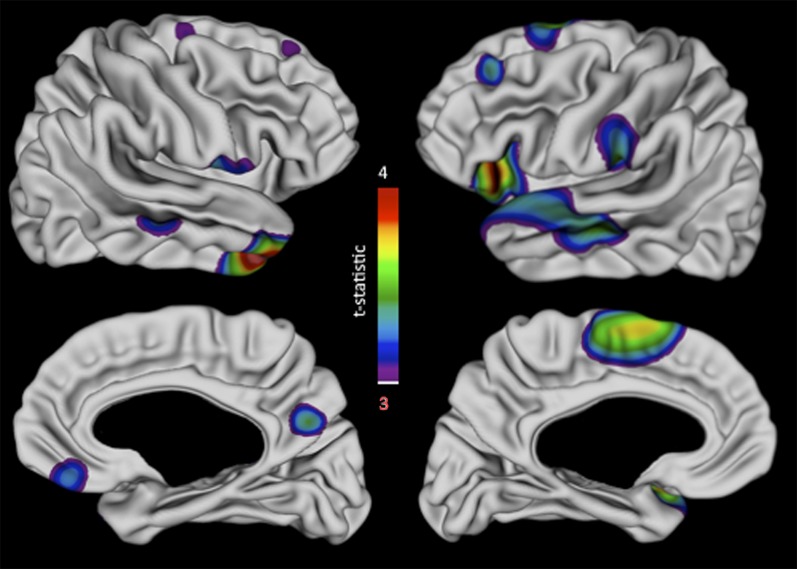
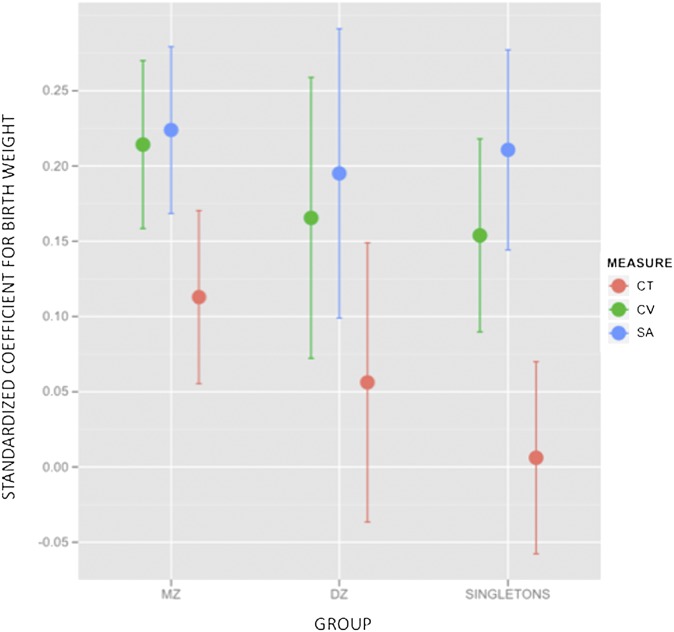
Prenatal life encompasses a critical phase of human brain development, but neurodevelopmental consequences of normative differences in prenatal growth among full-term pregnancies remain largely uncharted. Here, we combine the power of a within-monozygotic twin study design with longitudinal neuroimaging methods that parse dissociable components of structural brain development between ages 3 and 30 y, to show that subtle variations of the in utero environment, as indexed by mild birth weight (BW) variation within monozygotic pairs, are accompanied by statistically significant (i) differences in postnatal intelligence quotient (IQ) and (ii) alterations of brain anatomy that persist at least into late adolescence. Greater BW within the normal range confers a sustained and generalized increase in brain volume, which in the cortical sheet, is specifically driven by altered surface area rather than cortical thickness. Surface area is maximally sensitive to BW variation within cortical regions implicated in the biology of several mental disorders, the risk for which is modified by normative BW variation. We complement this near-experimental test of prenatal environmental influences on human brain development by replicating anatomical findings in dizygotic twins and unrelated singletons. Thus, using over 1,000 brain scans, across three independent samples, we link subtle differences in prenatal growth, within ranges seen among the majority of human pregnancies, to protracted surface area alterations, that preferentially impact later-maturing associative cortices important for higher cognition. By mapping the sensitivity of postnatal human brain development to prenatal influences, our findings underline the potency of in utero life in shaping postnatal outcomes of neuroscientific and public health importance.
Conflict of interest statement
The authors declare no conflict of interest.
Figures
Comment in
-
Epigenetic regulation of fetal brain development and neurocognitive outcome.Proc Natl Acad Sci U S A. 2012 Jul 10;109(28):11062-3. doi: 10.1073/pnas.1208085109. Epub 2012 Jul 2. Proc Natl Acad Sci U S A. 2012. PMID: 22753478 Free PMC article. No abstract available.
-
Twins, birth weight, cognition, and handedness.Proc Natl Acad Sci U S A. 2012 Nov 27;109(48):E3293; author reply E3294. doi: 10.1073/pnas.1213701109. Epub 2012 Sep 28. Proc Natl Acad Sci U S A. 2012. PMID: 23023259 Free PMC article. No abstract available.
References
Publication types
MeSH terms
LinkOut - more resources
Full Text Sources
