. 2012:2012:416739.
doi: 10.1155/2012/416739. Epub 2012 May 29.

Changes in the Th1:Th2 cytokine bias in pregnancy and the effects of the anti-inflammatory cyclopentenone prostaglandin 15-deoxy-Δ(12,14)-prostaglandin J2

Affiliations

Changes in the Th1:Th2 cytokine bias in pregnancy and the effects of the anti-inflammatory cyclopentenone prostaglandin 15-deoxy-Δ(12,14)-prostaglandin J2

Lynne Sykes et al. Mediators Inflamm. 2012.

Abstract

Pregnancy is a complex immunological state in which a bias towards T helper 2 (Th2) protects the fetus. Evidence suggests that proinflammatory cytokines increase the risk of poor neonatal outcome, independently of the direct effect of preterm labour. The anti-inflammatory prostaglandin 15-deoxy-Δ(12,14)-Prostaglandin J(2) (15dPGJ(2)) inhibits nuclear factor Kappa B (NF-κB) in amniocytes and myocytes in vitro and is a ligand for the chemoattractant receptor-homologous molecule expressed on Th2 cells (CRTH2) receptor. Here we examine the Th1:Th2 cytokine bias in pregnancy and whether 15dPGJ(2) could be used to inhibit the production of the proinflammatory cytokines through inhibition of NF-κB while simultaneously promoting Th2 interleukin 4 (IL-4) synthesis via CRTH2 in T helper cells. Peripheral blood mononuclear cells (PBMCs) from women at 28 weeks, term pre-labour, term labour as well as non-pregnant female controls were cultured with 15dPGJ(2) or vehicle control and stimulated with phorbol myristyl acetate (PMA)/ionomycin. The percentage of CD4(+) cells producing interferon gamma (IFN-γ) and tumor necrosis factor alpha (TNF-α) in response to PMA/ionomycin was significantly reduced in pregnancy. 15dPGJ(2) reduced IFN-γ and TNF-α production in stimulated T helper cells, but did not alter IL-4 production in CRTH2(+ve) cells. 15dPGJ(2) also reduced phospho-p65 in stimulated PBMCs. In summary, 15dPGJ(2) suppresses the Th1 response of PBMCs during pregnancy and active labour whilst maintaining the Th2 response suggesting a therapeutic benefit in reducing neonatal morbidity in inflammation-induced PTL.


Figures

Figure 1
Figure 1
Th1 and Th2 cytokine production in peripheral T cells from nonpregnant and pregnant women. Peripheral blood mononuclear cells were isolated and stimulated with PMA/ionomycin. The percentage of CD4+/IFN-γ +, CD4+/TNF-α +, and CRTH2+/IL-4 positive cells were detected by flow cytometry in samples derived from nonpregnant (NP), 28-week pregnant, term no labour (TNL), and term labour (TL) samples (a), (c), and (e). A reduction in the percentage of peripheral CD4 positive cells secreting the Th1 cytokines IFN-γ and TNF-α was observed, whereas the percentage of cells secreting the Th2 cytokine, IL-4, remained consistent throughout gestation. Mean fluorescence intensity (MFI) was also assessed as a measure of total cytokine production (b), (d), and (f). PMA/ionomycin stimulation induced both Th1 and Th2 cytokine production in all sample groups compared to NL controls. No differences in gestation-dependent responses were detected. (g) a ratio of IFN-γ : IL-4 revealed a decrease in the Th1 : Th2 ratio during pregnancy, which was increased prior to the onset of labour. For statistical analysis ANOVA with Dunnett's multiple comparison test with NP as a control was used; **P < 0.01 and *P < 0.05.
Figure 2
Figure 2
CRTH2 expression in lymphocytes derived from nonpregnant and pregnant subjects. Lymphocytes were gated according to forward scatter and side scatter and T helper cells were identified using CD4 as a cell surface marker (n = 8 for each group). A representative cytogram from a woman of 28-week gestation is presented with the right upper quadrant showing CRTH2+/CD4+ lymphocytes (a). The percentage of CRTH2 positive T helper cells (presented as a percentage of positive CD4 positive cells) increased slightly in the third trimester, although statistical significance was not reached (b). No change in mean fluorescence intensity was detected in either the nonpregnant or pregnant samples (c). For statistical analysis ANOVA with Dunnett's multiple comparison test with NP as a control was used.
Figure 3
Figure 3
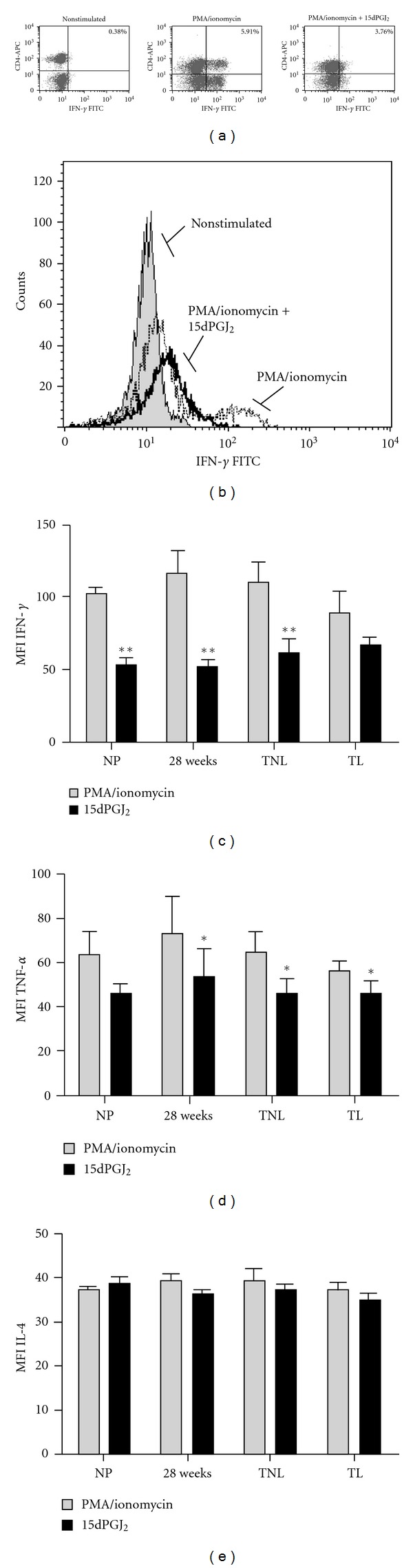
Effect of 15dPGJ2 on Th1 and Th2 cytokines. Peripheral blood mononuclear cells were incubated with vehicle control or 32 μM of 15dPGJ2 and stimulated with PMA/ionomycin before being gated on the lymphocyte population according to forward and side scatter. A representative 28-week patient sample is presented with CD4+/IFN-γ + cells shown in the right upper quadrant (a). A representative histogram reveals a clear shift to the right upon stimulation indicative of increased IFN-γ producing cells (b). This effect was attenuated with 15dPGJ2 pre-treatment. PMA/ionomycin induced IFN-γ and TNF-α production was decreased with 15dPGJ2 treatment (c) and (d); however, levels of IL-4 remained unchanged. No change in IL-4 producing cells was detected (e). For statistical analysis a Student's t-test was used to compare means between paired treated and nontreated samples; **P < 0.01 and *P < 0.05.
Figure 4
Figure 4
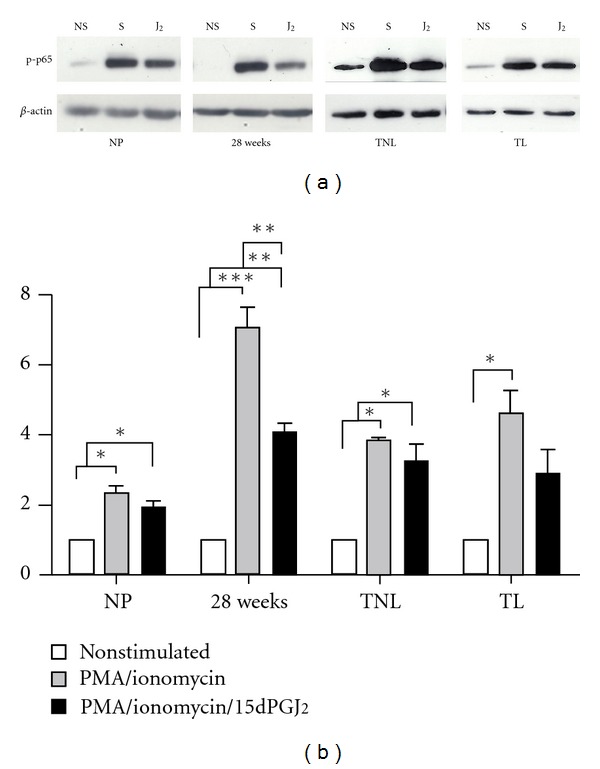
The effect of 15dPGJ2 on NF-κB p65 phosphorylation in peripheral blood mononuclear cells. PBMCs were treated as previously described before being extracted and levels of phosphorylated p65 (p-p65) examined using immunoblotting. Representative immunoblots are shown for each gestational time point (a). Immunoblots were reprobed for β-actin as an internal loading control. Densitometric analysis of the immunoblots was conducted revealing a significant increase in p-p65 levels upon stimulation with PMA/ionomycin in all samples (b). A significant decrease in PMA/ionomycin stimulated p-p65 was observed following 15dPGJ2 treatment in 28-week samples. The capacity of 15dPGJ2 to inhibit PMA/ionomycin-induced p-p65 was lost in those samples collected at term. NS: nonstimulated, S: PMA/ionomycin stimulated, and J2: 15dPGJ2 pretreatment. Effect of treatment was examined for statistical significance at each gestational timepoint using ANOVA with Bonferroni's multiple comparison test; ***P < 0.001, **P < 0.01 and *P < 0.05.
Figure 5
Figure 5
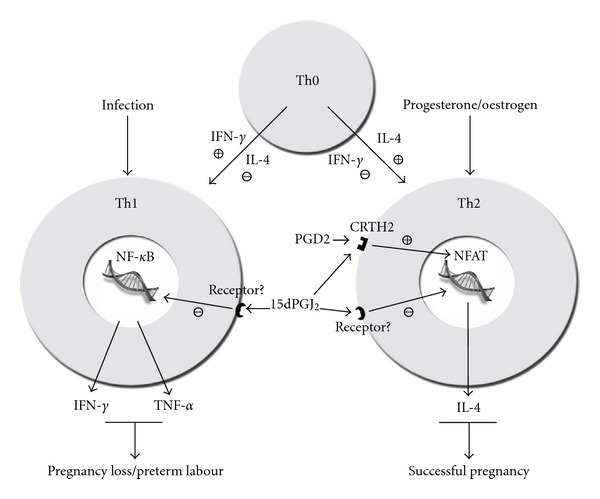
Schematic proposal of the Th1 and Th2 balance and the role of CRTH2 and NF-κB. T-helper cell precursors are directed toward committed immunophenotype by the typical Th1 and Th2 interleukins, IFN-γ and IL-4, respectively. Infection or propregnancy hormones such as progesterone can further modulate the Th1/Th2 bias. Based upon our findings and those of others, we propose that 15dPGJ2 maintains a Th2 bias principally through the suppression Th1 interleukins through the inhibition of NF-κB.

References

    1. Honest H, Forbes CA, Durée KH, et al. Screening to prevent spontaneous preterm birth: systematic reviews of accuracy and effectiveness literature with economic modelling. Health Technology Assessment. 2009;13(43):1–627. - PubMed
    1. Goldenberg RL, Andrews WW, Hauth JC. Choriodecidual infection and preterm birth. Nutrition Reviews. 2002;60(5):S19–S25. - PubMed
    1. Sykes L, MacIntyre DA, Teoh TG, Bennett PR. Targeting immune activation in the prevention of pre-term labour. European Obstetrics & Gynaecology. 2011;6(2):100–106.
    1. Yoon BH, Romero R, Park JS, et al. Fetal exposure to an intra-amniotic inflammation and the development of cerebral palsy at the age of three years. American Journal of Obstetrics & Gynecology. 2000;182(3):675–681. - PubMed
    1. Abrams ET, Miller EM. The roles of the immune system in Women's reproduction: evolutionary constraints and life history trade-offs. American Journal of Physical Anthropology. 2011;146(supplement 53):134–154. - PubMed

Publication types